

Unlocking Your Learning Superpowers
Golden Hook & Introduction
SECTION
Nova: Atlas, I want to play a quick game. Give me your five-word review of a learning approach that promises to transform your skills, fast.
Atlas: Ooh, five words? Okay… “Intense, strategic, effective, but… daunting.”
Nova: “Daunting!” I love that. Mine would be: “Transformative, focused, challenging, rewarding, essential.” But I think “daunting” really captures that first gut reaction to what we're diving into today: the world of ultralearning.
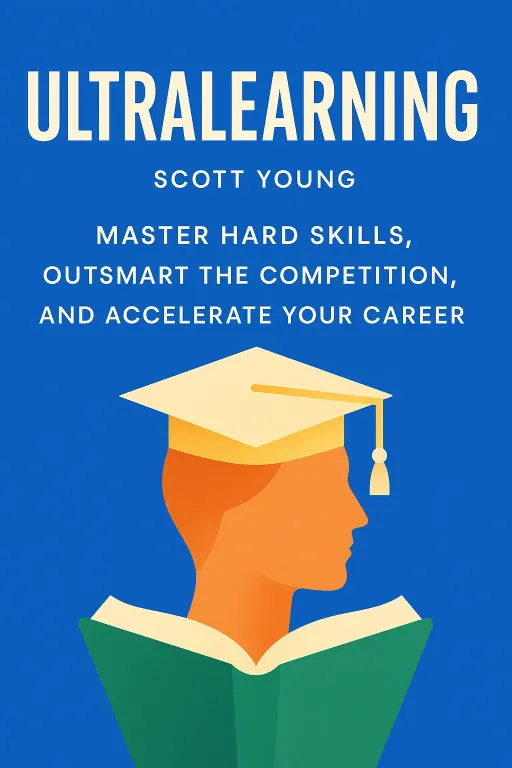
Atlas: Daunting, yes, but also incredibly intriguing for anyone who feels like they’re constantly playing catch-up in their field. We're talking about Scott Young's groundbreaking work, "Ultralearning."
Nova: Exactly. Young is famous for his incredible "MIT Challenge," where he essentially completed MIT's four-year computer science curriculum in just 12 months, all on his own. It’s an insane feat that perfectly illustrates the power of his intense, self-directed approach to mastering complex skills.
Atlas: That’s a wild story! And for our listeners, especially those in high-stakes environments, the idea of compressing years of learning into months is, well, it’s a superpower. But on the flip side, we’re also pairing that intensity with the wisdom of Olav Schewe and Barbara Oakley’s "Learn Like a Pro," which is all about making learning stick without having to be a superhuman.
Nova: And Barbara Oakley, her story is equally compelling. She started her academic life struggling with math and science, only to later become an engineering professor. She’s living proof that anyone can learn anything, provided they use the right strategies. Together, these two books offer a comprehensive toolkit, not just for rapid acquisition, but for intelligent, sustainable learning.
Atlas: So, we’re not just talking about cramming for a test; we’re talking about a complete overhaul of how we approach knowledge.
Nova: Precisely. Today we'll dive deep into this from two powerful perspectives. First, we'll explore Scott Young's "Ultralearning" and its blueprint for rapid skill mastery. Then, we'll discuss how Olav Schewe and Barbara Oakley's "Learn Like a Pro" provides the essential, science-backed habits to make that learning stick and last.
The Ultralearning Blueprint: Aggressive Skill Acquisition
SECTION
Nova: So, let's start with Scott Young and the idea of "ultralearning." It's not just about speed, it's a philosophy—a strategic blueprint for deep immersion. Think of it as deliberately designing intense, self-directed learning projects to acquire skills or knowledge at an accelerated rate.
Atlas: That sounds amazing, but also… exhausting. For someone who already feels stretched thin, constantly juggling work, family, and personal development, how do you even something like the MIT Challenge without burning out? It feels like it demands an impossible amount of dedicated time.
Nova: That’s a fair question, and it’s a common misconception. While Young did famously tackle MIT, his book isn't just for extreme cases. The core of ultralearning is about and, not just sheer hours. One of his key principles is "Meta-learning."
Atlas: Meta-learning? Sounds like learning about learning, which is a bit meta.
Nova: Exactly! Before you even start learning a subject, you spend time learning to learn that specific subject. You map out the territory: what are the core concepts, the common pitfalls, the best resources? It's like planning your route before you set off on a journey. For the MIT Challenge, Young spent weeks just analyzing the curriculum, identifying key textbooks, and finding online resources. This upfront investment saves immense time and effort later.
Atlas: Okay, so it’s not about just diving in headfirst. It’s about strategic preparation. But still, the "intense, self-directed" part sounds like it requires a monastic level of discipline that most of us just don't have. How do you make that translate to, say, learning a new software tool for work, or a new language for a vacation, without completely disrupting your life?
Nova: That's where another principle, "Directness," comes in. Ultralearning emphasizes learning by. If you want to learn to code, you build software. If you want to learn a language, you speak it. Instead of spending months passively reading about a skill, you immediately try to use it in a real-world context. Young calls this "project-based learning." For instance, if you're learning a new software, don't just watch tutorials; immediately try to replicate a complex task you'll actually need for your job.
Atlas: So it's not about quitting your job and going full hermit; it's about being strategic with the time you have, and making that time highly effective by focusing on practical application. I can see how that would cut through a lot of wasted effort. But is there a risk of becoming a "jack of all trades, master of none" if you're constantly ultralearning new things?
Nova: Not at all, because the intensity forces a deeper level of engagement. Another principle is "Drill." This means breaking down complex skills into their smallest components and practicing those components relentlessly until they're second nature. Think of a musician practicing scales or a basketball player practicing free throws. Young applied this to his learning by isolating difficult concepts and drilling them until they clicked. This isn't superficial; it builds mastery from the ground up.
Atlas: That's a great way to put it. So, if I'm trying to master a new analytical technique, I shouldn't just try to apply it to a massive dataset right away. I should break it down, understand the core mathematical operations, maybe even practice them with simpler, smaller examples until I'm absolutely fluent.
Nova: Exactly. And the beauty is, once you've mastered those foundational drills, the larger, more complex tasks become significantly easier. Ultralearning is about identifying the critical bottlenecks in your learning process and attacking them with focused, intense effort. It’s about being deliberate, not just diligent.
Smart Learning Habits for Sustainable Mastery: Overcoming Obstacles
SECTION
Nova: But Atlas, you hit on something crucial earlier: even the most intense learner needs a solid foundation, otherwise, it's just unsustainable burnout. And that's where Schewe and Oakley's "Learn Like a Pro" comes in. It’s the perfect complement, providing the science-backed habits to make that aggressive learning stick and prevent cognitive overload.
Atlas: So, if "Ultralearning" is the high-performance engine, then "Learn Like a Pro" is the fuel and the maintenance schedule. You need both to keep running smoothly. What are some of those foundational habits? Because I imagine a lot of our listeners struggle with poor retention and the ever-present beast of procrastination.
Nova: Absolutely. Schewe and Oakley are masters at demystifying the science of learning. One of their biggest takeaways, which is incredibly powerful, is "Active Recall." Most people learn by re-reading their notes or highlighting text. But that creates an illusion of competence. You recognize the information, but you can’t actually retrieve it from memory.
Atlas: Okay, active recall and spaced repetition… these sound like fancy terms for studying, but what's the difference? And how do they actually help with that feeling of 'I just read this, why can't I remember it?'
Nova: The difference is profound. Active recall means constantly. Instead of re-reading a chapter, close the book and try to explain what you just read in your own words, or answer questions about it. This forces your brain to retrieve the information, which is the act that strengthens neural pathways and solidifies memory. It's challenging, but it's incredibly effective. Think of it like flexing a muscle. If you want stronger muscles, you lift weights; you don't just look at them.
Atlas: That makes perfect sense. So, instead of just highlighting my reports, I should try to summarize the key points from memory after I read them. That sounds like a small shift, but it feels like it would make a huge difference in how much I actually retain.
Nova: It absolutely does. And hand-in-hand with active recall is "Spaced Repetition." This means reviewing information at increasing intervals over time. Our brains are designed to forget things that don't seem important. By strategically revisiting material just as you're about to forget it, you signal to your brain, "Hey, this is important, keep this!" This is far more effective than cramming, which just creates temporary, fragile memories.
Atlas: I've been there. Cramming for a presentation, feeling like I know it all, then the next day, it's gone. So, it's about making learning a marathon, not a sprint, even if you’re using ultralearning for a sprint that marathon.
Nova: Exactly! And Schewe and Oakley also tackle that other big monster: procrastination. They advocate for simple, actionable techniques like the Pomodoro Technique, where you work for focused 25-minute bursts followed by short breaks. It helps overcome the initial resistance to starting a daunting task.
Atlas: That’s going to resonate with anyone who struggles with getting started. It’s like the brain sees a huge mountain and just shuts down, but if you say, “Just climb for 25 minutes,” it feels much more manageable. It really breaks down the psychological barrier.
Nova: It's all about understanding how our brains work, not fighting against them. They emphasize that learning isn't just for geniuses; it's a skill that can be developed and optimized with the right strategies. By applying these foundational habits, you make any learning endeavor, even an ultralearning project, far more sustainable, less prone to burnout, and ultimately, more successful.
Synthesis & Takeaways
SECTION
Nova: So, what we've really explored today is that unlocking your learning superpowers isn't about choosing between aggressive intensity and smart habits. It's about strategically combining both. The strategic blueprint of ultralearning gives you the "how" for rapid, deep acquisition, while "Learn Like a Pro" provides the essential "what" for intelligent, sustainable mastery.
Atlas: For our listeners who are constantly seeking to upskill but feel like they're just treading water, this is a powerful combination. It's about making every minute of learning count, not just for the sprint, but for the marathon of a constantly evolving career and life. It's about getting more value from your limited time.
Nova: Absolutely. It transforms learning from a passive chore into an active, empowering strategy. Instead of just consuming information, you're building a robust mental framework that allows you to not only learn faster but also to retain more, apply it effectively, and adapt to new challenges.
Atlas: So, if you had to give our listeners one actionable step to start combining these two philosophies, what would it be?
Nova: I’d say start small, but start with intention. Pick one small skill you want to acquire or improve—maybe it's a new feature in a software program, or a concept you've been struggling with. Then, apply one ultralearning principle, like "Directness," by immediately trying to that skill. And pair it with one "Learn Like a Pro" habit, like "Active Recall," by testing yourself on what you've learned. Do that for just 15 minutes a day, treating it like an important meeting.
Atlas: That’s a fantastic, pragmatic approach. It ties into the idea that small insights really do add up, and that focused, strategic learning can reclaim your hours.
Nova: Indeed. It's about becoming the architect of your own knowledge, not just a passive recipient. The world is changing too fast to be a slow learner.
Atlas: What a powerful thought to leave us with. Thank you, Nova, for illuminating these incredible strategies.
Nova: My pleasure, Atlas. And thank you to all our listeners for joining us on this journey to unlock your learning superpowers.
Atlas: This is Aibrary. Congratulations on your growth!









