

The Learning Loop: How to Hack Your Brain for Rapid Growth in Tech and Life
Content
Content
Dr. Celeste Vega: -
Golden Hook & Introduction
SECTION
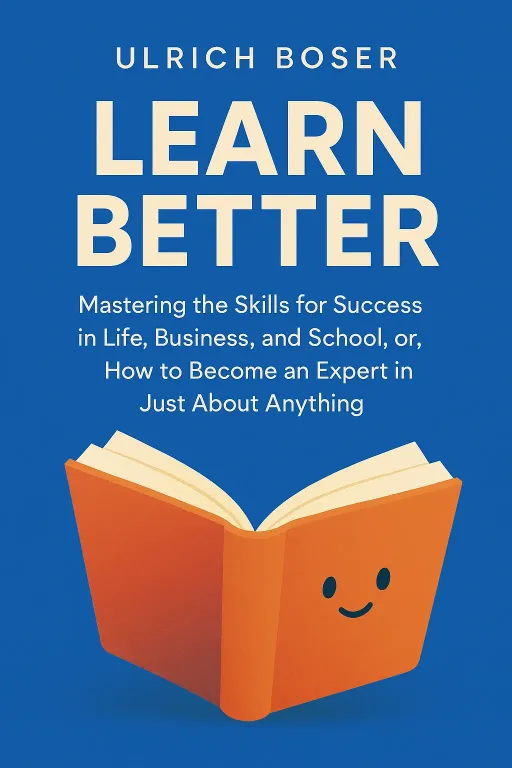
Dr. Celeste Vega: Imagine sitting in front of a computer screen, staring at a wall of code that refuses to work. You have spent hours on it. Your brain feels completely fried. Is it a lack of intelligence? Or is it simply that we were never taught how to learn? Today, we are tearing down the myth of the natural genius. We are diving into Ulrich Boser's groundbreaking book, Learn Better, to show that learning is a skill you can hack, develop, and master. Today, we are going to tackle this book from three different angles. First, we will explore how shifting to process-driven metacognition can supercharge your problem-solving. Second, we will look at the creative art of playing riffs to build deep, relational knowledge. And finally, we will show you how to ruthlessly audit your own brain to escape the trap of overconfidence. I am Dr. Celeste Vega, and joining me today is Dina, a software engineer who is navigating the exciting, fast-paced world of tech. Welcome, Dina!
Dina: Thanks, Celeste! I am so excited to be here. Honestly, that opening scenario you described? That is basically my daily life right now. Being in my first year as a software engineer, I feel like I am constantly drinking from a firehose. Every single day there is a new framework, a new tool, or a complex codebase to understand. So when I read Learn Better, it felt less like a book of academic theory and more like a survival guide.
Dr. Celeste Vega: A survival guide, I love that. And it really is! Boser argues that in our modern digital age, memorizing static facts is obsolete. The ultimate survival tool is learning how to learn. It is the skill that precedes all other skills.
Dina: Exactly. In tech, what you know today might be outdated next year. It is all about how fast you can adapt and acquire new forms of expertise. But what blew me away was the idea that this capacity isn't just something you are born with. It is a systematic process.
Deep Dive into Core Topic 1
SECTION
Dr. Celeste Vega: Yes! Let us start with that first pillar: metacognition. It is a big, fancy word, but it basically means thinking about thinking. It is the ability to monitor your own understanding. You ask yourself: How do I know what I know? Where am I getting stuck? And here is a mind-blowing statistic from the book: researcher Marcel Veenman found that metacognition accounts for about forty percent of learning outcomes, while IQ only accounts for twenty-five percent.
Dina: That is incredibly empowering. It means your strategy and self-awareness matter more than some fixed measure of intelligence.
Dr. Celeste Vega: Absolutely. And to illustrate this, Boser shares a fascinating study about learning how to play darts, conducted by psychologists Anastasia Kitsantas and Barry Zimmerman. They took a group of high school students and split them into three teams to learn darts. Team One was the Performance Team. They were told to focus entirely on the outcome, to get the dart as close to the center of the bull's-eye as possible. Team Two was the Learning Method Team. They were taught to focus on the process, the specific steps of throwing, like keeping their elbow straight, their stance balanced, and only later shifting their focus to the target. Team Three was the Conventional Wisdom Team. They were just told to do their best and use whatever approach they wanted.
Dina: I love this experiment because it is so counterintuitive to how we usually approach goals. We are so obsessed with the bull's-eye, right?
Dr. Celeste Vega: We really are! But listen to the results. The Learning Method Team, the ones focusing on the process and the mechanics, absolutely decimated the other groups. Their scores were nearly twice as high as the Conventional Wisdom Team. And not only did they perform better, they actually enjoyed the experience much more. They developed a sense of self-efficacy because they understood the system of throwing, rather than just throwing and hoping for the best.
Dina: That resonates so deeply with my experience in software engineering. When you are a junior dev, the temptation is to be like Team One, the Performance Team. You just want to get the code to work. You want to see that green checkmark on your test suite. So you copy and paste a solution from Stack Overflow, or you tweak things randomly until it magically runs. But if you do that, you haven't actually learned anything. You focused on the outcome, not the process.
Dr. Celeste Vega: That is such a perfect parallel, Dina. You are essentially throwing darts in the dark.
Dina: Yes! And then, the next time you encounter a similar bug, you are completely lost again because you didn't build the mental model. After reading about the dart experiment, I started changing my approach to debugging. Now, when I get stuck, I stop and focus on the process. I ask myself: What is the exact execution flow of this program? What is the data doing at step three versus step four? I am focusing on the mechanics of the code, not just the final output. It takes more mental effort, but it prevents what psychologists call cognitive overload. You aren't trying to solve the whole complex problem at once; you are breaking it down into discrete, manageable targets.
Dr. Celeste Vega: That is brilliant, Dina. You are actively managing your cognitive load. Our short-term memory is incredibly limited. It can only hold a few pieces of information at a time. If you try to grasp a massive, complex system all at once, your brain just short-circuits. You have to target your learning, breaking it down into digestible parts, and master those step-by-step. Just like the dart throwers mastering their elbow alignment before aiming for the bull's-eye.
Deep Dive into Core Topic 2
SECTION
Dina: It makes so much sense. But once you have those basic building blocks, how do you take it to the next level? How do you go from just knowing the rules to actually being creative and adaptive with that knowledge?
Dr. Celeste Vega: That brings us to our second core topic: extending and relating knowledge. Boser emphasizes that learning is a generative activity. We don't gain expertise by passively absorbing information, like a sponge soaking up water. We gain it by actively producing what we know, by making connections and, as Boser beautifully puts it, playing riffs.
Dina: I loved the musical analogy in the book! The story of Miles Davis and the recording of his legendary album, Kind of Blue.
Dr. Celeste Vega: Oh, it is such a beautiful story. In the spring of nineteen fifty-nine, Miles Davis brought these incredible jazz musicians into the studio. But instead of giving them fully written-out, complex sheet music, he gave them these incredibly sparse, simple sketches of melodies and scales. He basically told them, play in the sound of these scales. He forced them to improvise, to riff, to actively engage with the musical structure in real-time.
Dina: And the result was one of the greatest, most influential albums of all time.
Dr. Celeste Vega: Exactly. Because they weren't just reading notes off a page; they were actively generating the music. They had to dive deep into the essence of those scales and build cognitive links on the fly. And Boser argues that we need to do the exact same thing when we learn. We have to play riffs on our knowledge. We have to experiment, tinker, and apply what we are learning to new, unfamiliar contexts.
Dina: This is where my artistic side, my ISFP personality, really connected with the book. I often think of coding as a form of creative expression, very similar to painting or music. And Boser actually talks about Jackson Pollock, the famous abstract expressionist painter. People often look at Pollock's drip paintings and think, oh, that is just chaotic, random splattering. Anyone could do that. But Boser explains that Pollock's learning process was incredibly methodical. He attended a workshop by the Mexican muralist David Alfaro Siqueiros, who encouraged students to experiment with paint as a physical medium, pouring it, mixing in sand and dirt. Pollock took those techniques and spent years in his studio, practicing hours upon hours, refining his drip-and-pour approach. Later, physicists actually analyzed Pollock's paintings and discovered they contained complex fractal geometry that grew more dense and structured over his career. It wasn't chaos at all; it was a deeply disciplined, generative exploration of a technique.
Dr. Celeste Vega: Wow, fractal geometry in drip paintings! That is incredible. It shows that true creativity and innovation don't just come out of thin air. They are built on a foundation of methodical, active experimentation. You have to put in the hours of struggle to build those deep, relational pathways in your brain.
Dina: Yes! And in tech, we call this hacking. Facebook actually has a six-week hacking boot camp for new engineers. They don't sit you in a classroom and make you read manuals. They get you tinkering with the live codebase almost immediately. You are encouraged to find bugs, build small features, and actively break things. It is a practical, hands-on version of a thought experiment. You learn the system by interacting with it, by generating solutions, and yes, by making mistakes.
Dr. Celeste Vega: And that active struggle is where the real learning happens. Another powerful way to play riffs on your knowledge is through analogies. Our brains are naturally wired to struggle with abstract concepts. But analogies allow us to take knowledge on the road, as cognitive scientist Dedre Gentner says. We map a new, unfamiliar concept onto something we already understand. Think of Johannes Gutenberg. He didn't invent the printing press out of nothing. He saw a wine press squeezing grapes, and he made the analogical leap: what if we used a similar mechanical press to stamp letters onto paper?
Dina: That is a perfect example. In software engineering, we use analogies constantly to explain complex architectures. We talk about APIs being like waiters in a restaurant, taking your order to the kitchen and bringing back the food. Or we compare databases to highly organized filing cabinets. It makes the abstract concrete, which makes it so much easier to reason about.
Deep Dive into Core Topic 3
SECTION
Dr. Celeste Vega: It really does. But as we build this knowledge, we have to be incredibly careful. Because the more familiar we become with a topic, the more we fall into a dangerous psychological trap. And that leads us to our third core topic: rethinking and the illusion of competence.
Dina: Oh, this is a painful one.
Dr. Celeste Vega: It is! Daniel Kahneman, the Nobel Prize-winning psychologist, was once asked: if he had a magic wand and could eliminate one human cognitive bias to make us better thinkers, what would it be? And without hesitation, he said overconfidence. We are incredibly prone to overestimating our own understanding.
Dina: Boser illustrates this with a hilarious study by psychologist Art Markman about how toilets work.
Dr. Celeste Vega: Yes! Markman asked people, on a scale of one to ten, how well do you understand how a toilet works? Most people rated themselves quite highly, like a five or a six. They use toilets every day, they seem simple enough. But then, Markman asked them to write down a detailed, step-by-step explanation of the exact physical mechanism. How does the water leave the tank? What does the bump at the bottom of the bowl do? How does the water get distributed? And suddenly, people realized they had absolutely no idea. They had confused familiarity with actual, systemic understanding. This is called the illusion of explanatory depth.
Dina: I laughed out loud when I read that, but then I realized I do this all the time. I will read a software documentation page, or watch a tutorial video, and think, oh yeah, that makes total sense. I totally get how this authentication protocol works. But then, the moment I close the tab and try to write the code from scratch, my mind goes completely blank. I had the illusion of understanding because the explanation was clear and familiar, but I hadn't actually consolidated that knowledge in my own brain.
Dr. Celeste Vega: It is a classic trap. We mistake the ease of reading or listening for the ease of recall. This is why Boser argues that rethinking requires external checks. We need objective, outside reviews to show us what we don't know. In a professional setting, this is why Bill Gates, at the start of meetings, will ask incredibly detailed, specific questions about a memo's appendix. He is not just being difficult; he is evaluating whether the experts in the room truly understand the underlying data, or if they are just coasting on high-level summaries.
Dina: It is like a code review in software development. You think your code is perfect, but then a senior engineer looks at it and asks, why did you use this data structure here? What happens to memory usage if the input scales to a million users? It forces you to defend your logic, find the gaps in your thinking, and rethink your entire approach. It is a necessary reality check.
Dr. Celeste Vega: Exactly. And for our personal learning, we can build in these external checks using techniques like spaced repetition and active recall. Boser shares the story of Roger Craig, who won a record-breaking amount of money on the game show Jeopardy!. Craig didn't just study by reading encyclopedias. He used a software program called Anki, which uses spaced repetition algorithms. It would quiz him on facts right at the very edge of his memory, just as he was about to forget them. If he got a question wrong, the software would show it to him again in a few minutes. If he got it right, it might not show it to him for a month. He was practicing efficiently, targeting his weak spots, and ruthlessly auditing his own brain.
Dina: I actually started using Anki recently to memorize syntax and system design patterns! It is incredible how much more effective it is than just rereading my notes. It forces your brain to do the hard work of retrieval, which strengthens those neural pathways. It is like weightlifting for your memory.
Dr. Celeste Vega: It really is. And another simple, powerful tool Boser mentions is what Carnegie Mellon professor Marsha Lovett calls wrappers. After a lecture or a study session, you give yourself a quick, one-minute self-assessment. You ask: What were the key ideas? What is still confusing to me? How would I explain this to a beginner? It wraps the learning experience in a layer of metacognitive reflection, preventing you from just closing the book and assuming you have mastered it.
Synthesis & Takeaways
SECTION
Dina: It is all about building that habit of mind, constantly checking in with yourself. When you look at Boser's entire framework—Value, Target, Develop, Extend, Relate, Rethink—it is really a holistic system for continuous growth.
Dr. Celeste Vega: It is. It starts with finding personal value and meaning in what you learn, because motivation is the engine. Then you target specific, manageable skills, just beyond your comfort zone. You develop them through active practice and feedback. You extend your knowledge by playing riffs and applying it creatively. You relate concepts to understand the underlying system. And finally, you rethink and reflect to keep your ego in check and ensure true mastery.
Dina: It is a beautiful loop. And as someone who is looking to grow in so many areas of my life, not just tech, this framework feels incredibly liberating. It takes the pressure off having to be a natural genius. It means that with the right strategies, with patience, and with a willingness to engage in that uncomfortable, active struggle, we can learn just about anything.
Dr. Celeste Vega: Well said, Dina. That is the ultimate takeaway. Learning is not a spectator sport. It is an active, messy, beautiful process of doing.
Dina: Absolutely.
Dr. Celeste Vega: Before we wrap up, let us leave our listeners with a challenge. This week, don't just passively consume information. Whether you are reading an article, learning a new skill, or working on a project, take one minute at the end to do a learning wrapper. Ask yourself: What did I actually learn? Where am I still a bit fuzzy? Force your brain to do that active, metacognitive work.
Dina: I am definitely going to keep doing that with my code reviews. It is a game-changer.
Dr. Celeste Vega: Dina, thank you so much for sharing your insights and your journey with us today. It has been an absolute pleasure.
Dina: Thank you, Celeste! This was incredibly fun and super helpful.
Dr. Celeste Vega: And thank you to all our listeners. Keep learning, keep growing, and we will see you in the next loop.









