

Mastering the Art of Accelerated Learning
Golden Hook & Introduction
SECTION
Nova: What if I told you that the way most of us have been taught to learn, the comforting, familiar methods, are actually sabotaging our ability to truly understand and retain information?
Atlas: Oh, Nova, come on. Are you saying all those hours I spent highlighting and re-reading my textbooks in college were… effectively just a very expensive form of hand-eye coordination practice? Because that’s going to sting a little.
Nova: Well, Atlas, I was today years old when I truly grasped that the comforting illusion of passive review is often the enemy of deep, lasting knowledge. It feels productive, but it's often not.
Atlas: That's a bold claim right out of the gate! My curiosity is definitely piqued. What led you down this path of learning heresy?
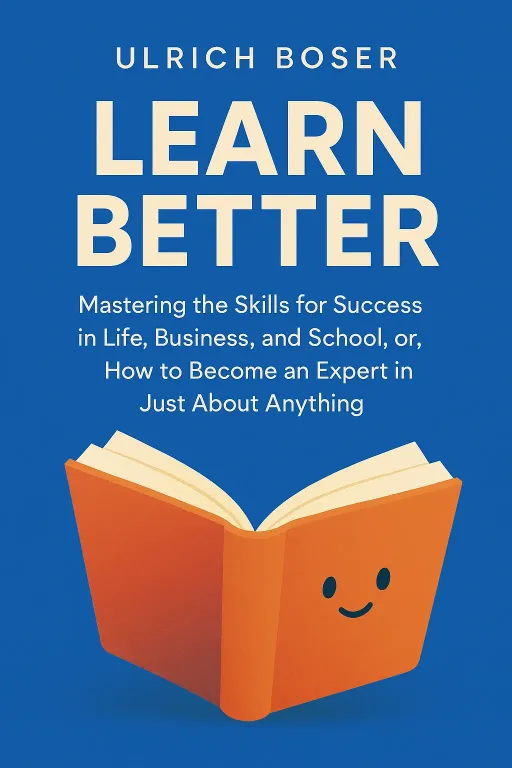
Nova: Today, we’re diving into the revolutionary insights from two seminal works: Ulrich Boser’s "Learn Better" and the groundbreaking "Make It Stick" by Peter C. Brown, Henry L. Roediger III, and Mark A. McDaniel. These aren't just self-help books; they're deeply rooted in cognitive science. Brown, Roediger, and McDaniel are leading cognitive scientists whose research has fundamentally reshaped our understanding of memory and learning, while Boser, a journalist and researcher, translates these complex ideas into incredibly practical strategies. Both books have been widely acclaimed for debunking common learning myths with rigorous, evidence-based approaches.
Atlas: So we’re talking about science, not just anecdotes. That’s exactly what our listeners, especially those driven achievers seeking clarity, want to hear. They want to know what works.
Nova: Precisely. And the core message is counter-intuitive: true learning isn't about how easily information goes in, but how effortfully it comes.
The Myth of Passive Learning & The Power of Retrieval Practice
SECTION
Nova: Let's start with what we works. When you're trying to learn something new, say, for a big presentation or a new skill, what's your go-to method?
Atlas: My instinct, and I imagine many of our listeners would agree, is to review my notes. Read them over and over, maybe highlight the important parts. It feels like I'm absorbing it, like the knowledge is soaking in.
Nova: That feeling, Atlas, is what cognitive scientists call the "illusion of fluency." When you re-read something, especially if you just read it, it feels familiar. Your brain processes it quickly, and that ease of processing tricks you into thinking you've mastered it. But you haven't. You've merely recognized it. It's like looking at a map versus actually navigating the terrain.
Atlas: Hold on, so that feeling of "I've got this, I just read it again" is actually a trap? That’s going to resonate with anyone who's ever felt confident before a test, only to draw a blank.
Nova: Exactly. Both "Make It Stick" and "Learn Better" hammer this home. They introduce us to the concept of. Instead of passively reviewing, you actively try to recall the information from memory. This could be through self-testing, flashcards, or simply trying to explain a concept aloud without looking at your notes.
Atlas: So you're saying the act of to remember is what actually solidifies the memory? That goes against every instinct I have for efficiency. If it's hard, I assume I'm doing it wrong.
Nova: It’s a classic case of what Boser calls a "desirable difficulty." Imagine you’re trying to build muscle. You don’t just watch someone lift weights; you have to do the heavy lifting yourself. It’s hard, it’s uncomfortable, but that effort is what causes your muscles to grow. The same applies to your brain. Each time you retrieve information, you’re not just accessing a memory; you’re strengthening the neural pathways to it.
Atlas: Can you give us an example? Like, a vivid case study that shows this in action?
Nova: Absolutely. "Make It Stick" often cites experiments where students were divided into groups. One group spent all their time re-reading a text. Another group read the text once, then spent the rest of their time practicing retrieving the information – essentially, self-testing. When tested a week later, the self-testing group consistently outperformed the re-reading group, often by a significant margin. The re-reading group felt more confident, but the self-testing group more. The effort of pulling that information out of their brain, even if it took a few tries, was the key.
Atlas: Wow. That's a game-changer. So for our listeners who are trying to absorb complex reports for leadership meetings, or even parents trying to remember historical facts for their kids' homework, the "tiny step" isn't about cramming more input, but trying to generate output?
Nova: Precisely. The tiny step here is to dedicate just 10 minutes daily to actively recall what you've learned. Close your notes and try to summarize the key points, or explain a concept to someone else – even a pet or a rubber duck! That active effort, that moment of struggling, is where the real learning happens. It solidifies the memory far more effectively than any amount of passive re-reading.
Atlas: It sounds like it’s about making your brain for it, not just letting it wash over you. That's a fundamental shift in how I've always approached learning.
Embracing Desirable Difficulties for Deeper Mastery
SECTION
Nova: And that naturally leads us to the second key idea, which often acts as a counterpoint to our natural inclination for ease: embracing a broader range of "desirable difficulties." Retrieval practice is one powerful example, but there are others, like interleaving, spaced practice, elaboration, and metacognition. These strategies all share a common thread: they make learning harder in the short term, but much more robust and flexible in the long term.
Atlas: "Desirable difficulties." I love that phrasing. It reframes what we often perceive as frustrating into something beneficial. But for a driven achiever, the idea of making something when you want to achieve mastery quickly might feel counter-intuitive. We're often told to focus and specialize. How does mixing things up, for example, actually help us master something faster, not just dilute our focus?
Nova: That's where comes in. Instead of practicing one skill or studying one topic for a long block of time before moving to the next, you mix it up. For instance, if you're learning different types of math problems – say, geometry, algebra, and calculus – you wouldn't spend an hour on geometry, then an hour on algebra. You'd interleave them, switching between problem types.
Atlas: My brain is already resisting! That sounds like it would slow me down, make me less efficient.
Nova: It feels that way in the moment because your brain has to constantly adapt and retrieve different strategies. But studies show that while performance during practice might be slower, retention and the ability to apply that knowledge to new situations is significantly higher. It forces your brain to discriminate between problem types and select the correct solution strategy, rather than just mindlessly applying the same method.
Atlas: So, it's not just about memorizing the solution to one type of problem, but building a mental library of to approach different problems? Like a leader who has to juggle different departmental challenges in one afternoon, instead of just focusing on one type of issue all week?
Nova: Exactly! It builds what "Make It Stick" calls "flexible knowledge." You're not just building a single, strong pathway; you're building a network of interconnected pathways. This is crucial for leaders who need to apply broad principles to varied, novel situations, or for parents teaching diverse skills to children. And then there's, which is simply distributing your learning over time rather than cramming. A little bit today, a little more tomorrow, a review next week.
Atlas: That I can relate to, especially when I think about how I learn new software. A quick tutorial, then come back to it a few days later, and I pick up more than if I tried to master it all in one sitting.
Nova: And it’s because your brain needs time to consolidate memories. Each time you revisit information after a delay, you're engaging in retrieval practice, and you're signaling to your brain that this information is important enough to keep. It’s the opposite of cramming, which leads to short-term recall but poor long-term retention.
Atlas: So, for our listeners who are constantly learning new things – new management techniques, new parenting strategies, new ways to foster well-being – it's about intentionally introducing these "desirable difficulties" into their daily routine. It’s about being strategic about how they engage with information.
Nova: Precisely. It’s about asking that deep question: How can you intentionally introduce "desirable difficulties" into your daily learning or problem-solving to strengthen your cognitive muscles beyond rote memorization? It could be explaining a complex project to a colleague from a different department, forcing you to elaborate and simplify. Or teaching your child a concept, which makes you deeply understand it yourself.
Atlas: It sounds like it's about building cognitive resilience, not just accumulating facts. And if it feels a little messy, or a little uncomfortable, that’s actually the brain working harder to connect the dots and build deeper understanding.
Synthesis & Takeaways
SECTION
Nova: So, what we’re really talking about today is a profound shift in our approach to learning. It’s moving away from the comfortable, passive consumption of information, which often creates an illusion of knowing, and embracing an active, effortful engagement with material.
Atlas: It’s empowering, actually. For the curious leader, the empathetic connector, the driven achiever – it’s a roadmap to genuine growth. It challenges the idea that learning should always feel easy, and instead, suggests that the struggle the lesson. That intentional discomfort is where true mastery lies.
Nova: Absolutely. The science from "Learn Better" and "Make It Stick" makes it clear: retrieval practice, interleaving, spaced practice, elaboration, and metacognition – these are the tools to build durable, flexible knowledge. They might feel harder upfront, but they lead to much deeper retention and a more profound understanding.
Atlas: So, that tiny step of 10 minutes of active recall daily, or intentionally seeking out varied challenges in your learning, isn't just about getting smarter. It's about building resilience, fostering a more intentional approach to personal and professional growth, and ultimately, contributing to a greater sense of clarity and well-being. It’s about trusting the process, even when it feels uncomfortable.
Nova: Exactly. It’s about recognizing that the brain is like any other muscle: it grows stronger through challenge, not through endless, effortless repetition. Embrace the difficulty, and watch your understanding deepen.
Atlas: That's a powerful message. It's about changing our relationship with effort.
Nova: Indeed. It's about learning better, to live better.
Nova: This is Aibrary. Congratulations on your growth!









