

** The Marketer's Playbook for Digital Mastery
Golden Hook & Introduction
SECTION
Dr. Roland Steele: Rose, as a product manager in marketing, you're on the front lines of a constant battle. Every week, there's a new 'game-changing' technology—a new AI tool, a new social platform, a new analytics suite. The pressure to adopt everything is immense. But what if chasing every shiny new object is actually the fastest way to fail?
Rose: You're describing my Tuesday morning. It's a tidal wave, and you're just trying to find a surfboard that works.
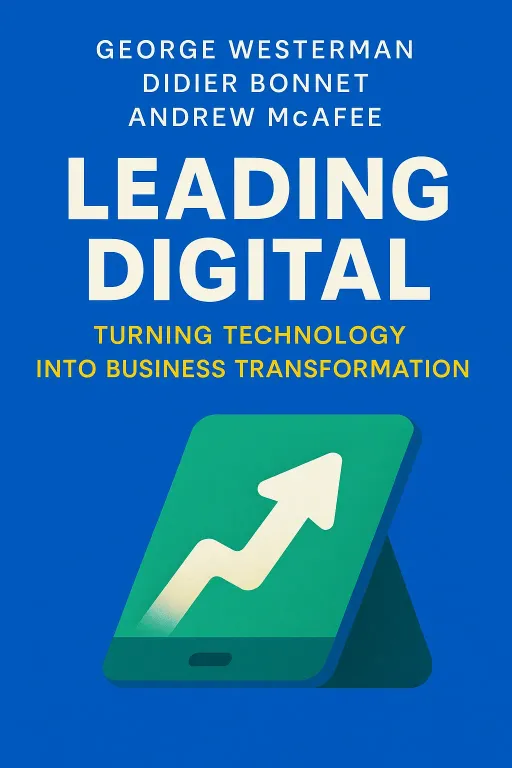
Dr. Roland Steele: Exactly. And what if the companies that look the most 'digital' are actually the least profitable? The book we're talking about today, "Leading Digital" by Westerman, Bonnet, and McAfee, calls these companies 'Fashionistas'—all style, no substance. And the data shows they perform worse than companies who are cautious with tech but have strong leadership.
Rose: That is a fascinating and, honestly, a slightly terrifying thought. So it's not about having the most toys.
Dr. Roland Steele: Not at all. And that’s what we’re going to get into. Today, we're going to unpack this from two powerful angles. First, we'll uncover the two essential ingredients of Digital Mastery and expose that dangerous 'Fashionista' trap. Then, we'll explore what it takes to craft a vision so powerful it can literally save a company from the brink of extinction, a lesson in leadership that goes far beyond a simple product roadmap.
Deep Dive into Core Topic 1: The DNA of a Digital Master
SECTION
Dr. Roland Steele: So let's start there, with this idea of the 'Fashionista.' The authors of 'Leading Digital' studied over 400 firms and found they fall into four categories based on two key dimensions. On one axis, you have 'Digital Capability'—that's the 'what.' It’s your tech, your platforms, your analytics. On the other axis, you have 'Leadership Capability'—that's the 'how.' It’s your vision, your governance, your ability to drive change. Rose, does this 'Fashionista'—a company that's high on tech but low on leadership, buying every new digital bauble without coordination—sound familiar?
Rose: Oh, I've seen that movie before, and it does not have a happy ending. It’s when the social media team launches a campaign on a new platform, the mobile team builds a separate app with a different vendor, and the web team is redesigning the homepage, and none of them are using the same customer data. From the outside, it looks like a lot of activity, a lot of 'digital transformation.' But for the customer, it's a Frankenstein's monster of an experience. It’s disjointed.
Dr. Roland Steele: A Frankenstein's monster. That's the perfect description. The book gives these exact examples. They describe one company where different business units all decided to build their own employee collaboration platforms. Marketing was on Slack, R&D was on Microsoft Teams, and the sales team was using some custom-built software. They were all being 'digital,' right? But could they talk to each other?
Rose: Absolutely not. It's digital, but it's digital silos. Knowledge gets trapped. You can't share insights. It's the opposite of collaboration.
Dr. Roland Steele: Precisely. And the authors found another company where three different marketing teams launched three separate mobile marketing initiatives. They were all targeting overlapping markets but used completely different vendors and technology sets. They couldn't share data, they couldn't build on each other's work, and they couldn't get a single, unified view of the customer. The outcome was just wasted money and a deeply confused customer base.
Rose: That's a product manager's nightmare. You're not building a customer journey; you're building a maze. It just goes to show that technology without a unifying vision—a core product mindset, really—is just expensive confetti. It looks pretty, but it doesn't build anything.
Dr. Roland Steele: Expensive confetti. I love that. And from an economist's perspective, the numbers in the book are brutal. The authors found that Fashionistas are, on average, 24% profitable than their industry peers. All that spending, all that activity, for a negative return.
Rose: Wow. So you're actively losing money by trying too hard in the wrong way.
Dr. Roland Steele: You are. And on the flip side, you have the 'Conservatives'—strong leadership, but they're scared of the tech. They're more profitable than the Fashionistas, but they're missing huge growth opportunities. The sweet spot, the goal, is to be a 'Digital Master'—strong in both tech and leadership. Companies like Nike, Asian Paints, P&G. They're 26% more profitable and generate 9% more revenue from their existing assets. It's a massive advantage.
Rose: So it’s about having both halves of the brain working together. The analytical, tech-savvy side and the visionary, strategic leadership side. That makes so much sense. It's not just about the tools; it's about the artist wielding them.
Deep Dive into Core Topic 2: Crafting a Transformative Vision
SECTION
Dr. Roland Steele: Exactly. The artist wielding the tools. That's the perfect segue. So if being a Fashionista is the road to ruin, what's the alternative? How do you build that leadership capability? It's not just about being a 'Conservative' who's afraid of tech. It's about becoming a 'Digital Master.' And that journey starts with the most important part of the leadership equation: having a vision. And the book gives this incredible, high-stakes example of a company that was literally printing a product that was becoming obsolete.
Rose: Okay, I'm hooked. This sounds dramatic.
Dr. Roland Steele: It is. We're talking about Pages Jaunes, the French Yellow Pages company. Picture this: it's 2009. Pages Jaunes is a hundred-year-old institution. Their main product is a heavy, yellow book that gets dropped on your doorstep. And their revenue is plummeting by over 10% every single year because of a little thing called Google.
Rose: Right. Their entire business model is melting like an ice cube in the sun.
Dr. Roland Steele: Completely. And the employees are skeptical. They've seen other tech fads, like the Minitel in France, come and go without really changing things. They think it's just bad management, not a fundamental shift in the world. So, a new CEO, Jean-Pierre Remy, comes in. Now, what do you think the typical CEO would do in that situation, Rose?
Rose: The typical CEO would probably say, "We need a website! Let's put the book online! Let's make a digital version of the book!" They'd try to digitize the existing product.
Dr. Roland Steele: That's the incremental, conservative move. But that's not what Remy did. He effectively held up the yellow book and told his company, "This isn't our business anymore." He completely reframed their identity. He said, "We are not in the business of producing heavy yellow books. We are in the business of."
Rose: Wow. That gives me chills. That is a fundamental mindset shift.
Dr. Roland Steele: It's everything. That one sentence changed the entire game. It was a vision. He then set an audacious goal: shift the company from less than 30% digital revenue to over 75% in just five years. To signal he was serious, he froze all non-essential investment in the traditional print business. He had to retrain the entire sales force—people who had sold paper ads their whole lives—to sell digital services, websites, and search engine marketing. It was incredibly painful. They faced massive internal resistance. But that vision was their North Star.
Rose: That's the difference between product management and product leadership. He redefined the 'Why.' As a product manager, it's so easy to get stuck on the 'What'—the features, the user interface, the next sprint. But he stepped back and asked, 'What is the fundamental human need we are serving?' And he realized the —the book—was irrelevant. The —connecting people—was the real asset.
Dr. Roland Steele: You've nailed it. The mission was the asset. And that mindset shift, that leadership capability, saved the company. It wasn't easy. A global recession hit, and things got worse before they got better. But because the vision was so clear, they persevered. By 2013, just four years later, they had nearly hit their transformation goal. The new digital revenue was growing fast enough to offset the losses from the dying paper business. That is the power of leadership.
Rose: It's a lesson that feels almost... historical. It reminds me of what you hear about great leaders like Lincoln. During the Civil War, he didn't just manage a conflict; he had to reframe the entire purpose of the nation with the Gettysburg Address. He elevated the 'why'. This CEO did the same for his company. He gave them a new, more powerful reason to exist.
Dr. Roland Steele: That's a brilliant connection, Rose. It is about reframing the purpose in a moment of crisis. And that's what separates the managers from the masters.
Synthesis & Takeaways
SECTION
Dr. Roland Steele: So, when you boil it all down, it really comes back to two incredibly powerful ideas from this book. First, realizing that digital success is a balanced equation: you need the tech capability on one side, and the leadership capability on the other. Just being a 'Fashionista' is a trap.
Rose: Absolutely. And second, that true leadership starts with a transformative vision that reframes your entire purpose, just like Pages Jaunes did. It’s about focusing on the 'why,' not just the 'what.' It's about the mission, not the medium.
Dr. Roland Steele: So for everyone listening, especially those in roles like Rose's, who are navigating this digital storm every day, here's the takeaway.
Rose: The next time your team gets excited about a new piece of technology, pause for a moment. Before you ask, 'What features does it have?' or 'How can we use this?', ask a bigger, more powerful question: 'What transformative customer vision could this technology unlock for us?' If you can't answer that question, you might be walking straight into the Fashionista trap. But if you can... you might just be on the path to becoming a Digital Master.