

The Digital Mastery Playbook: Leading with Vision in the Tech Age
Golden Hook & Introduction
SECTION
Nova: Grace, we've all seen it happen. A company spends a fortune on the latest, shiniest technology—a new AI platform, a fancy app—and a year later, nothing has really changed. The tech gathers digital dust. It’s a classic case of having the right tools but the wrong instructions. It begs the question: what’s the real difference between just technology and truly with it, like the visionaries we admire, from Steve Jobs to the leaders in this book?
Grace: That question is everything, isn't it? It’s the ghost in the machine of modern business. We're obsessed with the 'what'—what new tech to buy—but we often forget the 'why' and the 'how'. And that's where real leadership comes in.
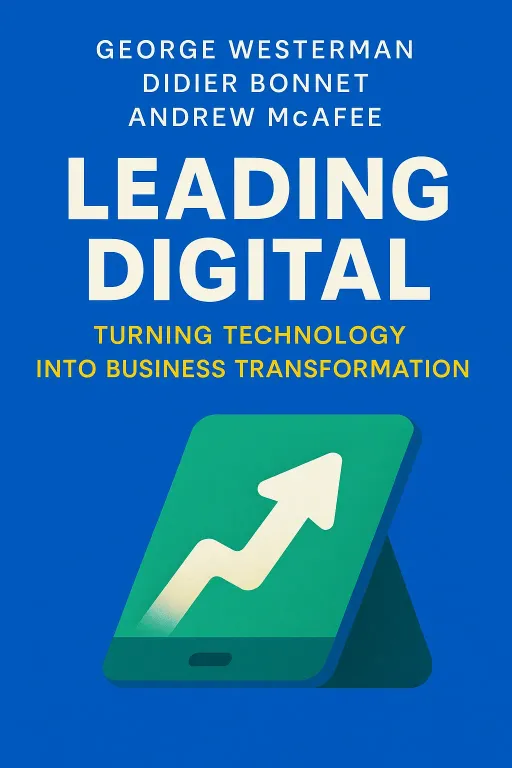
Nova: Exactly. And that's the core question in 'Leading Digital' by Westerman, Bonnet, and McAfee. They argue that becoming a leader in the digital age isn't magic; it's a skill you can learn. And today, we'll dive deep into their answers from two perspectives. First, we'll unpack the 'DNA' of a true Digital Master, exploring why having the latest tech isn't enough. Then, we'll focus on the single most powerful tool a leader has: a transformative vision, and how to wield it to turn a company's fate around.
Grace: I’m excited. It sounds like a blueprint for building organizational confidence in a very uncertain world.
Deep Dive into Core Topic 1: The Two Halves of Digital Mastery
SECTION
Nova: It really is. So let's start with that first idea: the DNA of a Digital Master. The authors did this massive study of over 400 firms and found something fascinating. Success wasn't about who spent the most money or who was in Silicon Valley. It came down to two distinct things: Digital Capability and Leadership Capability.
Grace: Okay, so break that down. What's the difference?
Nova: Think of it this way: Digital Capability is the 'what.' It's investing in technology to transform your customer experience, your operations, your business model. It’s Nike creating the FuelBand to connect with athletes, or Apple launching the iPhone. But Leadership Capability is the 'how.' It's the vision, the governance, the ability to engage your people and steer the entire organization through the change. It's the hard, human work.
Grace: I see. So you can have one without the other.
Nova: Precisely. And that's where their framework gets so useful. They mapped companies on a grid and found four types. You have 'Beginners,' who are low on both. You have 'Conservatives,' who have good leadership but are afraid of tech. And you have 'Digital Masters,' who are great at both and, by the way, are 26% more profitable than their peers. But the most cautionary tale, Grace, is the fourth group: the 'Fashionistas.'
Grace: Fashionistas. I love that. I can already picture it.
Nova: You can! They are high on digital capability—they buy every new shiny object. But they're low on leadership capability. Imagine the chaos. The book gives this perfect example of a company where different business units all decided to build their own employee collaboration platforms. Each one chose a different, incompatible technology. So, the marketing team couldn't talk to the sales team, who couldn't talk to R&D.
Grace: Oh, that's painful. It’s the illusion of progress.
Nova: Exactly! In another company, three separate mobile marketing initiatives were launched by different departments. They were targeting overlapping customers but used different vendors and different tech. Nothing could be integrated. Nothing could be scaled. They looked incredibly trendy from the outside, but internally, they were just building digital dead ends.
Grace: That is so vivid, and it feels incredibly familiar. There's so much pressure in every industry to 'do AI' or 'be on the cloud,' and leaders feel they need to show they're innovating. But without that central leadership—that 'how' you mentioned—it just becomes expensive, fragmented activity. It's a failure of confidence, in a way. The confidence to say 'no' or 'not yet' until there's a coherent vision.
Nova: A failure of confidence. That's a brilliant way to put it. It’s choosing activity over direction. And it proves that just throwing money at tech doesn't make you a master. It might just make you a very well-dressed mess.
Grace: So the real mastery, then, is in the leadership that guides the technology. It's not about the tool, but the artist.
Deep Dive into Core Topic 2: Forging the Future with Vision
SECTION
Nova: Exactly! A failure of confidence and vision. And that leads us perfectly to our second core idea: the immense power of a leader's vision. It's the antidote to being a Fashionista. And there's no better story in the book to illustrate this than the incredible turnaround of Pages Jaunes, the French Yellow Pages.
Grace: The Yellow Pages? Okay, you have my attention. That feels like a company that was destined to fail.
Nova: You would think so! Picture it: it's 2009. Their core print business is in a freefall, with revenues plummeting by over 10% every year. Digital search engines like Google and Yelp are eating their lunch. This is a hundred-year-old institution, and the employees are deeply skeptical. They've seen other tech fads come and go, and they think this is just another storm to weather.
Grace: A classic case of organizational inertia. They can't see the iceberg because they're too busy polishing the brass on the Titanic.
Nova: Perfectly said. So, a new CEO, Jean-Pierre Remy, steps in. Now, he doesn't just give a speech and say, 'we need to go digital.' That's what a Fashionista leader would do. Instead, he completely reframes their entire reason for being. He gets up in front of everyone and says, 'We are not in the business of printing heavy yellow books. We are in the business of connecting small businesses to local customers.'
Grace: Wow. That's a shift in identity.
Nova: It's a total reinvention. And then, he backs it up with an audacious, almost unbelievable goal. He declares that they will shift their business from less than 30% digital revenue to over 75% digital revenue... in just five years. He also sends a powerful signal by freezing all non-essential investment in the traditional book business. The message was clear: the old way is over.
Grace: That takes incredible courage. I'm thinking about the self-confidence required to make that declaration. He's essentially telling thousands of people that the thing they've built their entire careers on is now obsolete, but that are not. He's giving them a new, more vital mission. That's a lesson that goes way beyond digital transformation; it's about leading people through any kind of profound change. How on earth did he get them to believe him?
Nova: That's the critical part. He didn't just announce it and walk away. The book says he spent the next communicating this vision relentlessly and honestly. He talked to investors, to salespeople, to designers. He explained what parts of their company were still valuable—their brand, their customer relationships—and what had to change, like retraining the sales force to sell digital services instead of print ads. It was a difficult, painful transition. There was resistance. But he never wavered from that core vision.
Grace: So the vision wasn't just a slogan. It was a daily practice of reinforcement and commitment.
Nova: It was the North Star for every decision. And by 2013, just four years later, they had nearly met their goal. The growth in digital revenue was finally offsetting the losses from the dying print business. He saved the company by giving it a new soul.
Grace: That story gives me chills. It proves that leadership isn't about having all the answers. It's about framing the right question—'what business are we in?'—and then having the conviction to lead everyone toward that new answer.
Synthesis & Takeaways
SECTION
Nova: I think that's the perfect way to tie it all together. Today we've seen these two powerful, interconnected ideas from 'Leading Digital'. First, that true mastery is a blend of tech investment AND leadership capability. You can't just be a 'Fashionista' with all the latest gadgets but no direction.
Grace: And second, that the engine of that leadership is a clear, transformative vision. It's the force that turns a struggling company like Pages Jaunes from a relic into a relevant digital player. It’s what separates activity from achievement.
Nova: It really clarifies things, doesn't it? The technology is just a tool. The real work, the work of mastery, is the human work of leadership: creating a shared vision and having the courage to steer the ship in a new direction.
Grace: Exactly. It's about building an organization that's confident in its digital future, because its leader has given it a clear and compelling reason to be.
Nova: A perfect summary. So for everyone listening, here's the question to ponder, inspired by Grace's insight: Looking at your team or your company, are you more of a Fashionista, a Conservative, or on the path to becoming a true Digital Master? And more importantly, what's the first sentence of the transformative vision you'd want to write for your digital future?
Grace: That's a powerful question to end on. Thank you, Nova. This has been incredibly insightful.
Nova: Thank you, Grace. It was a pleasure.