

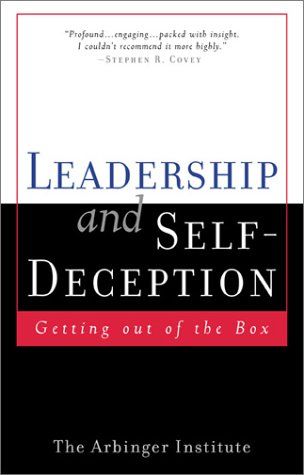
Leadership and Self Deception
Introduction
Nova: Have you ever worked with someone who was clearly the problem, but they were the only person in the entire room who couldn't see it? They were convinced that everyone else was the obstacle, even though it was obvious to everyone else that they were the one causing the friction.
Nova: Exactly. And that is the core mystery we are diving into today. It's called self-deception. It's the problem of not knowing you have a problem. We're looking at a classic in the leadership world, Leadership and Self-Deception by the Arbinger Institute.
Nova: Not quite cardboard, but it feels just as restrictive. This book argues that self-deception is actually the root of almost every human conflict, whether it's a corporate merger falling apart or a marriage on the rocks. It suggests that most of what we call leadership training is actually a waste of time because it focuses on behavior, while the real issue is something much deeper.
Nova: Precisely. Because if you're in the box, people can sense it. No matter what fancy management technique you use, they'll react to how you're seeing them, not what you're saying. Today, we're going to break down how we get into that box, how it sabotages our success, and most importantly, how to get out of it.
Key Insight 1
Life Inside the Box
Nova: To understand the book, we have to start with its central metaphor: The Box. When you are in the box, you see other people as objects rather than as people.
Nova: It's more subtle than that. Seeing someone as an object means you see them as a means to an end, an obstacle to your goals, or just a nuisance. You see their needs, their challenges, and their dreams as less real or less important than your own.
Nova: Exactly! You're in the box in that moment. When you're out of the box, you see people as people. You recognize that they have just as much going on as you do. Their hopes and fears are just as legitimate as yours. The book makes a massive point here: leadership isn't about what you do, it's about how you see the people you're leading.
Nova: According to Arbinger, it counts for very little. People have a built-in radar for sincerity. Think about it. Have you ever had a boss give you praise, but it felt... slimy? Like they were just doing it because they read a book that said they should praise their employees once a week?
Nova: That's because he was in the box! He saw you as an object to be managed, not a person to be valued. This is why the book is so revolutionary. It says that two people can do the exact same thing—say, give a piece of critical feedback—but if one is in the box and the other is out, the results will be completely different. One will build the relationship, and the other will destroy it.
Key Insight 2
The Mechanics of Self-Betrayal
Nova: It starts with something the book calls self-betrayal. This is the most fascinating part of the theory. Self-betrayal is when you have a sense of what's right to do for someone else, and then you don't do it.
Nova: The book uses a famous story about a man who wakes up in the middle of the night because his baby is crying. His first instinct—his sense of what he should do—is to get up and help so his wife can keep sleeping. She’s had a long day, too. But then, he doesn't move. He stays in bed. That is the moment of self-betrayal.
Nova: Exactly. And here's where it gets interesting. Once you betray that initial impulse to help, you have to justify your choice. You can't just think, I'm being selfish. Your brain won't let you. So, you start to tell yourself a story where you are the victim and the other person is the villain.
Nova: Exactly! He starts thinking, I have a big meeting tomorrow. I’m the breadwinner. Why is she just lying there? Is she faking sleep? She’s so inconsiderate! Suddenly, his wife isn't his partner anymore; she’s an object—an obstacle to his rest. He has to inflate her faults and minimize his own to justify his self-betrayal.
Nova: Precisely. And the more we justify ourselves, the more we enter the box. We start to see the world through a distorted lens. We aren't just wrong; we are self-righteously wrong. We truly believe we are the ones being mistreated, when in reality, we started the whole cycle by ignoring our own conscience.
Key Insight 3
The Dangerous Dance of Collusion
Nova: That is what the book calls collusion. It’s a toxic dance where we actually invite each other to stay in the box. It’s one of the most destructive forces in any organization.
Nova: It sounds crazy, right? But if I’m in the box, I need you to be a villain to justify my behavior. If you’re actually a nice, helpful person, then my story about you being a jerk falls apart, and I’m forced to realize that I’m the one being difficult. So, I subconsciously provoke you to act badly so I can feel justified in my anger.
Nova: You nailed it! That’s a perfect example of collusion. You’re both providing each other with excuses to stay in your boxes. The manager says, I have to micromanage because he’s lazy. The employee says, I’m going to do the bare minimum because my boss is a control freak. They are both getting what they want—justification—but the work is suffering, and the relationship is dying.
Nova: That’s why it’s called self-deception. In collusion, we aren't looking for solutions; we are looking for evidence. We stop caring about results and start caring about being right. In a business context, this is a disaster. Teams stop collaborating, information gets hoarded, and people spend more time complaining about their coworkers than actually doing their jobs.
Key Insight 4
Breaking Free and Staying Out
Nova: Well, remember what we said earlier: techniques don't work if you're in the box. Buying donuts while you still see your coworkers as lazy objects is just going to come across as fake. The book is very clear about what doesn't work. You can't try to change others, you can't just cope with them, and you can't just implement new communication skills.
Nova: The exit is surprisingly simple, but very difficult. You get out of the box the moment you stop resisting the humanity of others. It’s a shift in mindset. You have to stop focusing on how you’ve been wronged and start asking, what are this person’s needs, and how am I getting in their way?
Nova: Exactly. The book says that the moment you have a genuine desire to help someone, the moment you see them as a person with legitimate needs, you are already out of the box. You can't be in the box and see someone as a person at the same time. They are mutually exclusive states.
Nova: Not at all! In fact, you can be much more effective at holding people accountable when you're out of the box. If I'm out of the box, I'm holding you accountable because I want you to succeed and because I care about the team’s results. If I’m in the box, I’m holding you accountable because I want to punish you or prove I’m superior. Which one do you think you’ll respond to better?
Nova: It is! Staying out of the box is a constant practice. It’s about being aware of that feeling of self-justification. The moment you start feeling superior, or the moment you start building a case against someone, that’s your red flag. That’s the sign that you’re slipping back in. The key is to catch it early and remind yourself that the other person is a person, just like you.
Conclusion
Nova: We've covered a lot of ground today. We looked at the box, where we see people as objects. We explored self-betrayal, the moment we go against our conscience and start justifying ourselves. We saw how collusion creates those toxic loops of blame in our workplaces and homes. And finally, we talked about the only way out: seeing others as people.
Nova: It’s a challenging message, but it’s also an incredibly hopeful one. It means that we don't have to wait for other people to change for our lives and our leadership to improve. We have the power to change how we see the world, and that changes everything else.
Nova: That is the perfect place to start. If you can master that one habit, you’re well on your way to becoming a more effective leader and a more fulfilled person. Leadership and Self-Deception isn't just a business book; it's a guide to being a better human being.
Nova: That’s the spirit. This is Aibrary. Congratulations on your growth!