

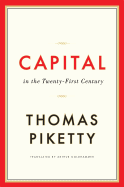
Le capital au XXIe siècle
Introduction
Nova: Imagine a seven hundred page book filled with dense economic data, historical tax records, and complex mathematical formulas. Now, imagine that book becoming a global sensation, topping the New York Times bestseller list and turning its author into what the media called a rockstar economist. That is exactly what happened in 2014 when Thomas Piketty released Capital in the Twenty-First Century.
Atlas: It is honestly wild to think about. Usually, books that thick are used as doorstops or for pressing flowers, not for light summer reading. But people were obsessed. I remember seeing it on every coffee table for a year. Why did a book about capital and inequality strike such a massive chord?
Nova: Because it hit right at the heart of the post-2008 frustration. People felt like the system was rigged, but they did not have the data to prove it. Piketty provided that data. He spent fifteen years digging through three centuries of records from over twenty countries to show that the gap between the rich and everyone else is not just a temporary glitch. According to him, it is a fundamental feature of capitalism.
Atlas: So he basically brought a mountain of receipts to the debate. But he did more than just complain about inequality; he claimed to have found a literal formula for it. Today, we are going to break down that formula, look at why the twentieth century was a weird historical fluke, and see if his controversial solutions actually hold water.
Key Insight 1
The Speedboat and the Rowboat
Nova: If you take away nothing else from this book, you have to understand one tiny formula: r is greater than g. That is the engine behind Piketty's entire argument.
Atlas: Okay, r is greater than g. It sounds simple, but what are we actually looking at here? What do those letters stand for in the real world?
Nova: R is the rate of return on capital. Think of it as the money you make from owning things—profits from a business, dividends from stocks, or rent from a building you own. G is the growth rate of the economy, which basically represents how much the total pie is growing and, by extension, how much wages are increasing for the average worker.
Atlas: So if r is greater than g, it means the people who own stuff are seeing their wealth grow faster than the people who just work for a living?
Nova: Exactly. Think of it like a race. Capital is a speedboat, and economic growth is a rowboat. Over the long run, the speedboat is always going to pull away. Piketty found that historically, the return on capital usually sits around four to five percent, while the economy typically grows at only one to two percent.
Atlas: That seems like a recipe for a permanent upper class. If your wealth grows at five percent and mine only grows at two percent, the gap between us just gets wider every single year, even if I am working my tail off.
Nova: That is his central point. Without some kind of outside intervention, like a massive war or a major tax change, wealth naturally concentrates at the top. It is not about who works harder; it is about the math of the system. If you start with a million dollars and it grows faster than the economy, you eventually own a bigger and bigger slice of the world.
Atlas: But wait, if this is a fundamental law, why did it feel like things were getting more equal for a while? My grandparents always talked about the middle class boom after World War Two. Was that just an illusion?
Nova: Not an illusion, but what Piketty calls a historical anomaly. He argues that the mid-twentieth century was the only time in modern history where the formula flipped, and that is what we are going to dive into next.
Key Insight 2
The Great Leveling
Nova: To understand why we think capitalism creates a middle class, we have to look at the period between 1914 and 1970. Piketty calls this the Great Leveling, but it did not happen because the system suddenly became nice.
Atlas: I am guessing it had something to do with the two world wars and the Great Depression? Not exactly a peaceful transition to equality.
Nova: Precisely. Those events were like a giant reset button for wealth. First, the wars literally destroyed physical capital—factories, buildings, and infrastructure were blown up. Second, the financial shocks of the Depression wiped out massive amounts of paper wealth. And third, to pay for the wars, governments hiked taxes on the rich to levels we can barely imagine today.
Atlas: How high are we talking? Because people today lose their minds over a few percentage points.
Nova: In the United States and the UK, top income tax rates actually hit ninety percent at one point. There was a genuine political will to prevent the return of a tiny, ultra-wealthy elite. Because of that, for a few decades, g—the growth of the economy—was actually higher than r, the return on capital.
Atlas: So the rowboat was actually faster than the speedboat for a minute. That explains why the post-war era felt so different. Everyone was getting a bigger slice because the economy was booming and the old wealth had been decimated.
Nova: Right. But Piketty's warning is that those decades were the exception, not the rule. Since the 1980s, we have been sliding back toward what he calls patrimonial capitalism. That is a fancy way of saying a society where your success depends more on who your parents are than on your own talent or work.
Atlas: That sounds like we are heading back to the nineteenth century. Like something out of a Charles Dickens novel where everyone is just waiting for a rich uncle to die so they can finally afford a house.
Nova: You are spot on, and Piketty actually uses literature to prove his point. He spends a lot of time talking about Jane Austen and Balzac to show what a world dominated by r greater than g actually looks like.
Key Insight 3
The Return of Jane Austen's World
Nova: One of the most fascinating parts of the book is how Piketty uses nineteenth-century novels to explain economic data. He looks at characters in Jane Austen's Pride and Prejudice or Balzac's Father Goriot.
Atlas: I remember those! In those books, nobody ever seems to have a job. They just talk about their five thousand pounds a year or their estates in the countryside.
Nova: Exactly. In that world, it was mathematically impossible to work your way to the top. If you were a brilliant lawyer or a hardworking doctor, you could never earn as much as someone who simply inherited a large estate. The return on that inherited capital was so much higher than any possible wage.
Atlas: So the advice back then was basically: don't bother working, just marry someone with a lot of land.
Nova: Literally. There is a famous scene in Balzac where a character explains to a young, ambitious student that even if he becomes the most successful lawyer in Paris, he will still be poor compared to someone who marries into a fortune. Piketty argues that we are returning to that exact structure.
Atlas: But we have tech billionaires and self-made moguls now. Surely that is different from a bunch of dukes owning all the land?
Nova: Piketty acknowledges the rise of the super-manager—the CEOs who get paid tens of millions of dollars. But he argues that even that wealth eventually crystallizes into capital. Once a billionaire has their money, it starts growing at that four to five percent rate. Eventually, their kids and grandkids will own the world without ever having to manage a company.
Atlas: It is the shift from meritocracy to inheritance. If the return on wealth is higher than the growth of the economy, then over time, the share of wealth that is inherited will always grow. We are moving from a society of workers to a society of heirs.
Nova: And that is why he is so worried. He thinks this concentration of wealth is not just unfair; it is a threat to democracy. If a tiny group of people owns everything, they eventually control the political process too. So, he proposed a solution that made a lot of people very angry.
Key Insight 4
The Global Wealth Tax and the Critics
Nova: Piketty's big solution is a global, progressive tax on wealth. Not just on income, but on the total value of everything you own.
Atlas: A global tax? That sounds like a logistical nightmare. How would you even get every country to agree to that? If the US taxes wealth, won't the billionaires just move their money to a tropical island?
Nova: That is exactly why he says it has to be global. He calls for international cooperation and a massive increase in financial transparency. He wants a world where governments know who owns what, so there is nowhere to hide. He suggests a small tax, maybe one or two percent, on large fortunes every year.
Atlas: I can imagine the pushback. I bet the critics had a field day with this. What were the main arguments against him?
Nova: Oh, they were fierce. Some economists, like Chris Giles from the Financial Times, accused him of having data errors in his spreadsheets. They argued that he over-counted wealth inequality in some places and ignored it in others. Piketty defended his work, but it sparked a huge debate about how we even measure wealth.
Atlas: What about the idea of human capital? I have heard critics say that Piketty ignores the fact that people are more educated and skilled today. Isn't my degree a form of capital?
Nova: That is a common critique. Critics argue that in the modern world, knowledge and skills are just as important as land or factories. If you include the value of human skills, the inequality might not look quite as scary. Others argue that r is not always greater than g—that the return on capital can be volatile and that the rich can lose their money just as easily as they make it.
Atlas: Plus, there is the political reality. Even if the math is right, getting the world to agree on a global wealth tax feels like trying to herd cats in a thunderstorm. It is a massive leap from a spreadsheet to a policy.
Nova: It is, but even his critics admit that he changed the conversation. Before this book, inequality was a side issue. After Piketty, it became the central question of modern economics. He forced everyone to look at the long-term data and ask: is this the kind of society we actually want to live in?
Conclusion
Nova: We have covered a lot of ground today, from the simple math of r greater than g to the world of Jane Austen and the controversial idea of a global wealth tax. Thomas Piketty's Capital in the Twenty-First Century is more than just a book; it is a warning that the natural state of capitalism is toward more inequality, not less.
Atlas: It really shifts your perspective. It makes you realize that the relatively equal world our grandparents lived in wasn't just the way things are—it was something that had to be built and protected. If we just leave the system on autopilot, the math says the gap will keep growing.
Nova: Exactly. Whether you agree with his solutions or not, Piketty's work reminds us that the economy is not a force of nature. It is shaped by laws, taxes, and political choices. We have the power to decide if we want a meritocracy or a new age of inherited dynasties.
Atlas: It is a heavy thought, but an important one. If you want to dive deeper, the book is a long read, but the data is eye-opening. It is a call to pay attention to the structures beneath our daily lives.
Nova: Thank you for joining us on this deep dive into one of the most influential books of our time. This is Aibrary. Congratulations on your growth!