

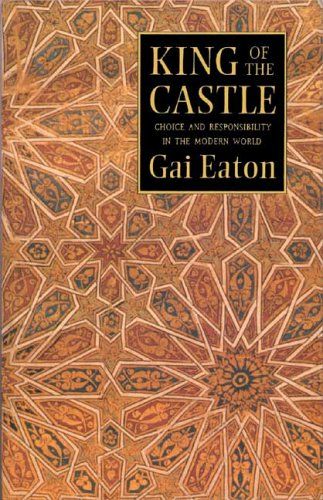
King of the castle
Choice and Responsibility in the Modern World
Introduction
Nova: Imagine a frog living at the bottom of a deep well. Every day, he looks up at that small circle of sky and thinks: this is the entire universe. Then one day someone tells him about mountains, oceans, deserts, and he scoffs. Mountains? Ridiculous. He's never seen one. Welcome to Aibrary. I'm Nova.
Nova: We are, because that frog is the perfect metaphor for a book that has been quietly shaking readers awake since 1977. King of the Castle: Choice and Responsibility in the Modern World by Charles Le Gai Eaton. The line I just paraphrased is actually his: The rationalism of a frog at the bottom of a well consists in denying the existence of mountains.
Nova: A fascinating figure. Born in Switzerland in 1921, raised agnostic in London, educated at Charterhouse and King's College Cambridge. He was a diplomat, a journalist in Jamaica and Egypt, and then in 1951 — at age thirty — he embraced Islam. He spent over twenty years in the British Diplomatic Service and later became a consultant at the Islamic Cultural Centre in London. He died in 2010, leaving behind a body of work that includes Islam and the Destiny of Man, but King of the Castle remains arguably his most powerful and accessible book.
Nova: Exactly. And that is what gives this book its unique authority. Eaton had lived inside Western civilisation long enough to see through it. He wasn't an outsider throwing stones. He knew the assumptions intimately because he had once shared them. King of the Castle examines those assumptions — the ones we never think to question — and holds them up to the light. The book's subtitle gives you the core: Choice and Responsibility in the Modern World. It's about what it means to be a free, morally accountable human being in an age of vast systems, institutions, and materialist worldviews.
Nova: It comes from the Islamic concept of the human being as God's Viceroy on Earth. In the traditional understanding, man is not simply a biological accident or an economic unit. He is a steward, entrusted with responsibility and genuine moral freedom. He is, in a sense, the king of his own castle — his own soul, his own little domain of choice. But modern society, Eaton argues, has been quietly evicting us from that castle, replacing sovereignty with subservience to systems. And most of us haven't even noticed the eviction notice.
How Modernity Quietly Possessed Us
The Unquestioned Assumptions We Live By
Nova: Eaton opens the book with a thought experiment that sets the tone for everything that follows. He asks the reader to imagine being transported back several centuries, mixing with people separated from us by hundreds of years. The mountains, the sky, the trees — they are the same. But those people do not see what we see in the same way. The outer world may be identical, but the inner world that gives things their meaning is completely different.
Nova: Exactly. And here is the key move: if every civilisation is captive to its own assumptions, what guarantee do we have that our assumptions are any less illusory than those of past ages? Eaton isn't starting by attacking the results of modern life. He's going deeper — he's questioning the premises. The first and most important premise he dismantles is the myth of progress.
Nova: Right. And Eaton points out that this is a historically very unusual belief. Most traditional civilisations understood time very differently. They did not worship the new. They saw wisdom as something accumulated over generations, passed down, not something you invent from scratch every few decades. Eaton writes that modern people are like people squatting in a little pool, hungry for certainties, holding on desperately to the current notion of what is rational. But rationality itself can become a cage.
Nova: He argues that secular societies have quietly taken on the totalising claims that once belonged to religion. They demand loyalty. They shape identity. They leave no space outside their reach. The citizen is made to feel free while being comprehensively possessed. You can vote, you can choose your career, you can buy whatever you like — but the framework within which all those choices happen is never up for debate. And the great enabler of this comprehensive possession is something he calls collective anonymity.
When No One Is Accountable
The Crisis of Anonymity
Nova: Here's one of Eaton's most striking passages. He writes: Of all the changes that have taken place in the human condition over the past hundred years, none is more significant than the increasing difficulty we now have in tracing acts to their owners. In earlier times and in more simple societies, each act was branded with its owner's name. In the complex societies of today, it might take the combined efforts of a detective and a moral philosopher to trace any given act to any one person.
Nova: Exactly. And from this flows one of the book's most morally urgent arguments. A society of jobholders and functionaries, absorbed into vast collectivities, produces people who have learned to outsource their conscience. Eaton is unsparing at this point. He writes: How often one hears the decent citizen of our time, functionary or official, say with becoming modesty: 'I didn't make the rules; it's not for me to question my orders!' Perhaps at some other time, in some other place, one might applaud his sense of duty; but too much has happened in the past forty years, and we have seen too much of what dutiful obedience may involve, and we have lost our innocence.
Nova: He does. He discusses Rudolf Höss, the commandant of Auschwitz, who wrote in his autobiography that his father always reminded him that the laws and decrees of the State had to be obeyed unconditionally, no matter how strong one's opposition might be. Eaton points out that this is a conditioned reflex — a kind of obedience that persists long after any legitimate authority has vanished. Höss himself described Himmler's basic orders as sacred and inviolable. Eaton notes how startling those words are: sacred, inviolable. They're religious language, applied to a man he describes as being from the dregs of humankind.
Nova: Yes. And Eaton pushes this even further. If law has no reference point beyond the will of whoever currently holds power, then obedience to it is nothing more than submission to force, dressed up in the language of civic duty. Laws change constantly. What was criminal becomes permitted; what was permitted becomes forbidden. On what basis, then, does the law have any claim on your conscience?
Nova: Eaton acknowledges that. He doesn't claim past societies were perfect. But he insists that they at least had a framework — a sacred reference point — that placed limits on what human authority could demand. When that framework is removed, there is no longer anyone or anything to tell us where and when to stop. As he puts it in the chapter Liberty and Obedience: It is difficult to adjust to the fact that there is no longer anyone to tell us where and when to stop.
Nova: Yes. Eaton asks the reader to sit with a very uncomfortable fact: Stalin, Hitler, Mao — none of them killed in the name of God. They killed in the name of ideology, nation, race, and class. The charge of fanaticism and mass violence, laid so often at religion's door, belongs by any honest accounting far more heavily to secular political ideologies. Nationalism, in particular, he regards as one of modernity's most dangerous substitute religions — taking the human hunger for belonging and the sacred and redirecting it toward something partial and contingent, with catastrophic results.
The Antidote to Dispossession
Man as Viceroy
Nova: This is where Eaton brings in the Islamic concept that gives the book its title and its spiritual core: man as God's Viceroy on Earth. And he writes: Men are creatures made for choosing and are, as such, responsible beings, accountable for what is in their little world, but with a responsibility which extends far beyond its limits since we are not, by nature, entirely confined in our mortal shells.
Nova: Exactly. And Eaton argues that this capacity to choose — freely, responsibly, with awareness of something beyond the merely material — is what makes us human. A society that keeps its citizens in permanent flux, where values shift constantly and nothing holds still, quietly destroys that capacity. Not through tyranny, but through disorientation.
Nova: Right. And here Eaton makes a subtle but crucial point: not choosing is also a choice. The man who simply follows orders has not absolved himself. He has chosen not to choose. And that choice has consequences — moral consequences — that cannot be outsourced to the system that gave him the orders.
Nova: Yes — one of the book's most memorable sections. Eaton writes: The world is full of mirrors and the animal creation shows us our own reflection. He tells a story from the Islamic tradition: one of the earliest Sufi Masters told his disciples, 'When I commit a fault, I am made aware of it by my donkey's temper.' The idea is that animals reflect back to us our own moral state. How we treat the natural world, how we relate to other creatures — it reveals who we really are.
Nova: It does. And it brings us to Eaton's broader argument about knowledge itself. He devotes an entire chapter to what he calls Knowledge and its Counterfeits. He argues that modern societies have confused information with wisdom, technical capability with understanding. We have mastered the how while forgetting the why. The problem, he says, was never the machine. It was always the man behind it, now stripped of any sacred reference point. Technology enables evil at a scale and efficiency previously unimaginable — industrialised war, bureaucratic atrocity, mass surveillance — because we have developed incredible technical power without the moral framework to govern it.
Nova: Precisely. And that distinction matters.
What Traditional Societies Knew That We Forgot
The Myth of Progress and the Wisdom We Abandoned
Nova: One of Eaton's recurring themes throughout the book is his refusal to accept the fashionable assumption that ancient people were simply ignorant, superstitious, or primitive. He rejects simplistic evolutionary narratives of history and argues that ancient people possessed forms of wisdom and metaphysical understanding that modern societies have largely abandoned.
Nova: And Eaton challenges that head-on. He points out that what we call progress is often just change, and not all change is improvement. The modern world operates on an assumption that things are getting better, that history moves upward. But Eaton asks: by what measure? If the measure is material wealth or technological capability, then yes. But if the measure is spiritual depth, moral clarity, or genuine human flourishing, the picture becomes much more complicated.
Nova: Not at all. He's saying we need to stop assuming that later is always better and that the new automatically supersedes the old. Accumulated wisdom — the insights about human nature, about virtue, about the sacred, that have been refined over thousands of years — cannot simply be dismissed because they don't fit into a modern spreadsheet. There's a reason Eaton titled one of his chapters The Only Heritage We Have.
Nova: Exactly. Eaton argues that when you sever people from that heritage — when each generation is convinced it has nothing to learn from those who came before — you leave them rootless, disoriented, and uniquely vulnerable to manipulation. If the past has nothing to teach you, then the present moment, with all its fashions and pressures, becomes the only reality. And that makes people extremely easy to possess.
Nova: Yes. The book's final chapter, What We Are and Where We Are, brings everything together. Eaton reminds the reader that human beings are mortal, that civilisations are mortal, that the earth itself is not eternal. The crucial question is not how long our civilisation will last or when it will collapse, but how we live in the meantime. What is asked of us is not to control the cosmic destiny — that is beyond our capacity — but to fulfill the function for which we were created.
Nova: To be kings of our own castles — our own souls — accountable for what happens in our little world, but with a responsibility that reaches far beyond it.
Conclusion
Nova: So let's step back and look at what King of the Castle actually achieves. It is not a policy book. It doesn't offer a five-point plan for fixing society. Eaton himself says the work cannot easily be confined to a single category — it moves through history, philosophy, sociology, spirituality, theology, and cultural criticism. But its core is a single, burning question: what does it mean to be a responsible human being in the modern world?
Nova: That's it exactly. But Eaton doesn't leave us in despair. The entire second half of the book — especially the chapter Man as Viceroy — is a restoration project. He is reminding us who we actually are. Not products of random biological accident. Not data points in a vast economic machine. But moral agents, entrusted with freedom, accountable for our choices, capable of reflecting something sacred in the way we live.
Nova: Several readers have described this book as life-changing. One reviewer on Goodreads wrote that it was one of the most incredible and profound reads of their life, that they had to slow down their reading just to digest what their mind was capturing. Another said the book compelled them to question the direction modern society is heading and to reconsider the ideals they'd been taught to aspire toward. A British Muslim reader on Amaliah wrote that Eaton's words reminded her that she has a moral duty to speak truth to power in all spaces, especially those that promote a version of living contrary to God-consciousness.
Nova: Yes. Because the trends Eaton identified — increasing collectivism, the difficulty of tracing acts to their owners, the erosion of moral agency, the worship of the new — have all accelerated dramatically since he wrote. The digital age, with its algorithms and platforms and vast data systems, has made collective anonymity even more pervasive. If anything, we need King of the Castle now more than ever.
Nova: Eaton is not telling you what to do. He is asking you to see clearly, and then to choose. The book is more diagnostic than prescriptive. But the diagnosis itself is an act of liberation — because you cannot reclaim your sovereignty until you recognise that it has been taken. King of the Castle is a mirror. It asks you to look at your own assumptions, your own unexamined beliefs, your own outsourcing of conscience, and then decide whether you are living as a viceroy or as a functionary.
Nova: King of the Castle: Choice and Responsibility in the Modern World by Charles Le Gai Eaton. Published by the Islamic Texts Society. If you are willing to engage seriously with questions of meaning, responsibility, and the place of the sacred in human life, it remains an essential read.
Nova: Congratulations on your growth!