

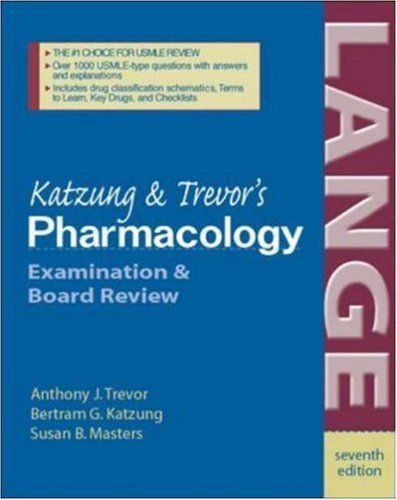
Katzung & Trevor's pharmacology
Introduction
Nova: Picture this: you are a medical student, and in front of you sits a pharmacology textbook that has helped train doctors for over four decades. It has over a thousand practice questions, two full-length board exams tucked inside, and a reputation as the bestselling pharmacology review book in the world. That book is Katzung and Trevor's Pharmacology Examination and Board Review. And today, we are cracking it open.
Nova: That is the question at the heart of this episode. This is not just any pharmacology review book. It was born at the University of California, San Francisco, crafted by two legendary professors, Bertram Katzung and Anthony Trevor. Both are professors emeritus in the Department of Cellular and Molecular Pharmacology at UCSF. Katzung earned his MD from SUNY Syracuse and his PhD from UCSF itself. He directed the department's entire teaching program from 1972 to 1995. That is over two decades of shaping how pharmacology is taught.
Nova: Exactly. And that blend of clinical science and teaching experience is what gives this book its authority. Now in its fourteenth edition, published in June 2024, it continues to evolve. Let us explore what makes Katzung and Trevor's Pharmacology such an enduring force in medical education.
The Parent Textbook and Its Board Review Companion
Two Books, One Legacy
Nova: To understand Katzung and Trevor's Pharmacology, you first have to understand its parent. Before there was the review book, there was Basic and Clinical Pharmacology, the massive comprehensive textbook edited by Katzung. It is now in its sixteenth edition and is often called simply Katzung. That book is the heavyweight. Hundreds of pages covering everything from basic principles to autonomic drugs, cardiovascular pharmacology, CNS drugs, chemotherapy, toxicology, and special topics.
Nova: Right. The big textbook is organized into ten major sections. Section one covers basic principles like drug receptors, pharmacodynamics, pharmacokinetics. Section two goes deep into autonomic drugs. Then cardiovascular-renal, drugs acting on smooth muscle, central nervous system drugs, drugs for inflammation and immune disorders, endocrine drugs, chemotherapeutic drugs, toxicology, and special topics.
Nova: What is really clever is that the review book is organized to reflect actual course syllabi. The authors understood that medical students do not study pharmacology in a vacuum. They study it alongside pathology, physiology, and clinical medicine. So the book is structured to integrate with how pharmacology is actually taught in medical schools across the country.
Nova: One thing I find remarkable is the continuity. Katzung started this project decades ago. The first edition of Basic and Clinical Pharmacology came out long before most of today's medical students were born. Yet every few years, a new edition arrives, updated with the latest drugs, the latest guidelines, the latest understanding of mechanisms. The fourteenth edition of the board review book, released in mid-2024, reflects recent developments right up to the present.
Structure, Questions, and How Students Actually Use It
What Is Inside the Book
Nova: Let us walk through what a student actually encounters when they open this book. The first thing is the organization. The book divides pharmacology into the topics used in most courses and textbooks. Major introductory chapters on autonomic pharmacology and CNS pharmacology serve as foundations because so many drug classes operate through these systems.
Nova: Exactly. And that philosophy runs through the entire book. Each chapter begins with a concise review of the core concepts. Then come the questions. These are not simple recall questions. They are USMLE-style. That means they present clinical scenarios. A patient comes in with these symptoms. Which drug would you prescribe? What is the mechanism? What is the side effect you need to watch for?
Nova: The book also includes beautiful illustrations and tables. Full-color figures that map out drug mechanisms, receptor pathways, and clinical decision trees. At the end of each chapter, summary tables distill the key information about every drug covered. These tables are what students photocopy, screenshot, and study from over and over in the days before an exam.
Nova: Let me give you a concrete example of how the book handles a specific topic. Take cardiovascular drugs, which is Katzung's own research area. The chapter will start with a review of cardiac physiology and the major drug targets. Then it will walk through drug classes systematically. Beta-blockers. Calcium channel blockers. ACE inhibitors. Diuretics. Antiarrhythmics. For each class, you get the prototype drug, the mechanism, the clinical uses, the adverse effects, and the key drug interactions.
Nova: That clinical reasoning is what makes this book effective. It is not just about passing the test. It is about becoming a better clinician. And that is where the UCSF pedigree really shows. These are professors who trained generations of physicians. They know what a doctor needs to know.
Katzung, Trevor, and the UCSF Pharmacology Dynasty
The Authors Behind the Name
Nova: Let us talk about the people behind the book, because their stories are as compelling as the content they created. Bertram Katzung earned his MD from SUNY Syracuse in 1957 and his PhD in pharmacology from UCSF in 1962. That is an MD-PhD before MD-PhD programs were common. He joined the UCSF faculty that same year and spent his entire career there.
Nova: He also served as acting chair of the Department of Pharmacology from 1978 to 1981 and directed the department's teaching program for all professional students from 1972 through 1995. That is twenty-three years of overseeing how pharmacology is taught to future doctors, dentists, and pharmacists at one of the top medical schools in the world.
Nova: Anthony Trevor's path was slightly different. He earned his PhD and became Professor Emeritus of Pharmacology and Toxicology in the same department at UCSF. His teaching focused on basic and clinical pharmacology for professional students in the schools of dentistry and medicine. Together, Katzung and Trevor formed a partnership that spanned decades.
Nova: Yet the name Katzung and Trevor remains on the cover. That brand recognition is powerful. When a medical student in India or Nigeria or Brazil searches for a pharmacology review book, that name is what they trust. It is remarkable that two professors at a single institution created something with such global reach.
Nova: Speaking of which, let us address the elephant in the room. Some students on forums like Student Doctor Network have called the Katzung and Trevor review book a bit over-detailed and confusing compared to other options. They say BRS Pharmacology is more concise. But the consensus is that for students who want a thorough understanding and are willing to put in the work, Katzung and Trevor is unmatched.
The Secret Sauce of a Forty-Year Bestseller
Why This Book Endures
Nova: So why has this book survived through fourteen editions while countless other pharmacology review books have come and gone? I think there are three reasons. First, it is comprehensive without being overwhelming. Second, its question-based format mirrors how students actually learn. And third, it is backed by the credibility of the parent textbook.
Nova: Fair. But compare it to the full Basic and Clinical Pharmacology textbook, which runs hundreds of dense pages. The review book is lean by comparison. It gives you what you need for the boards without drowning you in every detail of every drug ever discovered.
Nova: And the third factor, the credibility of the parent textbook, cannot be overstated. Basic and Clinical Pharmacology is one of the most widely adopted pharmacology textbooks in the world. When students use the board review book, they know it aligns perfectly with the full textbook. The terminology is consistent. The drug classifications are the same. The emphasis matches. It is a seamless ecosystem.
Nova: Let me share a specific example. The field of immunopharmacology has exploded in the last decade. Biologics, monoclonal antibodies, checkpoint inhibitors, CAR-T therapy. These are not minor additions to the pharmacopeia. They represent entirely new ways of treating disease. The Katzung series has had to expand and revise its immunopharmacology chapters dramatically to keep pace.
Nova: And yet, the fundamentals remain the same. Pharmacodynamics. Pharmacokinetics. Receptor theory. Drug metabolism. The book is grounded in principles that do not change, even as the specific drugs evolve. That is the genius of the Katzung approach. Teach the principles first, then apply them to whatever drugs are currently in use.
Conclusion
Nova: So here is what we have learned. Katzung and Trevor's Pharmacology Examination and Board Review is not just a book. It is a system. It is the companion to one of the world's most respected pharmacology textbooks. It was created by two UCSF professors who spent their careers at the intersection of research, clinical practice, and teaching. It has evolved through fourteen editions, incorporating the latest drugs and guidelines while staying true to foundational principles.
Nova: The book's format, concise chapter reviews followed by USMLE-style questions with detailed explanations, leverages the most effective learning strategies known to educational science. It does not just present information. It forces you to retrieve it. And retrieval is where learning happens.
Nova: The legacy of Bertram Katzung and Anthony Trevor is measured not just in editions sold or questions answered correctly. It is measured in the countless physicians who, when standing at a patient's bedside trying to decide which drug to prescribe, draw on knowledge first planted by this book. That is the true measure of a great educational work.
Nova: Thank you for joining us on this deep dive into Katzung and Trevor's Pharmacology. Whether you are studying for the USMLE, preparing for boards, or just curious about one of the most influential books in medical education, we hope you found this episode illuminating.