

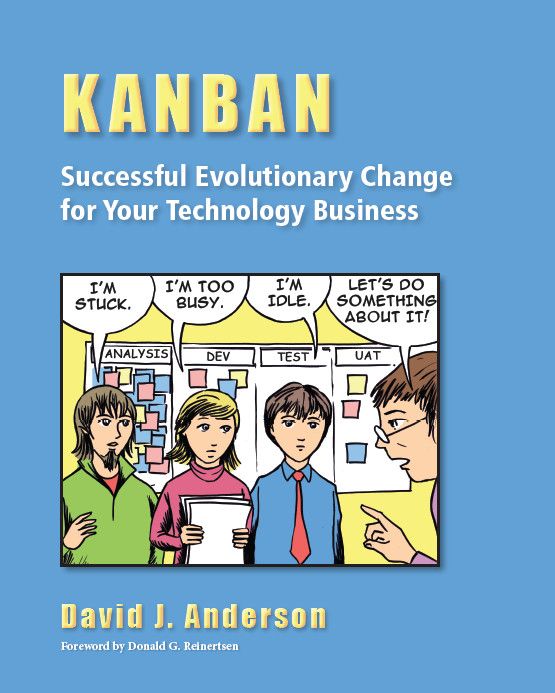
Kanban
Successful Evolutionary Change for Your Technology Business
Introduction: Beyond the Sticky Notes
Introduction: Beyond the Sticky Notes
Nova: Welcome to 'The Process Architects,' the show where we dissect the foundational texts that shape how we work today. Today, we are diving deep into a book that quietly revolutionized how many organizations approach change: David J. Anderson’s "Kanban: Successful Evolutionary Change for Your Technology Business."
Nova: Exactly. And here’s the surprising hook: while the name Kanban is rooted in the Toyota Production System from the 1940s, Anderson’s application, which launched the modern Kanban Method, was specifically engineered to handle the messy, intangible nature of knowledge work—software, marketing, operations—where you can’t just stack widgets on a shelf.
Nova: Because it provides the antidote to the 'Big Bang' approach to Agile adoption. Anderson argues that most radical transformations fail because they ignore the existing culture and processes. His method is designed to be evolutionary, not revolutionary. It respects where you are right now, which is a radical concept in the world of prescribed methodologies.
Nova: Agreed. Let’s get into the DNA of the Kanban Method as Anderson lays it out.
The Power of Evolutionary Change
The First Law: Start With What You Do Now
Nova: Chapter one of the book really sets the tone with the first core principle: Start with what you do now. This is the antithesis of prescriptive frameworks that demand you adopt a whole new set of roles, meetings, and artifacts on day one. Anderson is essentially saying, 'Show me your current workflow, warts and all.'
Nova: Precisely. You map your current process. If you have 'Requirements Gathering,' 'Development,' 'QA,' and 'Release,' you draw those columns. The magic isn't in the drawing; it’s in the agreement to based on what you see. Anderson emphasizes that you must respect the current process, roles, and responsibilities initially. You don't fire the Scrum Master or rename the Project Manager on day one.
Nova: Absolutely. He frames it as managing organizational change. People resist change when they feel they are losing control or when the change is too abstract. By starting with the known—your existing process—you lower the psychological barrier to entry. You are simply making the invisible visible. The research I found supports this; his method is described as incremental and sustainable precisely because it avoids radical upheaval.
Nova: That’s where the second principle kicks in: Agree to pursue improvement through evolutionary change. Once you see the waste, the bottlenecks, the places where work piles up—the visual evidence—the team naturally starts asking, 'How can we make this better?' The change comes from within the system, driven by data visible on the board, not dictated from above.
Nova: That’s a critical piece of the puzzle, Alex. Success Frames provide the target for the evolutionary steps. You don't just evolve randomly; you evolve toward a measurable goal. For instance, if the team sees a massive pile of items stuck in the 'Testing' column, the evolutionary step might be to introduce a 'Pairing' column or pull a developer into testing part-time. It’s a small, targeted experiment based on observed reality.
Nova: The primary risk is cultural rejection and process abandonment. When you impose a new structure too quickly, people often revert to old habits the moment the external pressure is off. By making changes small, incremental, and owned by the team seeing the problem, you build buy-in organically. It’s about building a culture of continuous learning, not just implementing a new set of rules. The book emphasizes respecting current roles and responsibilities, which is key to avoiding internal turf wars during transition.
Nova: Exactly. It’s about creating the conditions for improvement to happen naturally. And the next step in making that happen is visualizing the system so clearly that the need for improvement becomes undeniable. That brings us to the mechanics of flow management.
The Secret Weapon Against Multitasking
The Mechanics of Flow: Visualization and WIP Limits
Nova: It is the single source of truth for the workflow. But the real power, the element that separates Kanban from a simple task board, is the introduction of explicit policies and, most critically, Work-In-Progress limits. Anderson makes it clear: limiting WIP is the single most effective lever you have to improve flow.
Nova: He flips the entire concept of utilization on its head. He argues that high utilization—having everyone busy all the time—is the enemy of flow. When everyone is busy, context switching skyrockets, quality drops, and lead time balloons. The research I found mentioned that a key characteristic of Kanban is managing the work limit, not the worker limit. When WIP hits the limit, the team’s primary job shifts from 'starting new work' to 'finishing the work already started.'
Nova: Swarming, assisting, resolving blockers—that becomes the new priority. This forces the team to confront dependencies and bottlenecks immediately. If item A is blocked waiting for an external API, and you can’t pull in item D because the WIP limit is full, the team is forced to address the dependency on A, because finishing A is the only way to open up capacity for D. It makes systemic problems visible and urgent.
Nova: Explicit policies are the 'rules of engagement' for the board. For example, under the 'Testing' column, the policy might be: 'No item can enter Testing unless it has 100% automated unit test coverage.' Or, for the 'Ready for Review' column: 'Reviewers must dedicate 30 minutes twice daily to pull work.' These policies remove ambiguity. They standardize how work moves, which is essential for predictability.
Nova: Precisely. The reduction in lead time—the time from request to delivery—is the direct result of managing flow and reducing context switching. When you stop starting and start finishing, the time it takes for any single item to travel through the system plummets. It’s a direct consequence of respecting the WIP limits. It’s flow efficiency over resource efficiency.
Nova: It is. And this discipline, when applied consistently, leads to predictability. And predictability, in any business, is currency. Now, let's pivot slightly and address the elephant in the room for many Agile practitioners: how does this non-prescriptive method stack up against the reigning champion, Scrum?
Change Management vs. Prescribed Rituals
Kanban vs. The Agile Landscape: A Non-Prescriptive Approach
Nova: Alex, when Anderson wrote this book, the Agile world was heavily dominated by Scrum. His approach often gets positioned as the 'alternative.' But Anderson himself has clarified that Kanban is not necessarily an 'alternative' to Agile, but rather a different lens through which to view change, especially in knowledge work.
Nova: It’s a very pointed observation designed to highlight the difference. Scrum is prescriptive: it mandates time-boxed iterations, specific roles like the Scrum Master and Product Owner, and specific meetings like the Daily Scrum and Sprint Review. Kanban, on the other hand, is non-prescriptive about roles and cadence. It only mandates visualization, limiting WIP, managing flow, and making policies explicit.
Nova: Exactly. Kanban is designed to overlay or replace parts of an existing system. It’s about evolutionary change. If your current process has a cadence, you keep it. If it has roles, you keep them. You only introduce Kanban practices where they solve a visible problem. Anderson’s view is that Scrum is excellent for product development where cadence and commitment are paramount, but Kanban is superior for operational work or environments where the demand stream is highly variable and unpredictable.
Nova: And this leads to the concept of 'Classes of Service,' which is a major part of Anderson's framework. This is how Kanban handles priority without disrupting the flow structure. You might have 'Expedite' items that bypass WIP limits under specific, agreed-upon conditions, or 'Fixed Date' items that need special handling. This is far more nuanced than simply saying, 'Everything in the Sprint is high priority.'
Nova: The synchronization happens naturally at the board, driven by the WIP limits. The team gathers around the board, not necessarily at a fixed time, but whenever an item is ready to move or when a WIP limit is hit. The question shifts from 'What did you do yesterday?' to 'What is blocking this item right now?' It keeps the focus squarely on flow completion.
Nova: It is. And this focus on managing the work, rather than managing the people through rituals, is why Anderson’s method is so widely adopted across non-IT departments—HR, legal, marketing. They don't need a Product Owner or a formal Sprint Review; they just need to see their work, limit their multitasking, and deliver faster. The book is a masterclass in applying lean thinking to intangible assets, which is why we see those impressive case study results, like the 50% lead time reduction I mentioned earlier. It’s the result of disciplined flow management, not just a new set of meetings.
Case Studies and Encouraging Leadership
From Theory to Reality: Leadership and Metrics
Nova: We’ve talked philosophy and mechanics. Now, let’s ground this in the tangible results Anderson presents in the latter part of the book. He dedicates significant space to case studies, showing how these principles translate into measurable business success, often in environments that felt completely stuck.
Nova: The common thread, Alex, was the third core principle: Encourage acts of leadership at all levels. This is crucial. Anderson argues that you don't need a formal 'Agile Coach' or 'Scrum Master' title to drive improvement. The person who notices the bottleneck, the person who suggests the WIP limit change, the person who defines the 'Definition of Done' for a column—they are all acting as leaders. It democratizes improvement.
Nova: Exactly. And these observations are quantified using specific metrics that flow directly from the board. While Scrum often focuses on velocity—how much work done—Kanban focuses on flow metrics: Cycle Time, Lead Time, and Throughput. The goal is to make the average Cycle Time predictable. If you can tell a stakeholder, 'Based on our current flow metrics, this feature will likely take 12 days,' that predictability is gold.
Nova: It is. And the book details how these metrics are used to validate the evolutionary steps. Did the WIP limit reduction actually decrease the average cycle time? If yes, keep it. If no, try something else. It’s a scientific approach to process improvement, driven by data visible on the board, not by gut feeling or adherence to a ritual.
Nova: Quality is addressed through explicit policies, often tied to the 'Definition of Done' for each stage. A key practice is ensuring that quality checks are integrated the flow, not bolted on at the end. For instance, if you have a 'Testing' column, the policy might state that no item can move out of testing until a specific set of automated regression tests have passed. This prevents quality work from becoming a bottleneck later on. It’s about building quality in small, continuous increments, just like the process change itself.
Nova: That’s the perfect summary, Alex. Anderson provides a framework that is flexible enough for any knowledge domain, yet disciplined enough to deliver measurable results. It’s about making the system work better for the people in it, one small, evolutionary step at a time. We’ve covered the philosophy, the mechanics, the comparison to other methods, and the focus on leadership and metrics. It’s time to wrap up what listeners should take away from this foundational text.
Conclusion: The Art of Gentle Transformation
Conclusion: The Art of Gentle Transformation
Nova: We’ve spent this episode unpacking David J. Anderson’s seminal work, 'Kanban: Successful Evolutionary Change for Your Technology Business.' The key takeaway, the one thing I hope everyone remembers, is that radical change is often the enemy of lasting improvement.
Nova: If you are feeling overwhelmed by a rigid process, or if your current Agile implementation feels too heavy, Anderson’s Kanban Method offers a path forward that is gentle yet incredibly effective. Start by mapping your current process, identify your biggest flow constraint, and agree as a team to make one small, evolutionary change this week.
Nova: It’s a management philosophy disguised as a workflow tool. It teaches you how to manage complexity by managing flow, not by managing people’s schedules. It’s a timeless lesson for the modern knowledge worker.
Nova: That’s the goal. Thank you for joining us on this exploration of Kanban. This is Aibrary. Congratulations on your growth!