

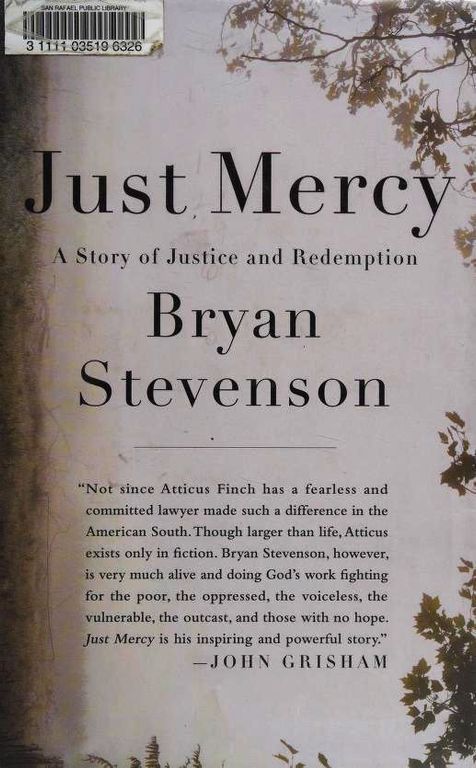
Just Mercy
Introduction
Nova: Imagine being sentenced to death for a crime you didn't commit. Now imagine that nearly everyone around you — the police, the prosecutors, the courts, even your own community — knows you're innocent, and yet you still sit on death row for six years. That's not fiction. That's the true story at the heart of Bryan Stevenson's Just Mercy, one of the most powerful books about justice in America ever written.
Nova: : Nova, that's chilling. And this is the Walter McMillian case we're talking about, right? The man from Monroeville, Alabama?
Nova: Exactly. Walter McMillian, a Black pulpwood worker, was arrested in 1987 for the murder of a young white woman named Ronda Morrison. He was convicted and sentenced to death despite a mountain of evidence proving his innocence. And the man who took on his case was a young, Harvard-trained lawyer named Bryan Stevenson, who had just moved to Alabama to start what would become the Equal Justice Initiative.
Nova: : So this book is part memoir, part legal thriller, and part social manifesto?
Nova: That's a perfect description. Just Mercy, published in 2014, weaves together Stevenson's personal journey, the harrowing story of Walter McMillian, and a searing indictment of the American criminal justice system. It spent over 200 weeks on the New York Times bestseller list, won the Carnegie Medal, and was adapted into a major film starring Michael B. Jordan and Jamie Foxx. But beyond the accolades, this book has changed how millions of people think about justice, mercy, and what we owe each other as human beings.
Nova: : I've heard Stevenson has this incredible line that really captures the heart of the book.
Nova: He does. He writes: "Each of us is more than the worst thing we've ever done." That single sentence is the moral engine of the entire book. Today, we're going to unpack Just Mercy — the story, the system it exposes, and why its message is more urgent now than ever.
Bryan Stevenson's Origin Story
The Lawyer Who Went to Alabama
Nova: Let's start with the man himself. Bryan Stevenson grew up in a poor, rural community in Delaware. His great-grandparents were enslaved in Virginia. He attended Eastern University and then Harvard Law School, but here's the surprising part — he almost didn't become the lawyer we know today.
Nova: : Wait, really? The guy who's argued before the Supreme Court multiple times?
Nova: Yes. Stevenson has said that during his first year at Harvard Law, he found the experience alienating and disconnected from the real-world problems he cared about. He almost dropped out. Then, during a summer internship, he was sent to meet with a death row prisoner in Georgia. That meeting changed everything.
Nova: : What happened in that meeting?
Nova: Stevenson was terrified. He was a young law student with no experience. The prisoner was a man condemned to die. But when he arrived, instead of talking about legal strategy, the man just wanted to talk to him — about life, about hope, about his family. At the end of their conversation, the man told Stevenson he was grateful he came, because nobody else had visited him in over two years. On the drive back, Stevenson realized that what this man needed wasn't just a lawyer. He needed someone who saw his humanity.
Nova: : That's incredibly moving. And that's when he decided to dedicate his life to this work?
Nova: It planted the seed. After graduating from Harvard, Stevenson turned down lucrative job offers and moved to Atlanta to work for the Southern Center for Human Rights. Then, in 1989, at just 29 years old, he moved to Montgomery, Alabama, and founded the Equal Justice Initiative — EJI — with almost no money and no staff. His mission was to provide legal representation to people on death row, people who had been wrongly convicted, and people who had been treated unfairly by the system because of their race or poverty.
Nova: : Moving to Alabama in 1989 to defend death row prisoners as a young Black lawyer — that takes extraordinary courage.
Nova: It does. And Stevenson has spoken about how isolating those early years were. He faced threats. He was once stopped by police who held a gun to his head while searching his car, simply because of his race. But he kept going. And one of his first major cases would become the centerpiece of Just Mercy — the case of Walter McMillian.
Walter McMillian's Wrongful Conviction
The Case That Shook a Nation
Nova: So let's dive into the Walter McMillian case, because it's almost unbelievable. In November 1986, Ronda Morrison, an 18-year-old white woman, was found murdered at the dry cleaning store where she worked in Monroeville, Alabama. For months, the police had no leads. Then, in June 1987, they arrested Walter McMillian.
Nova: : And what was the evidence against him?
Nova: That's the thing — there was essentially none. The prosecution's entire case rested on the testimony of a convicted felon named Ralph Myers, who had a long history of lying to authorities. Myers claimed he saw McMillian commit the murder. But here's the kicker: Myers's story changed multiple times, it was full of contradictions, and it directly conflicted with the physical evidence at the crime scene.
Nova: : So how did McMillian get convicted?
Nova: That's where the systemic failures come in. First, McMillian's trial was moved from Monroeville to Baldwin County — but not because of concerns about fairness. It was moved to a county with a larger white population, where the prosecution thought they'd have a better chance of conviction. The trial lasted only a day and a half. The jury, which was nearly all white, deliberated for just three hours before convicting him. And then the judge imposed the death penalty — overriding the jury's recommendation of life in prison.
Nova: : Wait, the judge can override the jury's recommendation?
Nova: At the time, Alabama was the only state that allowed judges to override jury sentencing recommendations in death penalty cases — a practice called judicial override. And it was used disproportionately in cases involving Black defendants. In fact, judges overrode life sentences to impose death in nearly 100 cases in Alabama, and it was abolished only in 2017. But for McMillian, the damage was done.
Nova: : And Stevenson got involved after the conviction?
Nova: Yes. Stevenson and EJI took on McMillian's appeal. What they uncovered was staggering. Multiple witnesses who had been pressured by police to lie. A key alibi witness — a police officer, no less — who testified that McMillian was at a church fish fry at the time of the murder. And perhaps most damning, Ralph Myers eventually recanted his entire testimony, admitting he had been coerced by law enforcement to falsely accuse McMillian.
Nova: : So the state knew they had the wrong man?
Nova: They did. And yet they fought the appeal every step of the way. It took six years of legal battles before McMillian was finally exonerated and released in 1993. Stevenson writes about the moment McMillian walked out of prison — how he looked up at the sky, something he hadn't seen freely in years, and simply said, "It's a nice day."
Nova: : After six years on death row for a crime he didn't commit, that's what he said? That's heartbreaking and beautiful at the same time.
The Broader Stories of Injustice
Children in Prison and the Condemned
Nova: The McMillian case is the narrative spine of Just Mercy, but Stevenson weaves in other cases that are equally devastating. One of the most haunting involves children sentenced to die in prison.
Nova: : Children sentenced to die in prison? You mean life without parole for juveniles?
Nova: Exactly. Stevenson tells the story of Joe Sullivan, a 13-year-old Black boy with intellectual disabilities who was convicted of sexual battery in Florida and sentenced to life in prison without the possibility of parole. Joe was tried as an adult, even though he was a child. Another case involves Antonio Nunez, who was 14 when he was sentenced to die in prison.
Nova: : Thirteen years old. That's a middle schooler.
Nova: It is. And here's a staggering statistic Stevenson cites: the United States was, at the time, the only country in the world that sentenced children to life in prison without parole. The only country. Stevenson took these cases all the way to the Supreme Court. In 2012, in Miller v. Alabama, the Court ruled that mandatory life-without-parole sentences for juveniles are unconstitutional. And in 2016, in Montgomery v. Louisiana, the Court made that ruling retroactive, affecting thousands of prisoners.
Nova: : So Stevenson's work literally changed the law for children across the entire country.
Nova: It did. And then there are the cases involving mental illness and trauma. Stevenson writes about Herbert Richardson, a Vietnam War veteran who suffered from severe PTSD. Richardson set off a small bomb on a porch in an attempt to scare someone — a woman who had ended their relationship. The bomb accidentally killed a young girl. Richardson was clearly mentally ill, clearly traumatized by war, and yet he was sentenced to death and executed in 1989. Stevenson was with him in his final hours.
Nova: : That must have been devastating for Stevenson.
Nova: It was. Stevenson writes that Richardson's execution radicalized him. It made him understand that the death penalty isn't just about guilt or innocence — it's about which lives we value and which we don't. Richardson was a Black veteran with mental illness. The system saw him as disposable.
Nova: : And there's another case that really stands out — the story of Marsha Colbey, right?
Nova: Yes. Marsha Colbey was a poor white woman in Alabama who gave birth to a stillborn baby at home. She was arrested and charged with capital murder — prosecutors claimed she had killed the baby. She spent years in prison before EJI helped secure her release. Her case exposes how the system criminalizes poverty, particularly for women. Stevenson uses her story to show that injustice isn't only about race — it's also about economic status, about who has the resources to defend themselves.
Statistics, Systems, and the Death Penalty
The Machinery of Mass Incarceration
Nova: Let's zoom out and look at the bigger picture Stevenson paints. Because Just Mercy isn't just a collection of individual stories — it's an indictment of an entire system.
Nova: : And the numbers are staggering, aren't they?
Nova: They are. Stevenson notes that the United States has the highest incarceration rate in the world. We have about 5 percent of the world's population but nearly 25 percent of the world's prisoners. The prison population has grown from about 300,000 in the early 1970s to over 2.3 million today. That's a more than 700 percent increase.
Nova: : What drove that explosion?
Nova: Stevenson points to several factors. The war on drugs, which disproportionately targeted communities of color. Mandatory minimum sentencing laws that took discretion away from judges. The rise of for-profit prisons that have a financial incentive to keep people locked up. And the politicization of being "tough on crime," which made prosecutors and politicians afraid to show mercy.
Nova: : And the racial disparities are impossible to ignore.
Nova: They're central to the book. Stevenson cites the statistic that one in three Black male babies born in 2001 could expect to go to prison in their lifetime, compared to one in seventeen white male babies. Black men are sentenced to federal prison at nearly six times the rate of white men. And when it comes to the death penalty, the disparities are even more stark: cases involving white victims are far more likely to result in death sentences than cases involving Black victims.
Nova: : So the system isn't broken — it's working exactly as designed?
Nova: That's one of Stevenson's most provocative arguments. He suggests the system isn't broken; it's functioning precisely as it was built to function — as a continuation of racial hierarchy and social control that traces back to slavery, through Jim Crow, and into the era of mass incarceration. He connects the dots between lynching and the death penalty, noting that the states with the highest rates of execution today are the same states that had the highest rates of lynching a century ago.
Nova: : That's a powerful and uncomfortable connection.
Nova: It is. And Stevenson doesn't just critique — he offers a way forward. He argues for what he calls "just mercy" — a justice system tempered by compassion, one that recognizes human dignity and the capacity for redemption. He writes that "the opposite of poverty is not wealth; the opposite of poverty is justice." That reframing is central to his philosophy: justice isn't a luxury for the comfortable; it's a necessity for the marginalized.
Stevenson's Philosophy of Justice
The Power of Proximity and Hope
Nova: One of the most compelling ideas in Just Mercy is what Stevenson calls "the power of proximity."
Nova: : What does he mean by that?
Nova: Stevenson argues that you cannot create meaningful change from a distance. You have to get close to the people who are suffering. You have to hear their stories, see their faces, understand their pain. He writes that proximity — physical and emotional closeness to the marginalized — is essential to justice work. It's what transformed him as a young law student visiting that death row prisoner in Georgia, and it's what he believes can transform society.
Nova: : So it's not just about changing laws — it's about changing hearts?
Nova: Exactly. But Stevenson is careful to say it's both. Laws matter. Policies matter. But they're not enough on their own. He tells a story about being at a conference and having someone ask him how he stays hopeful given all the suffering he witnesses. His answer is remarkable. He says he doesn't believe hope is an emotion — he believes hope is a discipline. Something you practice, something you choose, even when the evidence suggests despair.
Nova: : Hope as a discipline. That's a powerful reframing.
Nova: It is. And it connects to another of his core ideas: that we are all broken in some way. He writes, "We are all broken by something. We have all hurt someone and have been hurt. We all share the condition of brokenness even if our brokenness is not equivalent." The recognition of our shared brokenness, he argues, is the foundation of mercy.
Nova: : That's where his famous line comes in — "Each of us is more than the worst thing we've ever done."
Nova: Yes. And he means that for everyone — for the people he defends, for the prosecutors who wrongfully convict them, for the politicians who create unjust laws, and for us, the readers. The book challenges us to see the full humanity in every person, even — especially — those we're tempted to write off.
Nova: : How does this philosophy translate into action? What does Stevenson want readers to do?
Nova: He's very practical about it. He wants people to get proximate to suffering in their own communities. Volunteer at a prison literacy program. Mentor a child in the foster system. Advocate for sentencing reform. Vote for prosecutors and judges who prioritize justice over punishment. But more than any specific action, he wants readers to change the way they see — to stop defining people by their worst moments and start seeing their full humanity.
Nova: : And he's seen this approach work, hasn't he? The book itself has become a movement.
Nova: Absolutely. Just Mercy has been adopted by hundreds of colleges and universities as a common read. It's been used in book clubs, churches, and community organizations across the country. The 2019 film adaptation brought the story to millions more. And EJI has continued its work — in 2018, they opened the Legacy Museum and the National Memorial for Peace and Justice in Montgomery, which documents the history of racial terror lynching in America. The memorial has been called one of the most important civil rights sites in the country.
Conclusion
Nova: So where does Just Mercy leave us? I think it leaves us with a question — a deeply personal one. Stevenson writes that "the true measure of our character is how we treat the poor, the disfavored, the accused, the incarcerated, and the condemned." By that measure, how are we doing?
Nova: : Not well, if the book is any indication. But also — not hopelessly. Because Stevenson's story is ultimately one of change being possible.
Nova: That's exactly right. Walter McMillian walked free. Children are no longer sentenced to die in prison. The death penalty is in decline — executions have dropped by more than 75 percent since their peak in the 1990s. Public opinion has shifted dramatically on criminal justice reform. These changes didn't happen by accident. They happened because people got proximate, told the truth, and refused to give up.
Nova: : What would you say is the single most important takeaway for someone who hasn't read the book yet?
Nova: I'd say it's this: mercy is not weakness. In a culture that often equates justice with punishment, Stevenson shows us that true justice requires mercy — the willingness to see the full humanity in every person, to believe in redemption, and to fight for those the world has discarded. The book doesn't ask us to excuse harmful behavior. It asks us to resist the impulse to reduce any human being to the worst thing they've ever done.
Nova: : And that's a challenge for all of us, not just lawyers and judges.
Nova: It is. Whether we're in a courtroom, a classroom, a boardroom, or our own living rooms, we all have opportunities to extend mercy or withhold it. Just Mercy is an invitation to choose mercy — not because it's easy, but because it's just.
Nova: : Nova, this has been an incredible conversation. Thank you for walking us through this book.
Nova: Thank you for the thoughtful questions. And to our listeners: if Just Mercy has sparked something in you, I encourage you to read the book, watch the film, learn about the work of the Equal Justice Initiative, and most importantly, find a way to get proximate to the justice issues in your own community. As Stevenson reminds us, hope is a discipline — and it's one we can all practice.
Nova: : This is Aibrary. Congratulations on your growth!