

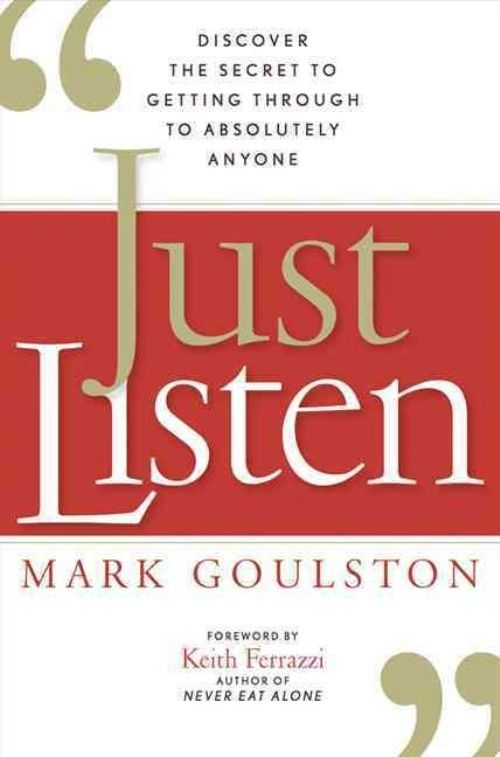
Just listen
Introduction: Listening at the Edge of Crisis
Introduction: Listening at the Edge of Crisis
Nova: Welcome to the show. Today, we’re diving into a communication manual that doesn't come from a boardroom, but from the high-stakes world of crisis intervention. Imagine sitting across from someone whose life, or someone else's life, hangs in the balance. That’s where Dr. Mark Goulston forged the lessons in his book, "Just Listen."
Nova: Not at all. Goulston argues that the ability to truly listen is the ultimate leverage. He posits that if you can get through to someone in a crisis, you can certainly get through to someone who just disagrees with your quarterly report. The core premise is a radical shift: moving from transactional communication—just waiting for your turn to talk—to transformational listening, where you actually change the other person’s emotional state.
Nova: That’s the genius of it. Goulston says that before anyone will listen to, they must first feel by you. He’s not talking about passive hearing; he’s talking about active, empathetic engagement designed to break down emotional resistance. This book gives us the blueprint for that engagement, drawn from situations where failure wasn't an option.
The Credibility of Crisis Communication
The Origin Story: From Psychiatry to Hostage Negotiation
Nova: Dr. Goulston’s background is fascinating. He wasn't just a therapist in a quiet office. He was a professor of psychiatry at UCLA for over 25 years, but crucially, he also served as a trainer for both the FBI and police departments on negotiation tactics.
Nova: In negotiation, the goal isn't just understanding; it’s de-escalation and achieving a specific outcome. Goulston realized that the fundamental barrier in any conflict, whether it’s a standoff or a tense business meeting, is the other person's. They aren't listening because they feel unheard, misunderstood, or undervalued.
Nova: Exactly. Goulston found that negotiators who focused solely on the demands—'Give me the gun'—failed. The successful ones focused on the first. They used listening to lower the emotional temperature. He translates this directly: to get buy-in, you must first address the emotional 'why' behind their resistance.
Nova: Precisely. And this leads to the book’s central thesis: the goal of listening isn't just to gather information; it’s to make the other person feel three specific things: Understood, Interesting, and Valuable. If you achieve those three things, they stop resisting and start considering your point of view.
Nova: It does. And Goulston codifies this into what he calls the 9 Fundamental Rules of Communication. These aren't vague platitudes; they are actionable mandates for shifting your focus entirely away from your own agenda when you first engage.
Nova: One of the most powerful is the rule against 'pre-scripting' your response. In a typical conversation, we spend 80% of the time the other person is talking formulating our rebuttal. Goulston demands you stop that. You must be fully present, not just waiting for a pause to insert your pre-written argument. It requires mental discipline.
Nova: Yes. Clear the slate. And then, you move into the active techniques, which are the 'how-to' for making them feel understood. This is where the real work begins, moving beyond just being quiet to actually engaging their emotional core.
Key Insight 1: The Transformational Triad
The Three Pillars: Making Them Feel Understood, Interesting, and Valuable
Nova: It starts with Empathy, which he defines not as agreeing with them, but as accurately reflecting their emotional state back to them. This is where techniques like Mirroring come into play. Mirroring isn't just repeating their last word; it’s reflecting the you sense.
Nova: A non-Goulston response is, 'Calm down, let’s look at the data.' A Goulston response, using mirroring, might be: 'It sounds like you are incredibly frustrated and feel like this whole process has completely spun out of control.' Notice the difference? You’ve validated the before addressing the.
Nova: Exactly. That’s the 'Understood' pillar established. The next pillar, 'Interesting,' is achieved through strategic, non-leading questions. These aren't 'yes or no' questions. They are open-ended probes that encourage them to elaborate on their perspective, making narrative the focus.
Nova: Perfect. You’ve just made them the expert in the room regarding their own problem. You’ve made them feel interesting. Goulston emphasizes that people are naturally drawn to those who show genuine curiosity about their internal world.
Nova: Value comes from showing that their input is essential to the solution. This is often done by linking their expressed concerns directly to the next step you propose. For instance: 'Because you’ve clearly articulated how critical speed is to your team’s success, I want to propose a phased rollout that addresses that urgency immediately.' You’re showing that their contribution wasn't just acknowledged; it was.
Nova: It is. And Goulston warns against the biggest pitfall: the 'Listening Trap.' This is when you listen intently, they feel heard, but then you immediately pivot back to your agenda without acknowledging the emotional journey you just took them on. That breaks trust instantly.
Key Insight 2: Practical Tools for Buy-In
The 12 Techniques: Moving from Resistance to Action
Nova: Goulston backs up these three pillars with 12 specific techniques designed to move people from a state of resistance to one of cooperation and action. These are the tactical moves.
Nova: Absolutely. One technique he stresses is 'Calm Presence.' In a tense situation, your physiology speaks louder than your words. If you are internally anxious, the other person will mirror that anxiety, escalating the conflict. Goulston advises specific breathing exercises—slow, deep breaths—to physically signal safety to the other person’s subconscious.
Nova: Precisely. Another powerful technique is 'Labeling the Unspoken.' This is advanced mirroring. You’re not just reflecting what they said; you’re naming the underlying emotion that they haven't even voiced yet. For example, if a subordinate is overly agreeable, you might say, 'I sense a real hesitation beneath your agreement on this plan. Is there something you’re concerned about that we haven’t discussed?'
Nova: Goulston says that in high-stakes scenarios, being wrong about the is less damaging than ignoring the of a strong, unvoiced emotion. People respect the attempt to see them fully.
Nova: That’s where the techniques transition from de-escalation to persuasion. One technique is called 'The Bridge.' After you’ve made them feel Understood, Interesting, and Valuable, you build a bridge from their reality to your proposal. You start with, 'Given everything you’ve told me about X, Y, and Z, the logical next step that honors those priorities is A.'
Nova: It is. And Goulston notes that if you skip the bridge and just jump to 'A,' they revert to resistance because they feel their reality was dismissed. The bridge must be built with their language and their priorities.
Nova: You likely did. Goulston would suggest you first listen to their concerns about the task—the workload, the visibility, the risk. Then, you build the bridge: 'Because you are the only person with the institutional knowledge to handle this complex integration, and because I value your expertise in navigating tricky political waters, I need you to lead this initiative.' You’ve tied the unpopular task directly to their perceived value.
Key Insight 3: Overcoming Internal Hurdles
The Obstacles and The Long Game of Connection
Nova: Before we wrap up, we have to address the internal obstacles. Goulston dedicates significant space to what stops us from listening well in the first place. He calls these 'Listening Obstacles.'
Nova: Ego is huge, but he also points to 'Emotional Contagion.' This is when you absorb the other person’s negative emotion—their anger, their panic—and it hijacks your ability to respond rationally. The hostage negotiator training is key here: you must maintain your own internal calm so you don't catch their crisis.
Nova: Exactly. You use your calm presence as an anchor. Another major obstacle he identifies is 'The Need to Fix.' We jump to solutions because fixing feels productive. But if you try to fix a problem before you’ve fully understood the emotional landscape of the person presenting it, your fix will be rejected.
Nova: Goulston insists that listening the productive work. It’s not a precursor to action; it the first, most critical action. He notes that true listening is a skill that requires constant practice, much like a musician practices scales. It’s not a switch you flip.
Nova: Start small. Pick one conversation a day where you commit to mirroring the emotion, without offering any advice or solution. Just state what you perceive they are feeling. If your partner says they had a terrible day, don't say, 'Well, at least you have tomorrow.' Say, 'It sounds like today was truly draining and frustrating for you.' See how they respond to that pure validation.
Nova: It’s about building a habit of empathy. Goulston’s work shows that when you consistently make people feel understood, interesting, and valuable, you don't just solve immediate problems; you fundamentally change the quality of your relationships and your influence over time. You become the person people to listen to, because you have proven you listen to them first.
Conclusion: The Ultimate Leverage
Conclusion: The Ultimate Leverage
Nova: We’ve covered a lot of ground today, moving from the tense world of hostage negotiation straight into our daily interactions. The key takeaway from Mark Goulston’s "Just Listen" is that communication is not about winning arguments; it’s about dissolving resistance.
Nova: Absolutely. Remember the tools: Mirroring the emotion, asking open-ended questions to make them feel interesting, and building a 'Bridge' that connects their reality to your proposed action. These aren't soft skills; they are high-leverage negotiation tactics applied to everyday life.
Nova: So, our challenge to our listeners this week is simple: In your next difficult conversation, resist the urge to pre-script your response. Focus entirely on accurately naming the other person's underlying emotion. See what happens when you stop trying to talk and start trying to truly see.
Nova: My pleasure, Alex. The path to influence starts not with a louder voice, but with deeper ears. This is Aibrary. Congratulations on your growth!