The Dual Engine of Innovation
Golden Hook & Introduction
SECTION
Nova: Forget the Silicon Valley billions. What if the secret to groundbreaking innovation isn't more funding, but less?
Atlas: And what if the spark isn't a lightning bolt of genius, but the quiet practice of connecting dots you never knew existed?
Nova: Precisely. Today, we're unpacking the dual engines that truly drive progress, drawing from two powerful but different lenses on what it means to innovate.
Atlas: I love that framing, Nova. It speaks directly to the pragmatic innovator who’s driven by impact but also keenly aware of efficiency and the value of focused learning. It’s not always about the massive splash, but the consistent, smart ripple.
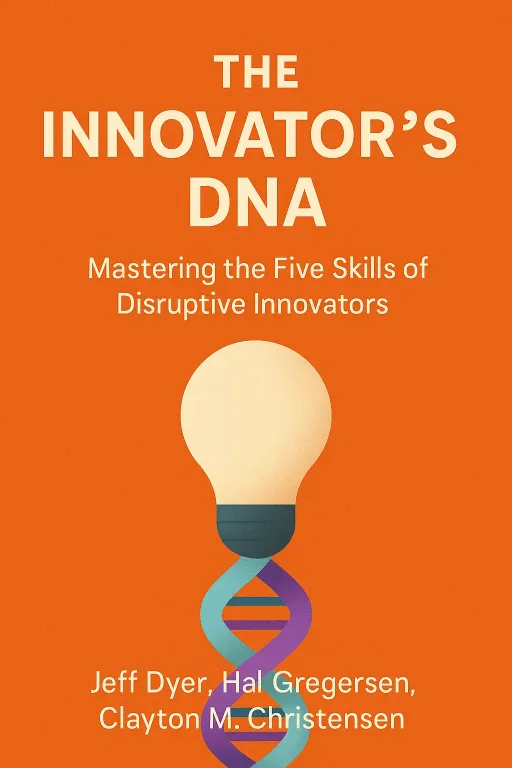
Nova: Absolutely. We're diving into two books that offer complementary blueprints for this. First, we're looking at "The Innovator's DNA" by Jeff Dyer, Hal Gregersen, and the legendary Clayton M. Christensen. You know, Christensen, whose work on disruptive innovation fundamentally reshaped how we think about market shifts and competitive advantage. This book distills years of research into five core discovery skills that he argues are the bedrock of innovation.
Atlas: And the other is "Jugaad Innovation," by Navi Radjou, Jaideep Prabhu, and Simone Ahuja. This one offers a powerful counterpoint, arguing that resourcefulness, flexibility, and cleverness are often the true engines of breakthrough ideas, particularly when resources are constrained. It challenges the notion that you need a massive budget to innovate.
Nova: Exactly. So, we have the internal engine of discovery skills and the external engine of resourceful execution. For anyone looking to optimize their career, fuel their ventures, or simply manage their time more effectively, these frameworks offer profound insights.
The Innovator's Palette: Cultivating Essential Discovery Skills
SECTION
Nova: Let's start with "The Innovator's DNA." The central premise here is that innovation isn't some mystical gift bestowed upon a select few. It's a set of observable, learnable, and improvable skills. Dyer and his colleagues identified five key "discovery skills" that distinguish innovators from their peers.
Atlas: Skills, you say? That’s music to the ears of the focused learner. So, what are these five pillars of innovative thinking?
Nova: They are: associating, questioning, observing, networking, and experimenting. Think of them as different tools in your innovation toolbox. Associating is about making connections between seemingly unrelated phenomena. Questioning is about challenging the status quo, asking "why?" and "what if?" Observing is about keen, detailed attention to the world around you. Networking is about connecting with diverse people and ideas. And experimenting is about prototyping, testing, and iterating.
Atlas: Okay, associating sounds particularly intriguing, especially given the "Tiny Step" takeaway. It feels like the spark that ignites everything else. But how does one associating? Is it just about reading a lot or being exposed to different things? Because for a pragmatic innovator, efficiency is key. We need actionable ways to cultivate this.
Nova: That’s a brilliant point, Atlas. Associating is indeed the spark. It’s the ability to connect questions, problems, or ideas in novel ways. Imagine a chef who can combine disparate ingredients – say, chili peppers and chocolate – to create something entirely new. Or a musician improvising a melody by weaving together familiar scales and rhythms in an unexpected sequence. That’s associating. It’s not just about consuming information; it’s about actively synthesizing it.
Atlas: So, it’s more than just passively absorbing. It’s about actively forging those links. For someone trying to optimize their career or build something new, how do we make this a conscious practice? If I’m in a role that doesn’t immediately scream "innovation," how do I build that associating muscle?
Nova: Great question. The authors suggest starting small. The "Tiny Step" we mentioned from the book content is perfect for this: "Today, practice 'associating' by finding one connection between a healthcare challenge and a data science solution you've encountered recently." This forces you to look at two distinct domains and find a bridge. It could be anything – noticing how patient data analytics could inform preventative care strategies in a specific disease, or how machine learning algorithms used in fraud detection might be adapted to identify anomalies in medical imaging.
Atlas: Ah, I see! So, it’s about deliberately seeking out those interdisciplinary connections. It’s not about waiting for a Eureka moment, but about creating the conditions for one. For the focused learner, this means setting aside just a few minutes, perhaps during a commute or a coffee break, to actively look for these bridges. It’s about turning passive observation into active synthesis. It makes the concept of "growth" feel much more tangible and less like an overwhelming marathon.
Nova: Exactly. And it’s not just about healthcare and data science. You could connect a challenge in urban planning with a solution from ecology, or a problem in education with a technique from game design. The more diverse the domains you draw from, the richer the potential associations. This deliberate practice builds that neural pathway, making you more adept at spotting opportunities and generating novel ideas, whether you’re building a business or optimizing your professional path. It’s about making your mind a more fertile ground for innovation.
Atlas: That’s incredibly empowering. It shifts the focus from needing a groundbreaking idea out of nowhere to cultivating the that generates those ideas. It feels very aligned with the "driven builder" mentality – you’re not waiting for inspiration; you’re actively building the capacity for it.
Jugaad Ingenuity: Resourceful Innovation for Maximum Impact
SECTION
Atlas: So Nova, we've talked about building our internal toolkit for discovery. But what happens when the external environment isn't providing the ideal ingredients? What if we're working with limited resources, tight budgets, or less-than-ideal circumstances? That's where "Jugaad Innovation" really shines, isn't it?
Nova: Absolutely, Atlas. "Jugaad" is a Hindi word that roughly translates to "frugal innovation" or "improvisation." It’s about finding clever, resourceful ways to solve problems and meet needs, often with limited resources. The authors, Radjou, Prabhu, and Ahuja, argue that this approach, born out of necessity in emerging markets, is actually a powerful model for innovation everywhere, especially for those of us who value efficiency and impact.
Atlas: This resonates so strongly with the pragmatic innovator profile. We don't always have the luxury of unlimited budgets or vast teams. How does this "Jugaad" philosophy actually work in practice? Is it about cutting corners, or is it about a fundamentally different way of thinking about problems and solutions?
Nova: It’s definitely not about cutting corners; it’s about resourceful ingenuity. It’s about doing more with less. The core principles are frugal, flexible, and inclusive. Frugal means getting the most value out of every resource—time, money, materials. Flexible means adapting quickly to changing circumstances. And inclusive means involving all stakeholders, including those who might traditionally be excluded, to co-create solutions.
Atlas: Can you give us a concrete example? Something that truly illustrates this principle of achieving significant impact with limited resources? Because for a driven builder, seeing that tangible outcome is crucial.
Nova: One of the most compelling examples is the Aravind Eye Care System in India. Founded by Dr. Govindappa Venkataswamy, or Dr. V, it revolutionized eye care. In a country where millions were going blind, and eye care was expensive and inaccessible, Dr. V envisioned a system that could provide high-quality eye surgery at an incredibly low cost.
Atlas: And how did they achieve that? Did they have some secret government funding or advanced technology nobody else had?
Nova: Not at all. Their innovation was systemic and deeply rooted in Jugaad principles. They adopted a high-volume, low-margin model, much like McDonald's or a car manufacturer. They streamlined processes, enabling surgeons to perform many more surgeries per day than typical Western hospitals. They focused intensely on efficiency, minimizing waste in materials and time. For instance, they designed their own surgical instruments and equipment, often adapting existing technologies. They also utilized a tiered pricing system: paying patients subsidized the care for those who couldn't afford it, making it inclusive.
Atlas: So, instead of trying to replicate the expensive, resource-intensive model of Western healthcare, they looked at the problem and said, "How can we achieve the —restoring sight—but with a completely different, resource-optimized approach?" That’s brilliant. It’s about innovating the itself, not just the technology.
Nova: Precisely. They didn't just innovate the surgery; they innovated the entire delivery model. They empowered nurses and technicians to handle many tasks, freeing up surgeons for complex procedures. They focused on rapid recovery and efficient patient flow. The result? They became one of the largest eye care providers in the world, performing tens of thousands of surgeries annually, many for free, while maintaining exceptionally high success rates. This is Jugaad innovation in action: achieving massive impact through resourcefulness, flexibility, and a deep understanding of local needs.
Atlas: That’s incredible. It’s a powerful reminder that constraint can be a catalyst. It forces you to be more creative, more efficient, and often, more impactful in the long run. For someone focused on career optimization or time management, this philosophy suggests that instead of complaining about limitations, we should see them as opportunities to innovate our own processes.
Nova: Exactly. And it complements the skills from "Innovator's DNA." You use your associating skills to see how a process from one industry might solve a problem in another, or how a piece of technology could be repurposed. You use your questioning skills to challenge existing assumptions about what's necessary. You use your experimental mindset to test frugal solutions without risking significant resources.
Synthesis & Takeaways
SECTION
Nova: So, we have these two powerful engines. On one hand, "The Innovator's DNA" gives us the internal toolkit—the cognitive skills like associating, questioning, observing, networking, and experimenting—that help us opportunities and novel solutions.
Atlas: And on the other hand, "Jugaad Innovation" provides the external framework—the philosophy of being frugal, flexible, and inclusive—teaching us to execute those discoveries effectively, especially when resources are scarce. They aren't competing ideas; they're deeply complementary. You need the skills to see the opportunity, and you need the resourceful mindset to bring it to life efficiently.
Nova: It’s the perfect synergy for the pragmatic innovator. You develop your capacity to connect disparate ideas, to challenge assumptions, and to observe keenly, and then you apply that with a Jugaad mindset to find the most efficient, impactful way to manifest those insights. This directly fuels growth, provides clarity on how to approach challenges, and drives tangible impact with optimized effort.
Atlas: Thinking about the "Tiny Step" again: practicing 'associating' today—finding that connection between a healthcare challenge and a data science solution—is actually the perfect micro-action that bridges both worlds, right? It’s building a discovery skill, and by looking for a connection, you’re inherently looking for a resourceful, potentially frugal, way to address a problem.
Nova: Precisely! It’s about making small, consistent efforts that build both your innovative capacity and your resourceful mindset. The growth recommendation to "embrace the journey" and realize "small steps build great things" is so vital here. Scheduling that 15 minutes daily for focused reading or practice isn't just about learning; it's about actively cultivating these engines of innovation and efficiency.
Atlas: For anyone listening who feels overwhelmed by the idea of innovation, or perhaps constrained by their current role or resources, this is an incredibly actionable takeaway. It’s not about a grand overhaul; it’s about the daily practice of connection and resourcefulness.
Nova: Ultimately, innovation is an inherent human capacity. When we consciously cultivate the skills to discover and the mindset to execute resourcefully, we unlock incredible potential for progress, not just in our careers or ventures, but in how we approach life itself.
Atlas: So, consider this your invitation. Think about a challenge you're facing right now, whether it's a professional project, a personal goal, or even a small daily hurdle. Where could applying just one of these "discovery skills," or seeking a more "Jugaad" approach to its solution, unlock progress?
Nova: This is Aibrary. Congratulations on your growth!