Deconstructing Modern Economic Paradigms
Golden Hook & Introduction
SECTION
Nova: Imagine for a moment that our entire economic system is a piece of software. It has been running for a few hundred years, it has some legacy code from the Industrial Revolution, and it has absolutely massive, unpatched security vulnerabilities. We keep trying to add plugins, but the core architecture is starting to glitch in ways that affect everyone’s daily life.
Atlas: That is a terrifying way to look at it, but it hits the nail on the head. Most people feel that glitch. They feel the friction between the promise of prosperity and the reality of their bank accounts. We are looking at two very different manuals for how to debug this system today.
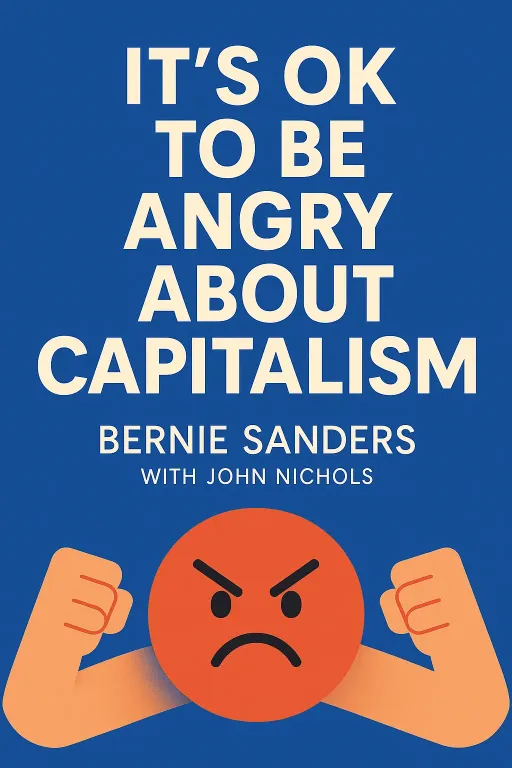
Nova: Exactly. We are diving into two distinct but deeply connected works. First, we have Bernie Sanders’s It’s OK to Be Angry About Capitalism. Sanders wrote this as a direct, no-nonsense manifesto, essentially distilling his decades of political advocacy into a single, cohesive argument against the oligarchy. It is raw, it is urgent, and it is unapologetic.
Atlas: And to provide the structural foundation for that conversation, we are pairing it with Michael Newman’s Socialism. While Sanders is the voice of the modern critique, Newman provides the historical, academic, and practical survey of what socialism actually looks like when you peel back the political shouting matches. It is a comprehensive look at the evolution of collective resource management.
Nova: Connecting these two gives us a complete picture. We have the moral imperative from Sanders and the structural history from Newman. Today, we are going to use these insights to build something practical. For the listeners who are tired of just analyzing, we are going to talk about how to apply these lessons to the projects you are building in your own communities.
The Hyper-Capitalist Paradox
SECTION
Atlas: Let’s start with the Sanders perspective. He frames the current hyper-capitalist structure as something that has fundamentally lost its way. He argues that we have prioritized corporate profit over human dignity. Now, I have to play the skeptic here. From an efficiency standpoint, capitalism has lifted more people out of poverty than any system in human history. How does Sanders account for that massive success while still calling for a complete overhaul?
Nova: That is the essential tension. Sanders does not deny the productive power of markets. Instead, he points to the distribution of that productivity. Think of it like a massive, high-powered engine. It generates incredible speed, but the design flaw is that the exhaust is being pumped directly into the cabin where the passengers are sitting. He argues that we have created a system where the pursuit of shareholder value—the quarterly report—has become the sole metric of success, completely ignoring the externalities.
Atlas: The externalities being the people, the environment, and the community resilience.
Nova: Exactly. When you optimize for one metric, like profit, you naturally degrade everything else that isn't being measured. Sanders highlights that in this hyper-capitalist model, human dignity—things like healthcare, education, and living wages—are treated as costs to be minimized rather than investments to be maximized. It is a design failure. If you are a builder, you know that if you build a bridge and you optimize only for the cheapest materials, the bridge eventually collapses. Sanders is saying the bridge is collapsing.
Atlas: That resonates with me. As someone who looks at systems, I see that constantly. We measure what is easy to count, not what is important. If we look at this through the lens of a project manager or a community leader, it is easy to fall into that trap. You want to get the project done on time and under budget, so you cut corners on the collaborative process, or you centralize decision-making because it is faster. You are essentially replicating that hyper-capitalist efficiency model on a micro-scale, right?
Nova: You hit on the exact point. We do it because it is the default setting. It is the path of least resistance. But Sanders suggests that by prioritizing that kind of speed and top-down control, we are stripping the participants of their agency. We are turning them into consumers of the project rather than architects of it.
Atlas: It makes me wonder about the cost of that speed. If you build a community initiative and you exclude the people it serves from the decision-making process, you might get the project launched, but do you actually have buy-in? Do you have a system that can sustain itself when the initial funding or energy runs out?
Nova: That is the million-dollar question. And that is where the distinction between a project that survives and a project that thrives becomes clear. If you treat participants as resources to be managed, they will eventually leave or disengage. If you treat them as stakeholders with democratic power, you build an asset that grows on its own.
The Socialist Spectrum
SECTION
Atlas: This brings us to Michael Newman’s perspective. If Sanders is identifying the problem, Newman is pulling the archives of history to show us that there are other ways to organize. When I hear the word socialism, my brain immediately goes to the political spectrum, the Cold War, and government bureaucracy. But Newman seems to argue that it is much more about resource management than state control.
Nova: That is a vital distinction. Newman’s work is fascinating because he traces the evolution of socialist thought from utopian ideas to practical models of collective ownership. He strips away the baggage of the 20th century to show that at its core, this is about how we manage the "commons." It is about asking: who owns the resources, and who decides how they are used?
Atlas: I like that framing. It is less about ideology and more about governance. If we are looking at this from a systematic architect’s point of view, it is a question of architecture. How do you design a system where resources are distributed in a way that serves the collective rather than the few?
Nova: Newman walks us through various models—cooperatives, syndicates, public ownership, and worker-managed enterprises. He shows that these aren't just theoretical musings. These are operating systems. Some of them are highly decentralized. Think about a local credit union or a community land trust. Those are, in essence, socialist structures functioning within a capitalist economy. They manage resources democratically.
Atlas: That is a concrete example. A credit union is a great bridge. It is owned by its members. The profits are reinvested into the members' services, not siphoned off to external shareholders. It is a perfect micro-example of what Newman is describing. It is efficient, but the objective function of the system is different. Instead of maximizing profit, it maximizes member utility.
Nova: Precisely. And that is the shift we need to make in our thinking. We tend to view these economic models as binary—you are either in a capitalist box or a socialist box. But Newman’s analysis suggests we should be looking at the toolbox. We can take the democratic governance structures from socialist theory and apply them to the projects we build today. You can have a project that is agile and innovative, but governed by the people it serves.
Atlas: I see how that connects back to the Sanders critique. Sanders is pointing out that the current "profit-only" software has bugs. Newman is saying, "Here is a library of alternative code you can use to rewrite the subroutines."
Nova: That is a brilliant analogy. You are essentially proposing that we can use these cooperative models to patch the holes in the hyper-capitalist system.
Architecting Democracy
SECTION
Atlas: Let’s get granular. I want to talk about the takeaway here. We have this idea of prioritizing dignity and using democratic resource management. If I am running a community development program—let’s say we are trying to revitalize a local park or launch an education initiative—how do I actually implement this? How do I move from theory to a structural blueprint?
Nova: The first step is to shift your definition of success. In a standard project, success is "Did we finish on time, on budget, and did the stakeholders sign off?" In a democratic, equitable model, success is "Did the participants gain agency, and is the project sustainable through their collective input?"
Atlas: That sounds good in a mission statement, but it is hard to do in practice. If you have a hundred people involved in a decision, you get gridlock. That is the classic argument against democracy in business. How do you maintain efficiency while ensuring equitable decision-making?
Nova: You have to build the structure for it. You don't just put everyone in a room and ask for opinions. That is chaotic. You use something like a council or a working group model. You delegate authority to teams, but those teams are accountable to the broader community. You create transparency. If people can see the data, see the budget, and see the decision-making process, they don't need to be involved in every micro-decision. They just need to know the system is fair.
Atlas: That makes sense. It is about modular design. You have a core, transparent governing body, but you empower autonomous teams to execute. It reminds me of the "sociocracy" model, where consent is prioritized over consensus. You don't need everyone to love the idea; you just need to ensure that the decision doesn't cause harm to the system.
Nova: Exactly. And that is a very socialist principle in practice—the idea of subsidiarity. Problems should be solved at the most local level possible. You don't need a central authority dictating what a local park needs. You need the people who live next to the park to have the budget and the power to design it.
Atlas: I am thinking about the "Systematic Architect" profile here. This person wants to build things that last. If you want a project to be resilient, you have to build in redundancy and distributed power. If the leader leaves, the project shouldn't collapse. By democratizing the decision-making, you are essentially decentralizing the risk.
Nova: That is the most pragmatic argument for this approach. It is not just about ethics; it is about risk management. If one person holds all the keys, that is a single point of failure. If the community holds the keys, the project is robust. It can withstand the departure of a founder, changes in funding, or shifts in the political landscape.
Atlas: That is a powerful realization. It shifts the conversation from "being nice" to "being strategic." You are not democratizing your project because it feels good; you are doing it because it is the only way to build a system that is future-proof.
Synthesis & Takeaways
SECTION
Nova: We have covered a lot of ground today. We started with the systemic glitches in our current economic software, moved through the historical toolbox of alternative governance, and landed on a practical, architectural approach to community building.
Atlas: What I am taking away is that we have to be intentional. We cannot just default to the standard, hyper-capitalist "top-down" model because it is easy. We have to design for democracy. We have to build in the structures that allow for equitable participation, not as an afterthought, but as the core framework.
Nova: It is about recognizing that every project, no matter how small, is a microcosm of the society we want to live in. If we build projects that are authoritarian and opaque, we are reinforcing those values. If we build projects that are transparent, democratic, and dignity-focused, we are actively constructing a new reality.
Atlas: That is the call to action for our listeners. Pick one initiative you are currently working on. It could be a neighborhood group, a workplace committee, or a volunteer project. Look at the decision-making flow. Is it centralized? Is it opaque? Then, ask yourself: what is one specific structural change I can make to give the participants more agency? Can you create a transparent budget? Can you rotate leadership roles? Can you implement a feedback loop that actually impacts the strategy?
Nova: It starts with one hour of deep work. Don't just collect information; implement a change. Take one piece of this "socialist" or "equitable" framework and test it. See what happens when you give power away. You might be surprised at the resilience you gain in return.
Atlas: I love that. It is the perfect challenge for the Systematic Architect. Build the system, but build it for the people.
Nova: It has been a pleasure diving into these ideas with you. We hope this has sparked some critical thinking and, more importantly, some structural change in your world.
Atlas: Remember, the best systems are the ones that serve the community, not the ones that just extract value.
Nova: This is Aibrary. Congratulations on your growth!