Navigating Grief and Reclaiming Existential Trust
Golden Hook & Introduction
SECTION
Nova: We treat our lives like a broken software update. If something goes wrong, we look for the patch, the workaround, or the quick restart. We want to optimize the pain away and get back to peak performance. But what if the most important parts of your human experience are not bugs to be fixed?
Atlas: That is a dangerous thought. It sounds like you are suggesting we should just sit in the mess rather than cleaning it up. I have spent my entire career treating problems as things to be solved, not things to be sat with. If I stop fixing, I feel like I am just drifting.
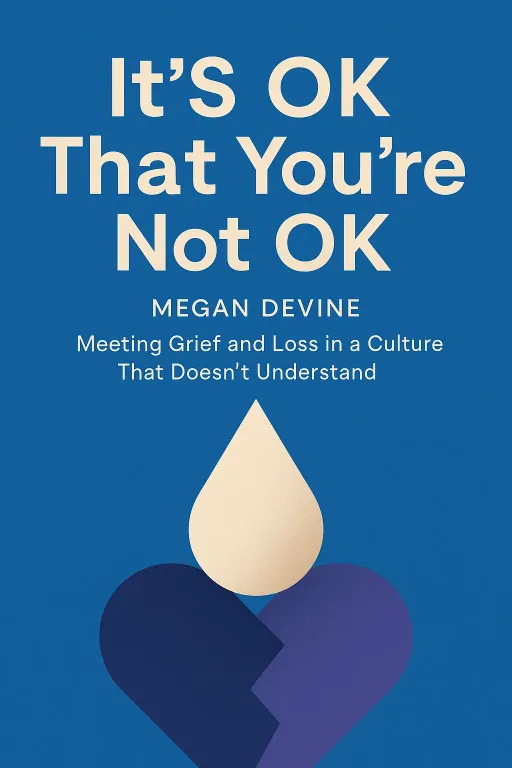
Nova: That is exactly the tension we are navigating today. We are looking at two books that seem like they come from different planets, but they actually hold the same map. We are talking about It’s OK That You’re Not OK by Megan Devine, and The Universe Has Your Back by Gabrielle Bernstein.
Atlas: Those two sound like an odd pairing. One is about the hard, gritty reality of grief, and the other is about spiritual alignment. How do you reconcile those?
Nova: It is easier than you think. Megan Devine is a therapist who wrote her book after the sudden, accidental death of her partner. She realized that everything she had been taught about grief—the stages of grief, the idea of moving on, the need to be positive—was actually making her suffering worse. And Gabrielle Bernstein, who has built a career on helping people transition from fear to trust, is essentially talking about the same thing: the exhaustion of control.
Atlas: I see the connection now. One is about the reality of the pain, and the other is about the fear of the future. Let’s break this down. Where do we start?
The Trap of Fixing Grief
SECTION
Nova: We start with the Myth of the Fix. Devine argues that our culture is obsessed with pathologizing grief. We treat it like a disease, something that needs to be cured or managed so we can get back to being productive, happy, and normal.
Atlas: But isn't that the goal? When I hit a wall, I want to know how to get over it. If I am grieving a loss, or even just dealing with a massive professional setback, I want to know the steps to recover. Are you saying that searching for those steps is actually the problem?
Nova: In a way, yes. Think about it this way. If you break your leg, you don't go to a doctor who tells you to just think positively and your bone will knit back together. You don't try to "fix" the leg by running on it to prove how strong you are. You treat the injury, you rest, and you accept the reality of the broken bone. Devine says grief is a reality, not a problem to be solved. When we try to "fix" grief, we are essentially trying to rush the healing process, which just adds a layer of secondary suffering on top of the initial pain.
Atlas: That resonates with me, especially in high-pressure environments. We are conditioned to think that if you are down, you are failing. So, we put on this mask of strength. We try to "fix" our emotional state with productivity or forced optimism. But what does Devine suggest we do instead? If we aren't fixing, are we just supposed to collapse?
Nova: It is the opposite of collapsing. It is about active presence. She talks about the difference between pain and suffering. Pain is the raw, difficult emotion of the event itself. Suffering is the extra layer of pain we create by resisting the reality of that event. When you stop trying to fix the pain, you actually gain the energy you were wasting on the resistance.
Atlas: That is a massive shift in perspective. It sounds like you are describing a form of radical honesty with yourself. Instead of saying, "I am fine, I will get over this," you just acknowledge, "This is incredibly difficult, and I am not okay right now."
Nova: Exactly. And that acknowledgment is the most powerful tool you have. It is not about wallowing. It is about dropping the burden of pretending. When you stop using your energy to maintain the facade of being "okay," you suddenly have that energy available to actually process what is happening. It is the difference between fighting a current and learning how to swim in it.
Atlas: I can see how that applies to more than just death or tragedy. I imagine our listeners who are dealing with a career shift, a failed project, or a major life pivot feel this pressure to "bounce back" immediately. Devine’s point is that the bouncing back is actually the thing that keeps you stuck.
Nova: That is a perfect way to put it. The rush to return to normal is often a flight from the present. We are so terrified of the weight of heavy emotions that we try to bypass them. But emotions don't have an "off" switch. They have a "through" switch. You have to go through them to get to the other side.
The Architecture of Trust
SECTION
Atlas: Okay, I am with you on the grief part. It makes sense to stop fighting the reality of the situation. But that leads me to the second book, Gabrielle Bernstein’s The Universe Has Your Back. If I am sitting in the reality of a difficult situation, how do I keep from spiraling into anxiety? How do I move from that raw honesty into a place of trust?
Nova: This is where Bernstein acts as the perfect counterpoint to Devine. While Devine helps us anchor in our current reality, Bernstein helps us navigate the fear of the future. She talks about the shift from hyper-vigilance to trust.
Atlas: I know hyper-vigilance. That is my default setting. It is that feeling that if I don't micromanage every detail, check every email, and predict every outcome, the whole system will collapse. It is exhausting, but I tell myself it is the only way to be successful.
Nova: That is the illusion of control. Bernstein points out that hyper-vigilance is based on the belief that you are the only one steering the ship. It is a very lonely and anxious way to live. She suggests that we are operating under the assumption that if we aren't constantly worried, we aren't doing our job. But what if that constant worry is actually blocking your best performance?
Atlas: That sounds like a trap. If I let go of the control, won't I just become passive? That is the fear. If I trust that things will work out, I might stop pushing, I might stop striving, and then I will definitely fail.
Nova: That is the common misconception. Trust is not passivity. Trust is a shift in your internal state. Think about it like this: there is a difference between working hard because you are driven by a vision, and working hard because you are driven by the fear of catastrophe. Bernstein argues that when you are driven by fear, you are essentially vibrating at a frequency of lack. You are attracting more reasons to be anxious.
Atlas: I am skeptical of the "vibrating at a frequency" language, but I understand the psychological principle. If I am making decisions based on fear, I am probably making defensive, short-sighted choices. I am playing not to lose, rather than playing to win.
Nova: Exactly. And that is where the "Universe" concept comes in. You don't have to call it the Universe if that terminology doesn't fit your worldview. You can call it "systems," "the market," "the outcome," or "the collective." The point is to recognize that you are not in total control of the outcome. You are only in control of your alignment with your values and your actions.
Atlas: So, it is about detaching from the specific outcome while maintaining high standards for the process.
Nova: Yes. That is it. It is the ability to say, "I am going to put my best work into this project, but I am not going to tie my internal worth or my peace of mind to whether this specific project succeeds or fails." That is the transition from control to trust.
Atlas: That is incredibly difficult to do in practice. Especially when the stakes are high. How does Bernstein suggest we actually make that switch?
Nova: She uses meditation and positive reframing. It is about catching yourself in the moment of hyper-vigilance. When you feel that tightening in your chest, that need to check your phone one more time, that urge to force a result—that is your cue. You pause. You acknowledge the fear. And then you consciously choose a different thought. It is a practice. Just like building a muscle.
Atlas: So, it is a two-step process. Devine gives us the tools to handle the present pain—the "I am not okay" part—and Bernstein gives us the tools to handle the future fear—the "I trust the process" part.
Synthesis & Takeaways
SECTION
Nova: Precisely. You cannot get to the trust if you haven't first allowed yourself the grief of the situation. You can't skip the "not okay" part to get to the "Universe has my back" part. That is just spiritual bypassing. You have to be willing to be in the mud before you can look at the stars.
Atlas: That is a powerful synthesis. If I am trying to manifest a positive outcome while I am secretly terrified and holding onto grief or resentment, I am just building on a cracked foundation.
Nova: And that is why these two books are so valuable when read together. Devine teaches us the courage to feel, and Bernstein teaches us the courage to surrender. Both require a level of vulnerability that most high-achievers find terrifying.
Atlas: It really comes down to efficiency, doesn't it? If I am wasting 50% of my mental bandwidth on resisting my current reality and 50% on fearing the future, I have zero bandwidth left for actual work.
Nova: That is the most pragmatic way to look at it. Resistance is a massive energy drain. When you accept your current state—whether it is grief, failure, or just a bad day—you reclaim that energy. When you choose trust over hyper-vigilance, you free up your cognitive resources for creative problem-solving instead of defensive posturing.
Atlas: I like this. It is not about being passive or "woo-woo." It is about strategic emotional management. It is about optimizing your internal state so you can actually perform at your best.
Nova: Exactly. The takeaway for our listeners who are focused on growth and efficiency is this: Give yourself permission to feel heavy emotions without immediately trying to 'fix' them. That is the Devine lesson. Then, use that clarity to move from a place of hyper-vigilant control to a place of aligned trust. That is the Bernstein lesson.
Atlas: It sounds simple, but I know it is going to be a daily practice. It is about checking in with myself. Am I fighting the current, or am I swimming with it?
Nova: And remember, the goal isn't to be perfectly calm or happy all the time. The goal is to be authentic. When you are authentic, you are aligned. And when you are aligned, you are much more effective than you could ever be while you are fighting your own reality.
Atlas: That is a great note to end on. It is not about being a robot that doesn't feel; it is about being a human who knows how to process.
Nova: We hope this helps you reclaim some of that wasted energy. It is time to stop the internal war and start building from a place of clarity.
Atlas: Absolutely. This was a great breakdown of two very different, but complementary, approaches to navigating life’s toughest moments.
Nova: This is Aibrary. Congratulations on your growth!