

Navigating Grief and Anxiety with Radical Compassion
Golden Hook & Introduction
SECTION
Nova: If you try to build a skyscraper on a foundation of sand, the whole structure eventually collapses. We spend so much energy trying to fix the cracks in our lives, trying to smooth over the grief or silence the anxiety, that we never stop to realize the foundation itself might just need a different kind of support.
Atlas: That is a brutal reality check, but it feels accurate. We are obsessed with optimization. We want to patch the wall and keep the project moving, but sometimes the structural integrity of our own headspace is compromised because we are fighting the wrong battle.
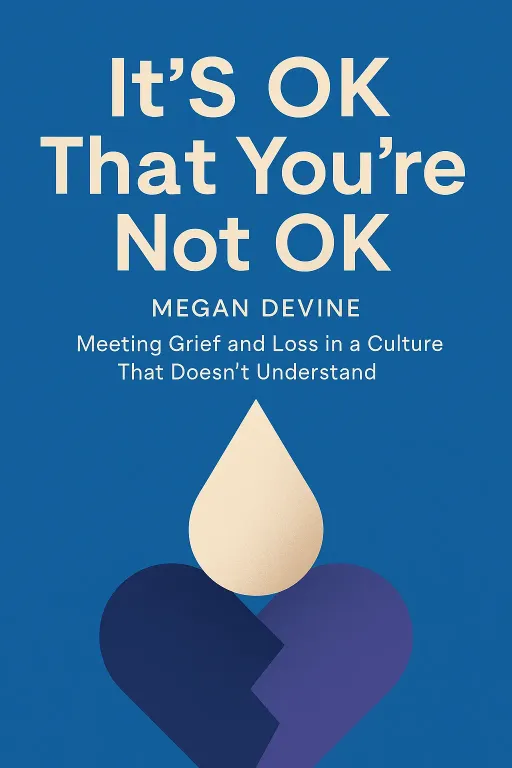
Nova: Exactly. We treat our internal lives like a project that needs a quick fix. Today, we are looking at two essential blueprints for handling that pressure. We are diving into the wisdom of Megan Devine’s book, It’s OK That You’re Not OK, and balancing it with the practical frameworks found in Max Lucado’s Anxious for Nothing.
Atlas: I have seen both of those titles everywhere. Devine’s work really shifted the conversation on how we talk about loss, and Lucado has been a staple for anyone trying to navigate high-stress environments without losing their mind.
Nova: It is a fascinating combination. Devine comes from a background as a therapist who experienced her own profound personal tragedy, which gave her a very raw, unfiltered lens on grief. She challenges the cultural obsession with moving on. Then you have Lucado, who draws on deep historical and spiritual frameworks to offer a guide for quieting a racing mind. Together, they offer a way to handle the overwhelm that we all face, whether it is from a major life setback or just the daily grind of a high-stakes career.
The Architecture of Grief
SECTION
Atlas: Let’s start with the grief piece. I am curious, because the common advice is always, stay positive, look for the silver lining, fix the problem. Devine argues against that, right? She says that’s actually destructive.
Nova: She does. She calls it the myth of fixing. Think about it like an architectural flaw. If you have a deep structural issue in a building, you cannot just paint over it and pretend the wall is solid. Devine argues that grief is not a pathology. It is not a disease you catch and then recover from. It is a reality you have to inhabit. When we tell someone to just look on the bright side, we are effectively telling them that their current reality is invalid.
Atlas: That makes sense. It is like telling a project manager who just lost a massive client that they should just focus on the next deal. It ignores the fact that the loss happened. It ignores the impact on the team. But if we stop trying to fix it, what is the alternative? Does that mean we just sit there and wallow?
Nova: That is the fear, isn't it? But the alternative is what she calls witnessing. It is about acknowledging the reality of the situation without the immediate urge to solve it. When you witness something, you are saying, I see the damage, I see the weight of this, and I am not going to minimize it by trying to rush you through it. It is about creating a space where the experience can just be, without the pressure of a deadline or an outcome.
Atlas: I can see how that is hard for a lot of people, especially those of us who are wired to build and improve things. If I am in a state of pain, my instinct is to immediately start drafting a plan to get out of it. You are saying that the plan itself might be the barrier to processing the emotion.
Nova: Precisely. The plan is a defense mechanism. It is a way to maintain control. When you are in the thick of a setback, you feel a loss of control. The desire to fix it is your brain trying to reclaim the steering wheel. Devine’s point is that the steering wheel is broken, and that is okay. You don't need to drive right now. You just need to exist in the space you are in. It is a radical shift from being a fixer to being a witness, both for others and for yourself.
Atlas: That sounds like a massive shift in mindset. Instead of asking, how do I get back to normal, the question becomes, how do I inhabit this new reality?
Nova: Exactly. And that is where the growth happens. If you skip the witnessing phase, you are just building on top of unresolved tension. You are essentially creating a building with a weak core that is going to crack again the moment the pressure increases.
The Framework of Anxiety
SECTION
Atlas: Okay, so grief is about witnessing the reality of the past or the loss. But what about the anxiety that comes from the future? That is where Lucado’s work comes in, right? He focuses on the racing mind.
Nova: That is the perfect pivot. If Devine is about the weight of what has happened, Lucado is about the noise of what might happen. His approach in Anxious for Nothing is about establishing cognitive routines. He argues that anxiety thrives in a chaotic, unmanaged mental environment. He suggests that we need to build frameworks—mindfulness, prayer, historical wisdom—to create a stable environment for our thoughts.
Atlas: I like the idea of a cognitive framework. It sounds like a set of standard operating procedures for the brain. When I am stressed, my thoughts usually spiral into worst-case scenarios. It is like a runaway feedback loop. Lucado is suggesting we can interrupt that loop with specific, intentional actions?
Nova: He is. He emphasizes that the mind is a garden, or in our architectural terms, a site that requires constant maintenance. If you leave a site unmanaged, weeds take over. He advocates for what he calls the calm approach, which is really about taking every thought captive and evaluating it. It is not about suppressing the thought; it is about examining it and deciding whether it deserves a place in your mental structure.
Atlas: That is a crucial distinction. I used to think mindfulness meant clearing your head of all thoughts, which sounds impossible for anyone who has a busy job. But what you are describing is more like a quality control process. You are filtering the thoughts that come in.
Nova: Yes, and that is the key. You become the architect of your own cognitive space. Lucado talks about the importance of gratitude and prayer, or for a secular audience, reflection and perspective-taking. These are the load-bearing supports. When you focus on what is true, what is noble, and what is right, you are reinforcing the structure. It gives you a place to stand when the storms of anxiety hit.
Atlas: I can see how that connects to the efficiency mindset. We are always looking for ways to optimize our workflow. Why not optimize our internal workflow? If I can build a routine that catches those anxious thoughts before they become a full-blown panic, that is a huge gain in productivity and well-being.
Nova: It is the ultimate productivity hack. When your mind is clear, your output is better. When you are constantly fighting an internal fire, you have no bandwidth for the work you are actually trying to do. Lucado’s framework isn't just about feeling better; it’s about functioning at a higher capacity because you aren't wasting energy on unnecessary mental cycles.
Integration and the Tiny Step
SECTION
Atlas: So, we have Devine saying, witness your pain, don't rush to fix it, and Lucado saying, manage your mind with intentional routines to prevent the noise from taking over. How do we put these two together? They seem slightly different in their approach. One is about slowing down and feeling, the other is about managing and organizing.
Nova: They are actually two sides of the same coin. Devine handles the emotional foundation, and Lucado handles the cognitive structure. You need both. You need to be able to sit with your grief when it hits, and you need to be able to manage your anxiety when it spirals. The bridge between them is the ability to pause.
Atlas: The pause. I imagine that is harder than it sounds.
Nova: It is. It is the hardest thing to do when you are in the middle of a high-pressure situation. But that leads us to the actionable takeaway here. The Tiny Step. When you feel that overwhelm, when the anxiety spikes or the setback hits, you don't need a ten-point plan. You need two minutes.
Atlas: Just two minutes? That seems manageable. What do I do in those two minutes?
Nova: You pause and you say to yourself, It is okay that I am feeling this way right now. That is it. You acknowledge the feeling. You allow it to exist. You don't try to solve it. You don't try to fix it. You don't try to suppress it. You just let it be there for 120 seconds.
Atlas: It sounds simple, but I can see the resistance. My brain would immediately say, two minutes is too long, we need to get back to work. But if I don't take those two minutes, I am just carrying that tension forward into the next hour, and the next, and it just compounds.
Nova: Exactly. It is the difference between a controlled release and a structural failure. By giving yourself that two-minute window, you are essentially letting the pressure valve release. You are witnessing your own state, like Devine suggests, and you are creating a moment of calm, like Lucado suggests. It is a way to reset your baseline.
Atlas: I like that. It is a maintenance protocol for the human system. Instead of waiting for a total system crash, you are doing regular, tiny, preventative maintenance.
Nova: That is a great way to put it. We maintain our buildings, our cars, our software, but we rarely maintain ourselves with the same level of intentionality. This two-minute rule is just the start. It is a way to build the habit of self-awareness.
Atlas: I am definitely going to try this. It feels like the kind of thing that seems too simple to work, which usually means it is exactly what I need. It is about the discipline of the pause.
Nova: It is. And it is about trusting the process. You are not going to solve every problem in two minutes, but you will change the way you relate to those problems. And that is where the real growth happens.
Atlas: This has been a great synthesis. We often think we have to choose between being emotional and being logical, but this shows we need both. We need the emotional intelligence to witness our pain and the cognitive discipline to manage our minds.
Nova: That is the ultimate goal. To build a life that is resilient, not just because it is strong, but because it is flexible. You can handle the weight of the grief, and you can navigate the noise of the anxiety, because you have the tools to do both.
Atlas: I appreciate that framing. It makes the whole concept of self-improvement feel a lot more grounded, a lot less like a frantic search for the next hack, and more like the careful, intentional work of building a life that actually lasts.
Nova: That is exactly it. It is not about the quick fix. It is about the long-term integrity of who you are. And that starts with just giving yourself permission to be exactly where you are, for just a couple of minutes.
Atlas: I think that is a great place to leave our listeners. A challenge to build that pause into their day.
Nova: Absolutely. It is the most important part of the blueprint. Thank you for joining us in exploring these ideas. It is a journey, and every step counts.
Atlas: And remember, the structure of your life is up to you. Keep building with intention.
Nova: This is Aibrary. Congratulations on your growth!









