

German History Through a New Lens: Beyond the Textbook
Golden Hook & Introduction
SECTION
Nova: Okay, Atlas, hit me with it. Give me five words for Christopher Clark's "Iron Kingdom." What comes to mind immediately?
Atlas: Five words, huh? Brutal, brilliant, bewildering, foundational, and profoundly misunderstood.
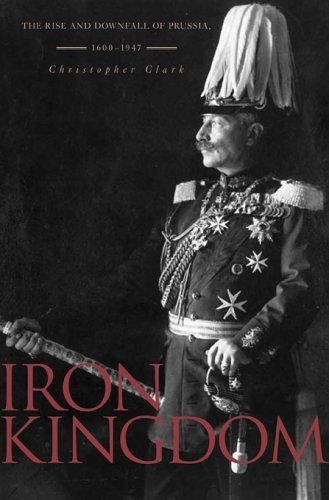
Nova: Oh, "misunderstood"—that's a strong one, and I think it perfectly captures why we need to talk about this book today. We're diving into a monumental work, "Iron Kingdom: The Rise and Downfall of Prussia, 1600-1947" by Christopher Clark. Clark is renowned for his ability to unearth the hidden complexities of historical narratives, often challenging long-held assumptions, and this book is a prime example of his meticulous scholarship.
Atlas: "Misunderstood" resonated because, for many, Prussia is just synonymous with rigid militarism, right? It’s the iron fist, the goose step, Bismarck. When you talk about "simplistic interpretations," is that what we're typically missing?
Nova: Absolutely. That simplistic view is precisely what Clark meticulously deconstructs. He takes this state, often seen as a one-dimensional, aggressive military machine, and reveals it as an incredibly complex, dynamic entity that was, for centuries, a crucible of Enlightenment ideas, administrative innovation, and even surprising religious tolerance.
The Prussian Paradox - Complexity Beyond Simplistic Narratives
SECTION
Nova: Think about the name itself: "Iron Kingdom." It conjures images of steel and discipline. But Clark shows us that the "iron" wasn't just about military might; it was also about the iron will required to forge a state out of disparate territories, often with diverse populations and competing interests. It was a bureaucratic marvel, a state built on rational administration, public education, and a surprisingly modern civil service, long before many of its European counterparts.
Atlas: So, it's not simply a tale of conquest and military power. It’s also about what held it together, the internal mechanisms. Can you give us an example of this complexity, something that challenges that "iron fist" stereotype?
Nova: Certainly. Consider Frederick the Great, often portrayed as the quintessential enlightened despot and military genius. While his military campaigns were indeed transformative, Clark also highlights his deep engagement with philosophy, his patronage of the arts, and his reforms that included abolishing torture and promoting religious freedom for Protestants, Catholics, and even Jews. This wasn’t just a brutal warrior king; it was a figure grappling with the intellectual currents of his age, attempting to build a modern state on principles that were radical for the 18th century.
Atlas: That’s fascinating because it forces us to look beyond the caricature. It makes me wonder, how did a state that embraced such progressive ideas also become the bedrock for later, much darker chapters in German history? How do we reconcile those two images?
Nova: That's the core paradox Clark explores. Prussia’s legacy is undeniably dual-edged. Its efficiency, its emphasis on duty, its strong state apparatus – these were elements that could be and eventually were co-opted and distorted by later regimes. But Clark’s work encourages us to see the origins of these traits not as inherently malevolent, but as products of their time, evolving from pragmatic state-building efforts. It’s about understanding the of history, not just the outcome.
Atlas: It’s like understanding the DNA of a nation, realizing that even the most seemingly rigid structures have deeply complex and often contradictory roots. That sounds incredibly valuable for anyone trying to visually represent history, to avoid those flat, one-dimensional depictions.
Nova: Exactly. It’s about seeing history not as a straight line, but as a tangled web, where threads of progress and reaction are interwoven. And this complexity becomes even more vivid when we consider how these narratives, and political events, are expressed visually.
Visual Culture as a Political Mirror - Weimar vs. Third Reich
SECTION
Nova: So, let's pivot from the foundational "Iron Kingdom" to a period where Germany’s internal struggles were dramatically externalized through its visual culture: the Weimar Republic and the Third Reich. If Prussia gave us the blueprint for German statehood, these periods showed us how that state, and its people, themselves and how they were their world.
Atlas: "Made to see"—that’s a powerful phrase. What exactly do you mean by "visual culture" in this context? Are we talking about art, propaganda, architecture? How does that reflect and influence politics?
Nova: All of the above, and more! Visual culture encompasses everything from fine art and architecture to everyday objects, public spectacles, and propaganda posters. In the Weimar Republic, after the trauma of World War I, you saw an explosion of artistic experimentation. Think Expressionism, Bauhaus design, Dadaism. This visual landscape was chaotic, vibrant, often critical, and deeply reflective of the new, fragile democracy and the social upheaval. Artists were grappling with modernity, disillusionment, and a desperate search for new meaning.
Atlas: Can you give us a concrete example of a Weimar visual that speaks to its political climate? Something that really captures that era?
Nova: Absolutely. Consider the works of Otto Dix or George Grosz. Their art was often grotesque, satirical, and fiercely critical of the social conditions, the lingering militarism, and the political corruption of the time. They painted a Germany that was raw, damaged, but also fiercely alive with intellectual and artistic energy. Their visual storytelling wasn't just aesthetic; it was a direct political commentary, often unsettling, reflecting the anxieties and freedoms of the Weimar era.
Atlas: So, the visual chaos reflected the political and social chaos. What happens when we jump to the Third Reich? I imagine it’s a stark contrast.
Nova: It's a complete inversion. The Third Reich understood the immense power of visual culture to narratives and consent. They purged anything deemed "degenerate art" – much of what defined Weimar’s visual output. In its place, they imposed a rigid aesthetic: monumental neoclassical architecture, heroic realism in painting and sculpture depicting idealized Aryan figures, and massive, meticulously choreographed rallies.
Atlas: That's a huge shift from critical expression to enforced uniformity. Was it just a reflection of their ideology, or did this visual culture actively public perception and political events? Did it influence people's actual beliefs?
Nova: It absolutely did both. The visual culture of the Third Reich wasn't just a backdrop; it was a weapon. The grand scale of their architecture was designed to dwarf the individual, to evoke a sense of awe and submission to the state. The heroic sculptures projected an image of racial purity and strength, reinforcing their eugenicist ideologies. The rallies, with their banners, symbols, and synchronized movements, were carefully crafted spectacles intended to create a powerful emotional experience, fostering a sense of collective identity and unwavering loyalty. It was an immersive propaganda machine designed to make people the power and righteousness of the regime, influencing their consent and participation.
Atlas: It’s chilling how effectively visuals can be used to manipulate. For someone who wants to tell stories visually and understand design for impact, this is a stark lesson in how powerful that impact can be, for good or ill.
Nova: Precisely. It shows that visual literacy isn't just about appreciating art; it's about critically understanding how images, symbols, and aesthetics are used to convey messages, solidify power, and shape our perception of reality.
Synthesis & Takeaways
SECTION
Nova: So, whether we're looking at the complex origins of Prussia or the visual battlegrounds of Weimar and the Third Reich, the common thread is the profound importance of looking beyond the surface. History isn't just a collection of dates and names; it's a dynamic interplay of human experience, political forces, and cultural expression, often profoundly articulated through visuals.
Atlas: And for those of us who want to bring history to life, who are trying to connect the past to the present, understanding these nuances and the power of visual culture is crucial. It helps us avoid oversimplification and truly grasp the depth of historical events.
Nova: Exactly. By using a "new lens" to examine German history, as Christopher Clark does with Prussia, or by dissecting the visual narratives of different eras, we develop a deeper appreciation for history's complexity. It empowers us to recognize when narratives are being simplified or manipulated, whether in historical accounts or even in the political landscape of today. Visual literacy in history empowers us to understand not just what happened, but it was presented, and crucially, it mattered then and still matters now.
Atlas: That’s a powerful thought to leave with. So, the question for our listeners is: What historical narrative have you accepted at face value, and what might you uncover if you started looking at it through a new, more visually attuned lens?
Nova: This is Aibrary. Congratulations on your growth!