Beyond the Algorithm: The Human-Centric AI Design Principle
Golden Hook & Introduction
SECTION
Nova: Atlas, I want five words. Give me your five-word review of an AI system that's been poorly designed.
Atlas: Oh, man. "Frustrating, confusing, useless, annoying, quit."
Nova: Oh, I love that. "Quit." That's the ultimate condemnation, isn't it? Because we've all been there. We've all encountered that piece of technology, or now, that AI, where you just throw your hands up and say, "I'm out."
Atlas: Absolutely. It's like, you promise me the moon, but then you hand me a wrench and expect me to build my own rocket.
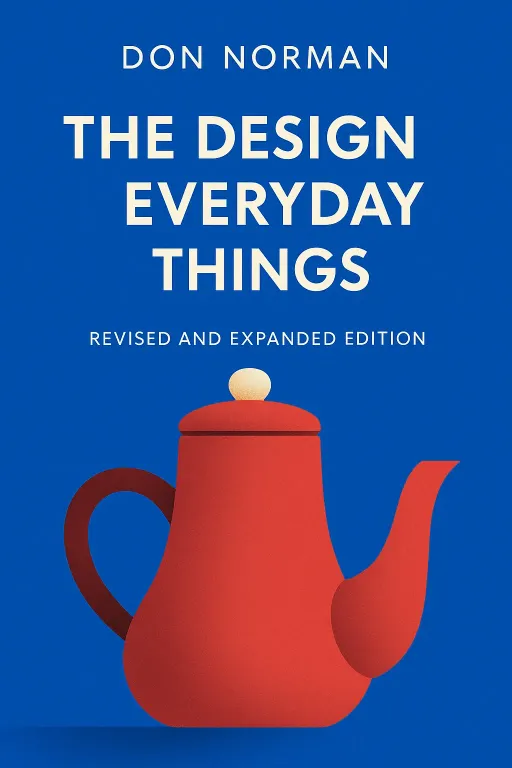
Nova: Exactly! And that perfectly sets the stage for today because we're diving into the fascinating intersection of human experience and artificial intelligence. We're drawing inspiration from the timeless wisdom of Don Norman's "The Design of Everyday Things" and the crucial insights of Caroline Criado Perez's "Invisible Women." Norman's work, originally published decades ago, almost single-handedly launched the field of user-centered design, making him a household name in product development long before AI was even a glimmer in anyone's eye. He fundamentally shifted how we think about the objects we interact with daily.
Atlas: That makes sense. It’s like, he taught us to look at a door handle and ask, "Why can't I figure this out?" instead of blaming ourselves.
Nova: Exactly. And that human element is precisely where so much of our current AI development hits a critical "blind spot."
The Blind Spot: Technical Marvel vs. Human Experience
SECTION
Nova: We are so captivated by the sheer technical marvel of AI – the ability to generate text, create images, predict patterns – that we often overlook the most fundamental question: how does a human interact with this? We prioritize the algorithm's power over the user's intuitive experience, and that creates friction, not fluid interaction.
Atlas: That sounds rough, but I can see how that would be a common trap for developers. There's so much pressure to push the boundaries of what AI do. But what do you mean by this "blind spot" leading to friction? Can you give us an example where this plays out in real life?
Nova: Think about the early days of smart home devices or even some current AI assistants. You get a new smart speaker, for instance. The marketing promises seamless control, futuristic convenience. You set it up, excited. But then you try to get it to do something simple, like play a specific song or adjust your thermostat. You use natural language, but it constantly misunderstands. You try different phrasings. You get frustrated. You might even shout at it.
Atlas: Oh man, I’ve been there. You feel like you’re failing a tech IQ test, and it’s supposed to be the smart one!
Nova: Precisely! The cause of this frustration isn't necessarily a lack of technical prowess in the AI. The AI process language, it connect to your devices. The problem is the of interaction. The designers focused on building a powerful engine, but didn’t sufficiently consider how a human would intuitively it. There are no clear "signifiers" of what commands it understands, no "affordances" for natural interaction. The outcome? That feeling of "quit" you mentioned. This isn't just annoying; for businesses investing in AI, it's a direct path to user abandonment, mistrust, and ultimately, a loss on investment.
Atlas: So you're saying that the human element isn't just a "nice-to-have" in AI design, but a critical factor for adoption and strategic business value? Because for those of us looking at AI product strategy, we're always asking, "How does this actually move the needle?"
Nova: Absolutely. It moves the needle by ensuring the AI is. If a system, no matter how technically brilliant, requires a manual to operate or consistently frustrates its users, it won’t integrate into their lives. It will remain an expensive, underutilized novelty. The "blind spot" is failing to see that the ultimate metric of AI's success isn't just its processing power, but its seamless, trustworthy integration into human workflows and lives.
The Shift: Designing for Understanding and Inclusivity
SECTION
Nova: So, how do we fix this? How do we move beyond that blind spot? The shift begins by fundamentally re-evaluating what "smart" AI truly means. It’s not just about raw power; it's about understanding and inclusivity. This is where Don Norman and Caroline Criado Perez give us two critical lenses. Norman, with his user-centered design, talks about affordances and signifiers.
Atlas: What exactly do you mean by affordances and signifiers in the context of AI? That sounds a bit like jargon.
Nova: Good question, Atlas. Let's make it concrete. An is what an object you to do. A door handle affords pulling or pushing. For AI, it means the system is designed in a way that naturally suggests how you can interact with it. A is a cue that tells you how to use it—like an arrow on a door telling you to push.
Atlas: Okay, so how does that translate to an AI? Like, how does an AI have a "door handle?"
Nova: Think about a well-designed AI chatbot. Instead of just a blinking cursor, it might start with, "Hi, I'm here to help with X, Y, or Z. What can I do for you today?" Those are signifiers. It tells you its scope and invites a specific kind of interaction. An affordance would be its ability to understand variations in your language, not just exact keywords. It natural conversation. A poorly designed one might just say, "How can I help?" and then fail to understand anything beyond a very narrow set of commands, leaving you guessing.
Atlas: That’s a great way to put it. So it's about making the AI's capabilities and limitations clear, and its interaction intuitive, so you don't feel like you're talking to a brick wall.
Nova: Exactly. And building on that, Caroline Criado Perez's "Invisible Women" introduces an even deeper layer: inclusivity. Her book brilliantly reveals how data bias and male-centric design lead to products and systems that fail half the population. For AI, this is absolutely critical. If your generative AI is trained predominantly on data from one demographic, what happens when it's deployed to serve everyone?
Atlas: I mean, I’ve heard about data bias, but how does it specifically impact a generative AI product? Isn't it just generating text or images?
Nova: It’s far more insidious than that. Imagine an AI medical diagnostic tool. If it’s trained primarily on male physiological data, which has historically been the norm in medical research, it might consistently misdiagnose conditions in women or delay their diagnosis because their symptoms don't fit the "norm" it was taught.
Atlas: Wow, that’s kind of heartbreaking. So it's not just about being "fair," it's about the AI literally failing at its core function for a significant portion of its users.
Nova: Precisely. The outcome of such bias isn't just ethical concern; it's a deeply flawed product that delivers inaccurate, sometimes dangerous, results. It erodes trust, leads to poor outcomes, and undermines the very purpose of the AI. Designing for inclusivity, as Perez argues, means actively seeking out diverse datasets, understanding the nuances of how different groups interact with technology, and building systems that are representative and equitable from the ground up. This directly fosters trust and adoption because users know the system is designed, not just a subset of the population.
Atlas: So for a strategic integrator or someone building an ethical AI framework, this isn't just about ticking a box for diversity. It's about building a better, more robust, and ultimately more successful AI product. How does prioritizing human understanding and ethical inclusivity actually improve the AI's performance and ROI?
Nova: It's simple, really. An AI that is understandable and usable is an AI that gets adopted. An AI that is inclusive and unbiased is an AI that builds trust and delivers accurate results across all user groups. Without these, your cutting-edge algorithm is just that—an algorithm—not a genuinely intelligent partner. When users trust an AI, they engage with it more, provide more feedback, and integrate it more deeply into their lives, which in turn improves the AI's learning and performance. It’s a virtuous cycle. The ROI comes from widespread, effective, and trusted adoption, not just from the raw computational power.
Synthesis & Takeaways
SECTION
Nova: So, when we bring Don Norman and Caroline Criado Perez together, the profound insight is this: the real intelligence of AI isn't just in its algorithms, its ability to generate text or predict patterns. It's in its ability to seamlessly integrate into and diverse human lives. Without prioritizing intuitive interaction and ethical inclusivity, even the most powerful AI remains a sterile, often detrimental, novelty. It will be that "frustrating, confusing, useless, annoying" system that people ultimately "quit." The future of AI success hinges on our ability to design it not just humans, but truly humanity at its core.
Atlas: That’s actually really inspiring. It shifts the focus from just raw power to genuine partnership. It makes me wonder, for anyone listening who's developing their next generative AI product, how can it be designed so intuitively that a new user understands its core function without any instructions? What's that one design decision that makes all the difference?
Nova: That's the deep question, isn't it? It means starting with the human, not the code.
Nova: This is Aibrary. Congratulations on your growth!