Building Enduring Competitive Edge Through Innovation
Golden Hook & Introduction
SECTION
Nova: Everyone chases innovation, but what if the real secret to an enduring competitive edge isn't about being first, but about being? About building a moat so deep, your rivals don't even bother trying to cross it?
Atlas: Unreplicable, huh? My five-word review for today's deep dive: "Strategic genius, surprisingly down-to-earth."
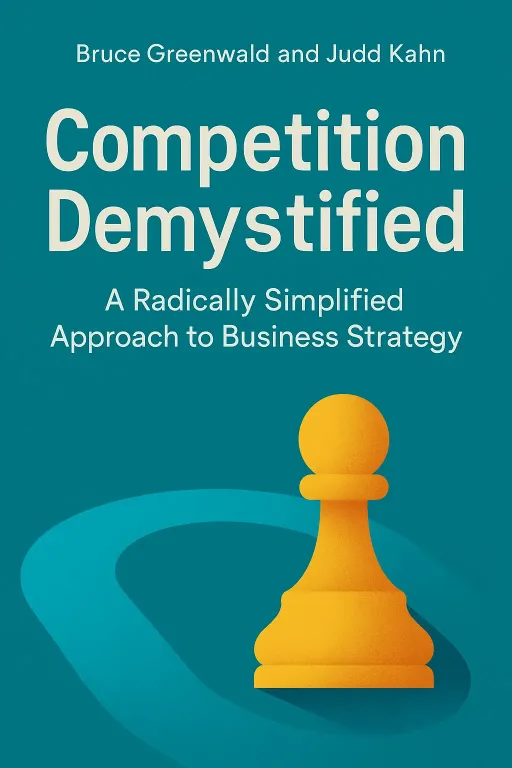
Nova: I love that, Atlas, because today we’re pulling back the curtain on something foundational to business success, drawing insights from two brilliant minds. First, Bruce Greenwald and Judd Kahn’s seminal work, "Competition Demystified." Greenwald, often called "the dean of Wall Street deans," brings an incredible academic and practical rigor from his economics professorship at Columbia Business School to simplify what makes a business truly defensible.
Atlas: That makes sense. It sounds like he’s cutting through the noise, which is exactly what you want when you’re trying to figure out how to stay ahead in a competitive market. What’s the big idea he wants us to grasp?
Deep Dive into Core Topic 1: The Art of Building Unreplicable Moats
SECTION
Nova: The big idea is this: sustainable competitive advantage isn't some mystical force. It's about constructing "moats." Not just being good, or even great, but building barriers that make it incredibly difficult for competitors to replicate your success. He argues there are three primary types of these economic moats.
Atlas: Moats! I like that visual. So, for someone like Mark, who’s navigating the food industry, what do these "unreplicable" moats actually look like? Are we talking secret recipes, or something deeper?
Nova: Exactly, it’s far deeper than just a secret recipe, though that can be part of it. Greenwald identifies three core types. The first is a. This is about having a unique cost advantage or proprietary technology that others can't access or replicate easily. Think about a food producer with exclusive access to a rare, high-quality ingredient, or a manufacturing process that's dramatically more efficient, cutting costs in a way rivals simply can't match without massive investment.
Atlas: Oh, I see. So it’s not just about making something cheaper, but having a fundamental, structural reason you can make it cheaper, or better, than anyone else. That’s a game-changer for supply chain optimization.
Nova: Precisely. The second is a. This is about customer captivity or high switching costs. It's when your customers are so loyal, or it's such a hassle for them to switch, that they stick with you even if a competitor offers something slightly cheaper or newer. Imagine a local artisan bakery—let's call it "The Daily Crumb"—that has cultivated such a strong community following through unique sourdoughs and personalized service that people drive across town, past other bakeries, just for their bread. Their customers aren't just buying bread; they're buying into a relationship, a tradition, a taste they can't get anywhere else. The switching cost isn't monetary; it's emotional and experiential.
Atlas: That’s a perfect example. I imagine a lot of our listeners can relate to that—that one coffee shop or farmer’s market vendor they just to go to. So it’s not about locking people in with contracts, but locking them in with value and connection.
Nova: Exactly. And the third moat is. This is where, as a company gets larger, its per-unit costs decrease, making it incredibly hard for smaller new entrants to compete on price. Think about a national food distributor. They can buy ingredients in such massive bulk, and optimize their logistics across an entire continent, that a regional competitor simply can't achieve the same cost efficiency. They have a scale advantage that’s incredibly difficult to replicate.
Atlas: So, when Mark is looking at his existing food products, he should be asking: "Do I have a unique ingredient source or process? Do my customers feel a deep connection or face real friction if they leave? Or can I scale in a way that makes my operations inherently more cost-effective?"
Nova: That’s the strategic mind at work! It's about identifying those inherent advantages. But this leads us to an interesting tension. Many people hear "competitive advantage" and immediately think "innovation." But doesn't everyone to innovate? Isn't that how you build a moat in the first place?
Atlas: That's what I'm thinking. If everyone's innovating, how do you make innovation unreplicable?
Deep Dive into Core Topic 2: Innovation Beyond the Hype
SECTION
Nova: That's exactly where Dan Breznitz steps in, Atlas, and challenges our assumptions about what "innovation" truly means. Breznitz, a professor and co-director of the Innovation Policy Lab at the University of Toronto, wrote "Innovation in Real Places" precisely to broaden our perspective beyond the typical Silicon Valley narrative of disruptive tech.
Atlas: Oh, I like that. So it's not just about the next big app or AI breakthrough? Because for many businesses, especially in traditional sectors like food, that kind of innovation can feel very distant or even irrelevant.
Nova: Absolutely. Breznitz argues that innovation isn't just radical invention; it's a much more diverse, nuanced, and context-dependent process. He identifies different forms of innovation that thrive in various contexts. It's not just about inventing a new product, but also about:,,, and.
Atlas: So it's about looking at your entire operation through an innovative lens, not just your R&D department. For someone trying to optimize their supply chain or navigate complex regulatory compliance in the food industry, this "diverse innovation" approach must be incredibly empowering. It means innovation can happen in those "boring" but crucial areas.
Nova: Exactly! Let's take a hypothetical example related to Mark’s food business. Instead of trying to invent a completely new superfood, imagine a company that innovates in its by developing a hyper-efficient, zero-waste packaging system for its organic produce, dramatically reducing its environmental footprint and operational costs. Or perhaps they innovate in their by creating a blockchain-based traceability system that assures consumers of ingredient origin and ethical sourcing, building unparalleled trust.
Atlas: Wow, that’s a powerful distinction. That’s not a flashy, "next big thing" innovation, but it builds an incredible demand moat through trust and a supply moat through efficiency. It strengthens the core business.
Nova: Precisely. Breznitz’s point is that innovation isn't a one-size-fits-all phenomenon. What works in Silicon Valley for software might be completely irrelevant for a food producer in a rural economy. The most potent innovation is often deeply embedded in local contexts, leveraging unique resources, skills, and market needs. It’s about being smart and strategic about and you innovate.
Atlas: So, if Greenwald gives us the "what" – the types of unreplicable moats – then Breznitz gives us the "how" – the many diverse ways to innovate or that moat, making it deeper, stronger, and more unique? It’s like they complete each other.
Synthesis & Takeaways
SECTION
Nova: They absolutely do. Together, these two perspectives offer a profound insight: enduring competitive edge isn't a static achievement, nor is it solely about radical invention. It's a dynamic interplay of strategically identifying and building defensible barriers, and then continuously innovating in diverse, context-aware ways to strengthen and evolve those barriers.
Atlas: That's a huge takeaway. So for someone like Mark, looking at his food products and supply chain, the "tiny step" isn't just about a new recipe, but about finding a "niche innovation"—whether it's in his packaging, his sourcing, his distribution, or even his customer engagement—that strengthens his unique advantages, making them even harder to replicate. It's about trusting his instincts and leveraging what's already unique about his operation.
Nova: Precisely. It’s about realizing that your unique advantages might not be what you initially thought. They could be in the way you structure your team, the relationships you build with local farmers, or the sheer efficiency of your delivery network. It's about being pragmatic, visionary, and a great communicator to articulate that unique value.
Atlas: So, what’s the one thing listeners should walk away with to apply this today? What's the ultimate lesson from these two perspectives?
Nova: The ultimate lesson is that true competitive edge isn't a singular, flashy invention that everyone talks about. It's a dynamic, often quieter, interplay of strategic defensibility and continuous, context-aware innovation. It’s about being in ways that to your customers and are because they're woven into the very fabric of how you operate. It’s about understanding that your strength lies not just in what you produce, but in you produce it, you serve, and the unique, often overlooked, advantages you cultivate.
Atlas: That's actually really inspiring. It means everyone has the potential to build an enduring edge, not just the tech giants.
Nova: It’s empowering, isn’t it? It challenges us to look beyond the obvious and find strength in our unique realities.
Atlas: Couldn't agree more.
Nova: This is Aibrary. Congratulations on your growth!