

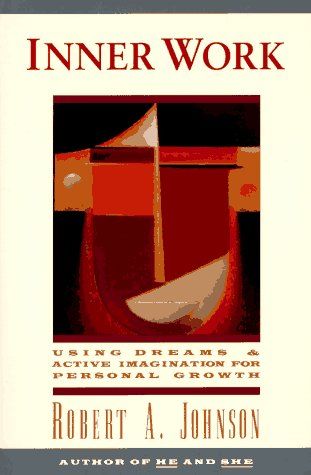
Inner Work
Introduction
Nova: Imagine waking up from a dream so vivid that it lingers with you all day. You know it meant something, but you cannot quite crack the code. Most of us have been there. We shrug it off, get coffee, and move on. But what if that dream was not random noise? What if it was a direct message from a part of you that you have never fully met?
Nova: : And let me guess — there is actually a method for decoding those messages that does not involve a dusty dream dictionary claiming that every snake means the same thing?
Nova: Exactly. That is the heart of today's conversation. We are diving into Inner Work, the 1986 classic by Jungian analyst Robert A. Johnson. It is a practical guide to using your dreams and your imagination to talk to your unconscious mind. And here is a wild starting fact: Johnson believed that the unconscious is not some murky basement of repressed memories. He described it as a marvelous universe of unseen energies, forces, forms of intelligence, even distinct personalities that live within us.
Nova: : Distinct personalities living inside me? That sounds either profound or slightly terrifying. Which is it?
Nova: A bit of both, honestly. But Johnson spent his entire life making these ideas accessible and practical. Inner Work has sold millions of copies because it gives regular people — not just therapists — a clear, four-step method for doing the most important work there is: integrating who you really are. And here is why this matters now more than ever: we live in a culture obsessed with external achievement, but Johnson argued that without inner work, we are only half alive. We have lost a part of ourselves.
Nova: : So this is not just about interpreting dreams for entertainment. This is about… becoming whole?
Nova: That is exactly it. And today we are unpacking how he taught people to do that — using nothing more than a journal, some quiet time, and a willingness to listen to the parts of themselves they have ignored. Let us get into it.
Robert A. Johnson's Remarkable Journey
The Man Who Almost Died and Found His Calling
Nova: To understand Inner Work, you have to understand the man who wrote it. Robert Alex Johnson was born in Portland, Oregon in 1921. And his entire life path was shaped by something that happened when he was just eleven years old.
Nova: : What happened?
Nova: He was hit by a car. His leg was crushed, and due to an undetected blood leak, he nearly died. He had what he later described as a profound near-death experience — a confrontation with nothingness, with blackness, that marked him forever. That trauma forced him inward at a very young age. It sparked a spiritual searching that would define the rest of his life.
Nova: : So the inner work began not as an intellectual pursuit, but as survival.
Nova: Precisely. He later studied at Stanford, at the University of Oregon, and eventually at the C. G. Jung Institute in Zurich, Switzerland, where he trained directly in the tradition of Carl Jung. He became a practicing Jungian analyst in San Diego and wrote several bestselling books — He, She, We, Owning Your Own Shadow — but many consider Inner Work his masterpiece. It was published in 1986, and by the time Johnson died in 2018 at the age of 97, his books had sold more than 3 million copies.
Nova: : Three million copies for a book about dream interpretation. That tells me people are desperate for this kind of guidance.
Nova: They really are. And Johnson had a rare gift: he could translate Jung's dense, complex theories into language anyone could grasp. He was not writing for academics. He was writing for you and me — people who wake up from strange dreams and wonder, what was that about? His key insight was that dreams are not random. They are direct communications from the unconscious, and they speak in a symbolic language that we can learn.
Nova: : So he is basically saying the unconscious has been sending us letters our whole lives, and most of us have not even opened the envelope.
Nova: That is the perfect metaphor. And Inner Work is the guide to opening that envelope — systematically, respectfully, and with real results.
Why the Unconscious Matters
Your Inner Universe
Nova: Let us get into the core premise. Johnson opens Inner Work with a bold claim. He writes: The unconscious is a marvelous universe of unseen energies, forces, forms of intelligence — even distinct personalities — that live within us. It is the secret source of much of our thought, feeling, and behavior.
Nova: : That is a pretty radical reframe. Most of us think of the unconscious as a dark little closet where we shove things we do not want to deal with.
Nova: Right, and Johnson says that is only part of the picture. Yes, the unconscious contains our shadow — the repressed, unacknowledged parts of ourselves. But it also contains immense creativity, wisdom, and guidance. The problem is that modern life has severed the connection between our conscious ego and this deeper source. We walk around with what Johnson called a vague sense that we have lost a part of ourselves.
Nova: : And the conscious ego — that is basically the narrator in our head, the I that we think of as me?
Nova: Exactly. The ego is what we are and know about consciously. It is essential — it gives us the capacity for awareness and self-reflection. But it is only a small fraction of the total psyche. Johnson's point is that if we only live from the ego, we are like a CEO who never talks to the rest of the company. We become isolated, one-sided, cut off from our own depths.
Nova: : So inner work is about reopening that communication channel?
Nova: That is it. Johnson defined inner work as the effort by which we gain awareness of the deeper layers of consciousness within us and move toward integration of the total self. Integration, not perfection. The goal is not to eliminate the unconscious or control it — it is to enter into partnership with it. He believed that when we do this, we live richer, fuller lives. We stop being at the mercy of our unconscious patterns and start collaborating with them.
Nova: : And he gave us two main tools for doing that: dream work and active imagination.
Nova: Yes. And the dream work method is where most people start, because dreams are the most accessible portal. As Johnson put it, dreams are dynamic mosaics, composed of symbols, that express the movements, conflicts, interactions, and developments of the great energy systems within the unconscious. Every night, your unconscious produces this incredible symbolic art — and most of us just sleep through it.
The Four-Step Dream Work Method
Cracking the Code
Nova: Alright, let us walk through the method. Johnson's dream work has four steps: associations, dynamics, interpretations, and rituals. And the first step is where most people go wrong.
Nova: : Let me guess — people jump straight to interpreting before they do the groundwork?
Nova: Exactly. Step one is associations, and Johnson is very specific: this is Jungian association, not Freudian free association. Freud would have you start with a dream symbol and let your mind wander wherever it wanted. Johnson said that actually leads you away from the dream's specific message. Instead, you take each element of the dream — every person, object, setting, action — and ask: what does this remind me of in my life, personally?
Nova: : So if I dream of a snake, I do not Google what snakes symbolize. I ask myself what a snake means to me.
Nova: Precisely. Maybe you grew up in the desert and snakes were a common sight. Maybe a snake terrifies you for reasons unique to your history. Maybe you find them fascinating. The meaning is personal. Johnson insisted that every symbol in your dream has a special, individual connotation that belongs to you alone. You are the dictionary.
Nova: : That is oddly empowering. But also a lot of work.
Nova: It is. That is why he called it inner work. Step two is dynamics — connecting those dream images to the inner dynamics operating in your life right now. You ask: what part of me does this dream figure represent? What inner conflict is being dramatized here? Johnson's key rule is to always apply the dream inwardly first, before you go looking for external meanings.
Nova: : So if I dream about fighting with my boss, it might not actually be about my boss at all.
Nova: Exactly. It might be about an internal authority figure — your own inner critic, or your ambition, or a part of you that feels dominated. Step three is interpretation — synthesizing all the associations and dynamics into a coherent understanding of what the dream is trying to communicate. And step four is where Johnson really distinguishes himself from other dream work approaches.
Nova: : Which is?
Nova: Ritual. He insists you must do something physical. You have done your best to understand the dream with your mind, he writes. It is time to do something physical. This step is very important because it helps you to integrate your dream experience into your conscious, waking life. It could be writing the dream in a special journal. Drawing a key symbol. Going for a walk to contemplate it. Or something more creative: if you dreamed about needing to honor your feeling side, you might spend an evening doing something that feels deeply meaningful but that you never make time for.
Nova: : That is beautiful. It turns insight into action. It makes the dream real.
Nova: And Johnson believed that without this physical component, the insights remain abstract and fade within hours. The ritual tells your psyche: I am listening. I am taking this seriously. It closes the loop.
Active Imagination as the Next Frontier
The VR Headset of the Soul
Nova: Now here is where things get really fascinating. Johnson actually argued that dream work, powerful as it is, is only the entry point. There is a deeper practice called Active Imagination, which Jung himself considered even more effective for connecting with the unconscious.
Nova: : Active Imagination. I have heard the term but never quite understood what separates it from regular daydreaming.
Nova: Here is the best analogy I have found. If dream work is like watching a movie that your unconscious produced and then discussing it afterward, Active Imagination is like putting on a virtual reality headset and stepping into the story in real time, as an active participant. You are not just observing symbols — you are talking to them.
Nova: : So you consciously enter a fantasy or vision and interact with whatever shows up?
Nova: Yes, and Johnson describes it as the ability to go into his fantasy or vision, participate consciously in it, and make it into an active exchange between the conscious and unconscious energy systems. It is a dialogue. You invite an image to appear — maybe from a recent dream, maybe from a strong emotion you are feeling — and then you talk to it.
Nova: : Talk to it? Like, out loud?
Nova: You can write the dialogue down, using all caps for what the inner figure says and lowercase for your responses. Johnson suggests starting with simple questions: Who are you? What do you want? What do you have to say to me? And here is the astonishing part: they answer back. You find that they express radically different viewpoints from your conscious mind. They tell you things you never consciously knew.
Nova: : That sounds borderline… I do not know. Made up?
Nova: Johnson addressed that skepticism directly. He said it is nearly impossible to produce anything in the imagination that is not an authentic representation of something in the unconscious. Think about it — where else would these images come from? Everything in your imagination has an origin inside you. The question is whether you engage with it consciously and productively, or let it run you from behind the scenes.
Nova: : So the alternative to Active Imagination is not nothing — it is being unconsciously driven by these inner forces without any say in the matter.
Nova: Exactly. But Johnson also gave important warnings. First, this is not passive fantasy. Passive fantasy is watching a mental movie for escape. Active Imagination requires your full, conscious participation and a goal of resolution. Second, you need clear boundaries between this practice and your daily life. You do not want to blur the lines. And third, you need an ethical compass. The inner figures are not human — they do not necessarily share your values. Johnson says the conscious ego, guided by a sense of ethics, must set limits to protect the process from becoming destructive or going off into extremes.
Nova: : So you are not just supposed to do whatever the inner voice tells you.
Nova: Absolutely not. You listen, you dialogue, you learn — but you remain the one in charge of how those insights get integrated into your actual life. When Active Imagination is done correctly, Johnson says, it pulls the different parts of you together that have been fragmented or in conflict. It brings about peace and cooperation between the warring ego and unconscious. It is some of the most powerful inner work a person can do.
Rituals, Integration, and the Chase Dream Example
Making It Real
Nova: Let me give you a concrete example of how all of this fits together. Johnson walks through a very common dream — being chased through a city by a shadowy figure. You wake up with your heart pounding.
Nova: : I have definitely had that dream. Multiple times.
Nova: Most people do. So step one, associations: you list every detail. The city feels impersonal — maybe it reminds you of your workplace. The chase feeling recalls a time you avoided a difficult confrontation. The shadowy figure brings to mind a colleague you distrust, but also a vague sense of something about yourself you do not want to face.
Nova: : Already this is more specific than any dream dictionary could give me.
Nova: Step two, dynamics: you consider that the shadowy figure might represent your own ambition that you have been running from, or a creative part of yourself you are afraid to express. Step three, interpretation: the dream seems to be saying that avoiding something internal is causing anxiety that follows you everywhere.
Nova: : And then step four — the ritual?
Nova: You might draw the cityscape and the figure. You might write a plan to address that avoided work confrontation. You might simply take a walk and consciously turn around at some point as a symbolic act of stopping the flight. The ritual does not have to be elaborate — it just has to be personal and physical. Johnson says this is what separates inner work that fades from inner work that transforms.
Nova: : And the ritual idea applies to Active Imagination as well?
Nova: Yes, it is the fourth step there too. One practitioner shared that after a powerful dream involving a polar bear, their ritual was simply holding a piece of ice in each hand until it completely melted — a physical anchor for the insight. Johnson said: to incarnate your imagination does not mean to act out your fantasies in a literal way. It means to take the essence you have distilled from it and incarnate it by doing physical ritual or integrating it into your practical life.
Nova: : So the ritual is like a bridge between the symbolic world and the material world. It says: this mattered. I am bringing it with me.
Nova: Beautifully put. And Johnson emphasized that this work is not for every dream. You do not need to four-step your dream about grocery shopping. He said to focus on dreams with emotional charge — the ones that stick with you, recurring dreams, nightmares, vivid symbols. Those are the ones carrying messages. And he recommended doing this work in the morning when dreams are fresh, setting aside twenty to thirty minutes of quiet time.
Nova: : What about people who say they do not dream?
Nova: Johnson would say everyone dreams — multiple times per night. The issue is recall. Even just keeping a journal by your bed and writing down whatever fragments you remember can dramatically improve dream recall within a week or two. Your unconscious notices when you start paying attention.
Conclusion
Nova: So here is what I want to leave you with. Robert A. Johnson spent nearly a century on this earth — a life that began with a near-fatal car accident at age eleven that forced him to look inward. What he discovered, and what he spent decades teaching, is that we all have an inner world as vast and rich as the outer one. And most of us are only half awake to it.
Nova: : That is a humbling thought. That there is this entire universe inside me, sending messages every night, and I have mostly been ignoring it.
Nova: But the beauty of Johnson's approach is that it is never too late to start. You do not need a therapist — though one can help. You do not need special equipment. You need a journal, some quiet time, and a willingness to listen. His four steps — associations, dynamics, interpretation, ritual — are a framework anyone can use. And if you go deeper into Active Imagination, you discover that you can actually have a conversation with the different parts of yourself.
Nova: : The takeaway, if I am hearing you right, is that inner work is not self-indulgence. It is not navel-gazing. It is the most practical thing you can do, because everything you do in the outer world — your relationships, your career, your choices — is shaped by what is happening in your inner world whether you are aware of it or not.
Nova: Exactly. Johnson put it simply: much of ourselves and many determinants of our character are contained in the unconscious. It is only by approaching it that we have a chance to become conscious, complete, whole human beings. The dream you had last night might just be an invitation. The question is whether you will open the envelope.
Nova: : So start small. One dream. Four steps. See what happens.
Nova: That is it. The inner work is yours to do. And it begins tonight, when you close your eyes and your unconscious starts speaking. The only thing left is to listen.
Nova: : This is Aibrary. Congratulations on your growth!