The Architecture of Personal and Social Change
Golden Hook & Introduction
SECTION
Atlas: Nova, sometimes it feels like we're all just trying to push a boulder uphill when it comes to changing habits or achieving big career goals. You know, you what you should do, you to do it, but that boulder just sits there, mocking you.
Nova: Absolutely, Atlas. And what if I told you that most of us are trying to push that boulder with one finger, when we actually need six powerful levers to move it?
Atlas: Six levers? That sounds… a lot more strategic than just gritting my teeth and trying harder. Because that’s usually my go-to, and frankly, it’s exhausting.
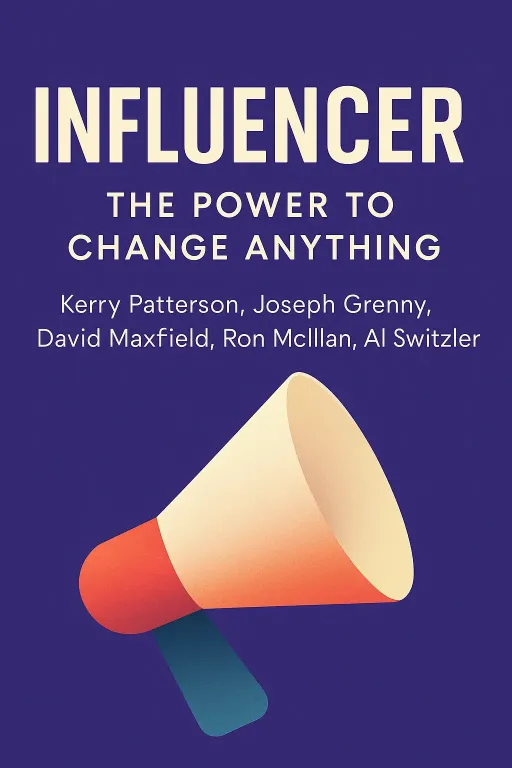
Nova: It is exhausting! And that's precisely the core insight from Kerry Patterson's groundbreaking work, "Influencer: The Power to Change Anything," which he co-authored with his brilliant colleagues. Patterson, renowned for his extensive research into organizational behavior and communication, really challenged the conventional wisdom on why change efforts so often fail, even in high-stakes environments.
Atlas: Okay, so he’s saying it’s not just about willpower or motivation? That’s going to resonate with anyone who feels stuck despite their best intentions.
Nova: Exactly. He reveals that our attempts at change often falter not because of a lack of desire, but because we're wildly underestimating the complex web of forces that truly drive human behavior. We're operating with a limited toolkit, trying to solve a multi-faceted problem with a single solution.
Deep Dive into Core Topic 1: The Multi-Dimensional Nature of Influence for Change
SECTION
Nova: Think about it: when we want to change something, whether it's a personal habit or a large-scale organizational shift, we typically focus on one or two things, right? We might try to motivate ourselves, or we might tell someone what to do.
Atlas: Yeah, like, "I'll just work harder," or "I'll tell my team to prioritize this new process." Seems logical enough.
Nova: It seems logical, but it’s often insufficient. Patterson and his team identified six distinct sources of influence, and true change, lasting change, happens when you align of these sources. Let me give you an example that I think illustrates this perfectly.
Atlas: Please, I’m picturing myself trying to move that boulder right now.
Nova: Imagine a mid-sized tech company, let’s call them InnovateX. They invested a huge amount in a new, cutting-edge project management software. It was objectively better, promised to streamline workflows, and cut costs. The leadership was all-in, championing the new tool.
Atlas: Sounds like a no-brainer. Success guaranteed.
Nova: Right? So, they rolled it out. They provided extensive training sessions, explaining all the new features and benefits. They sent out company-wide memos, emphasizing how crucial this new software was for their future success. They even tied it to strategic goals. This addressed what we call "personal motivation" and "social motivation"—they tried to convince people it was important and that everyone else was doing it.
Atlas: And I'm guessing it didn't go as planned. Because that’s usually how these stories go.
Nova: It was a disaster. Adoption was abysmal. People would attend the training, nod along, and then go right back to using the old, clunky system. Missed deadlines piled up, frustration mounted, and the massive investment seemed wasted. The leaders were baffled. "Don't they to be more efficient?" they'd ask.
Atlas: That’s a familiar story, especially for our listeners in fast-paced environments. For a focused strategist, if the better tool is there, and people are told to use it, why wouldn't they? What’s the disconnect?
Nova: The disconnect was that they only addressed a fraction of the influences. Here's what was really happening: The old system was still fully functional and, crucially, to access and use in the short term. No one had taken it offline. That’s a "structural ability" problem – the environment made it easier to stick with the old way.
Atlas: Oh, I see. The path of least resistance. Our brains are wired for that.
Nova: Exactly. Furthermore, while leadership it was important, many mid-level managers weren't consistently using the new software themselves. They were still sending emails or using spreadsheets, undermining the "social ability" and "social motivation" for their teams. If your boss isn't using it, why should you? It creates a mixed message.
Atlas: That's a huge point. Lead by example. The social proof wasn't there at the ground level.
Nova: And finally, there was no immediate, tangible reward for using the new system, nor any penalty for using it. People were busy, and the path of least resistance was still open. That's a "structural motivation" issue. InnovateX eventually succeeded, but only after they aligned these other sources. They made the old system gradually inaccessible, had team leads actively champion and model the new software, and integrated its consistent usage into performance reviews.
Atlas: Wow. So, it's not just about wanting to change, or even knowing how. It's about designing an environment where change is the easiest, most rewarding, and most socially supported option. That's a lot more involved than I thought. For someone trying to level up their own career, how do they even begin to map these invisible forces?
Deep Dive into Core Topic 2: Intentional Laws for Personal and Professional Growth
SECTION
Nova: That's a perfect segue, Atlas, because once you understand the at play—what's pushing and pulling you—the next step is to intentionally your growth. And that's where John C. Maxwell's work, "The 15 Invaluable Laws of Growth," becomes incredibly powerful. Maxwell, as many know, is a renowned leadership expert who's spent decades distilling timeless principles for personal and professional development through his vast body of work.
Atlas: So, if Patterson helps us see the hidden currents, Maxwell gives us the engine and the rudder to navigate them?
Nova: Precisely! Maxwell's central premise is that growth isn't automatic; it's a deliberate process governed by principles, or "laws," that are as consistent as gravity. You don't just to grow; you these laws. For our listeners who are aspiring builders, seeking clarity and a solid future, this is incredibly actionable wisdom.
Atlas: Okay, I like that. "Laws of Growth." It implies they’re non-negotiable, not just suggestions you might get around to. But for someone already swamped, or a pragmatic learner trying to integrate more into their day, how do they integrate these "laws" without feeling overwhelmed?
Nova: It’s not about doing everything at once, but about being intentional with your focus. Take, for example, what Maxwell calls the Law of Intentionality. It simply states: "Growth doesn't just happen." Think of Sarah, a driven engineer we know. She was incredibly talented, worked hard, but felt stalled in her career. She’d wait for opportunities to arise, expecting her good work to be noticed and rewarded with promotions or new challenges.
Atlas: I know that feeling. You put in the hours, you excel, and then you wonder why things aren't progressing as fast as you'd hoped. You feel like you're doing everything right.
Nova: Exactly. Sarah was waiting for growth to come to her. But after discovering Maxwell's work, she realized she had to be the architect of her own development. She started proactively seeking mentorship, identifying specific skill gaps she wanted to fill, and—this is key—scheduling dedicated, protected learning time into her week. She started with just 20 minutes a day, just like our own growth recommendation. She wasn't waiting for a training program; she was building her own.
Atlas: So, it’s not enough to be ambitious; you have to be about that ambition. It means taking ownership of your development, not just your output. It's about being the active agent.
Nova: That’s it. And it connects beautifully to another law, the Law of the Ladder: "Character growth determines the height of your personal growth." Sarah focused not just on technical skills but on her communication, her ability to lead small projects, her resilience. These are often unseen foundational efforts that ultimately allow you to climb higher. It’s about building a robust internal structure, not just adding decorations to the outside.
Atlas: That makes a lot of sense. For our listeners who are focused strategists, trying to integrate learning into a busy life, it sounds like it’s about making growth a non-negotiable appointment with yourself, not just an aspiration you hope will materialize.
Synthesis & Takeaways
SECTION
Nova: What’s fascinating, Atlas, is how these two ideas beautifully intertwine. Patterson shows us the landscape of influence – identifying what’s pushing and pulling us, the hidden barriers and levers. Maxwell then gives us the compass and the map to navigate that landscape purposefully, with intentional laws for growth.
Atlas: So, it’s about first understanding the system you’re in, then choosing the right tools and principles to build your future within that system. It’s a very holistic approach. For our listeners who are aspiring builders, looking to stack skills and secure their future, what’s one immediate, actionable step they can take this week?
Nova: Here’s what I’d suggest: Take 15 minutes. Pick ONE specific career goal you have—maybe it's mastering a new skill, taking on a new responsibility, or even just consistently dedicating time to learning. Now, don't just think about what you to do. Instead, think about the that might be making it harder.
Atlas: Forces, like Patterson's influences?
Nova: Precisely. Are you trying to change a habit where the environment isn't supporting it? Is your social circle or team doing the opposite of what you want to achieve? Are you lacking a clear, step-by-step path, or is there no reward for the new behavior? Just identify of those influences that’s currently working against your goal.
Atlas: That's a powerful way to start. It's about seeing the system, not just the symptom. It really makes you think about growth differently, like you're a detective for your own development.
Nova: Absolutely. It's about becoming the architect of your own change, not just a passenger in your professional journey.
Atlas: A fantastic deep dive into intentional growth and influence.
Nova: This is Aibrary. Congratulations on your growth!