The Influence Equation: Engineering Human Connection
11 minGolden Hook & Introduction
SECTION
Nova: Sylivia, as an engineer, you live in a world of logic, data, and elegant systems. But have you ever been in a meeting where a truly terrible idea starts gaining momentum, and you're just baffled, watching logic fly right out the window?
Sylivia: Oh, absolutely. It’s one of the most frustrating experiences. You have the data, you have the better design, but the room is moving in a different direction. It feels like there’s a fundamental logic failure happening, but it’s not in the code or the architecture—it’s in the people.
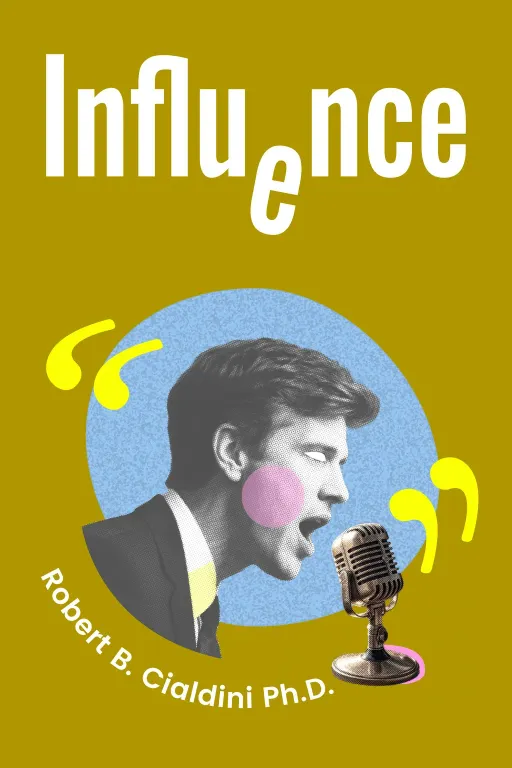
Nova: Exactly! And that is the perfect entry point for today. That exact 'human system bug' is what the social psychologist Robert Cialdini explores in his classic book,. It’s like the ultimate, and slightly dangerous, user manual for the human mind.
Sylivia: I love that framing. A user manual. Because it implies there are underlying rules we can learn.
Nova: There are. And Cialdini argues that in our increasingly complex world, we rely more and more on mental shortcuts to make decisions. As Albert Einstein, someone I know you admire, once said, "Everything should be made as simple as possible, but not simpler." Cialdini shows us what happens when these simplifications are exploited.
Sylivia: Okay, I'm hooked. Where do we start?
Nova: Today we'll dive deep into this from two perspectives. First, we'll explore the hidden 'glitches' in our mental code that make us vulnerable to perceptual tricks. Then, we'll discuss the powerful 'social debt algorithm' of reciprocity that shapes our interactions and negotiations.
Deep Dive into Core Topic 1: The Glitch in Our Code
SECTION
Nova: So let's start with one of the most counter-intuitive stories in the book. It perfectly illustrates a glitch Cialdini calls a 'trigger feature.' Imagine a friend of his who owned a jewelry store in a tourist town in Arizona. She had a batch of turquoise jewelry that just would not sell, which was strange because it was peak tourist season and the jewelry was good quality for its price.
Sylivia: Okay, so a classic inventory problem. She probably tried marking it down.
Nova: She did! She tried moving the display to a more central location, she told her staff to push it harder—nothing worked. Finally, right before leaving on a buying trip, she scribbled a frustrated note to her head saleswoman: "Everything in this display case, price x ½." She was just ready to cut her losses.
Sylivia: Makes sense. A 50% off sale should clear it out.
Nova: You would think! But when she returned a few days later, she wasn't surprised to find that every single piece had been sold. She surprised to find out that her employee had misread the note. She didn't read "½"—she read it as a "2." She had accidentally the price of every item. And at twice the price, the entire lot sold out.
Sylivia: Wow. That makes absolutely no logical sense. You double the price, and it sells? That's a fascinating bug.
Nova: It's a perfect bug! Cialdini explains that these tourists, who knew very little about turquoise, were operating on a standard principle, a mental shortcut: "expensive = good." In their minds, a higher price was a trigger for higher quality. The price itself became the only feature they judged it on.
Sylivia: That's incredible. It's a heuristic. A default setting in our mental code that, in this case, led to a completely irrational outcome. We see this in tech all the time. A new piece of software or hardware comes out with a premium price tag, and that price itself becomes part of the marketing. It signals, 'this is the professional, high-quality choice,' even if a cheaper alternative is just as good.
Nova: Precisely. And compliance professionals, as Cialdini calls them, know how to activate these triggers. This leads to our first major weapon of influence: the Contrast Principle. This principle states that our perception of something is heavily influenced by what we saw immediately before it.
Sylivia: So it’s about manipulating the baseline for comparison.
Nova: Exactly. Cialdini describes going undercover with a real estate salesman named Phil. Phil’s strategy for selling houses was to always start by showing clients a couple of undesirable properties on the company’s books. He called them 'setup' properties.
Sylivia: So he wasn't actually trying to sell those?
Nova: Not at all. He'd take them to a rundown, overpriced house or two. He said he loved watching their eyes get wide with disappointment. Because after they'd seen these dumps, when he finally took them to the house he wanted to sell, their eyes would "light up." The house would seem magnificent in comparison.
Sylivia: That is… brilliant and slightly terrifying. That is a perfect description of how project proposals are sometimes presented. You're shown a 'setup' option first—one with a ridiculously long timeline and a massive budget. It's the sacrificial lamb. Then, the proposal the presenter actually wants is shown, and it looks incredibly lean and reasonable by comparison, even if it's still a huge ask on its own.
Nova: It's the exact same principle. It hacks our perception of value. By controlling the context, you control the decision. It’s a powerful tool for a leader to be aware of, both to use ethically and to defend against.
Deep Dive into Core Topic 2: The Social Debt Algorithm
SECTION
Nova: And this idea of manipulating perception leads us to our second, and perhaps even more deeply ingrained, human script: the rule of Reciprocity.
Sylivia: The old give and take. This feels fundamental.
Nova: It is. Cialdini argues it's the very foundation of what makes us human—our ancestors learned to share food and skills with the confidence that the favor would be returned. The rule is simple: we feel obligated to repay what another person has provided us. But this deeply embedded social rule can also be weaponized.
Sylivia: How so?
Nova: He describes a simple experiment. A researcher, let's call his assistant Joe, is in a room with a test subject, supposedly for an art appreciation study. During a break, Joe leaves and comes back with two Cokes, handing one to the subject and saying, "I asked the guy for a Coke and he didn't have change, so I got one for you, too." To another group of subjects, Joe does nothing.
Sylivia: Okay, a small, unsolicited favor.
Nova: Exactly. Later, Joe mentions he's selling raffle tickets and asks the subject if they'd like to buy any. The result? The subjects who had received the free Coke bought twice as many raffle tickets as those who hadn't. And here's the kicker: it didn't matter if they liked Joe or not. The feeling of indebtedness completely overrode their personal feelings toward him.
Sylivia: So the sense of obligation is its own independent variable. It's a 'social debt algorithm' that can override other factors like personal affinity. That’s huge for leadership and teamwork. It explains why small, proactive favors—helping a colleague with a tough piece of code, bringing them a coffee when you get yours—build so much social capital. It's not just about being nice; it's about actively building a web of reciprocity that makes collaboration smoother.
Nova: You've nailed it. But it gets even more subtle. Cialdini introduces a tactic called the 'Rejection-Then-Retreat' technique. He tells a story about being stopped by a Boy Scout. The scout first asks him to buy a five-dollar ticket to the annual circus. Cialdini politely declines.
Sylivia: A reasonable request, but easy to turn down.
Nova: Right. But then the scout says, "Well, if you don't want to buy any tickets, how about buying one of our big chocolate bars? They're only a dollar each." Cialdini, who doesn't even like chocolate, immediately buys two. He walks away wondering why he just paid two dollars for candy he didn't want, from a boy scout he was trying to get away from.
Sylivia: Ah, I see it. The retreat from the big request to the small one is a concession. And that concession is a of a gift.
Nova: Precisely! The scout made a concession, so Cialdini felt an automatic, powerful obligation to offer a concession in return—by saying yes to the smaller request.
Sylivia: That is a classic negotiation pattern. In tech, you see it constantly with feature scope or deadlines. A product manager might start by asking for ten features by the end of the quarter, which is impossible. The engineering team rejects it. The product manager then 'concedes' and says, "Okay, you're right. How about just these three critical ones?" Those three were what they wanted all along, but now the engineering team feels a sense of obligation to agree because a concession was made. They feel like they've 'won' the negotiation.
Nova: And that feeling of responsibility and satisfaction with the outcome is a powerful side effect that makes the tactic even more effective. You've been influenced, but you feel good about it.
Synthesis & Takeaways
SECTION
Nova: So when we put it all together, Sylivia, we have these two incredibly powerful, often invisible forces at play. First, our brain's love of shortcuts, which the Contrast Principle can exploit to change our perception of reality.
Sylivia: And second, our deep-seated need to repay social debts, which the rule of Reciprocity and its variations, like Rejection-Then-Retreat, can leverage to get us to say yes.
Nova: It's a potent combination. How do you see these fitting together from an engineer's perspective?
Sylivia: It feels like one is hacking perception, and the other is hacking social protocol. Both are so effective because they operate below the level of our conscious, logical thought. They target the automatic, heuristic-driven part of our brain. And in a fast-paced environment like tech, where we're making hundreds of small decisions a day, we rely on those automatic systems constantly. That's what makes us so vulnerable.
Nova: So, knowing all this, what's the defense? How do we build a firewall against this kind of manipulation, especially when we want to be good leaders and collaborators, not just cynics?
Sylivia: I think the defense isn't to stop trusting people or to reject all favors. The defense is awareness. It's about developing what I'd call a 'mental tripwire.'
Nova: A mental tripwire. I love that. What does it do?
Sylivia: When you feel that sudden, strong, almost visceral pull to say yes—especially right after someone has made a concession—or when an option suddenly looks unbelievably good compared to what you just saw, that's the tripwire. It should trigger a pause. And in that pause, you just ask one simple question: "Why do I feel this way?" Is it because of the genuine merit of this request or this item? Or is it because a principle of influence is at play?
Nova: So you're not analyzing the request itself, you're analyzing the the request is generating.
Sylivia: Exactly. You're debugging your own emotional response. That pause, that single moment of awareness, is everything. It moves the decision from your automatic, easily-hacked system to your conscious, logical system. And that's where you regain control. That's how you build self-confidence and make choices, as a leader or just as a person, that are truly your own.