

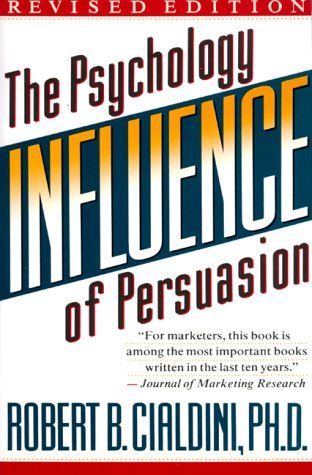
Influence
Introduction
Nova: Have you ever found yourself saying yes to a salesperson or a request from a friend, only to wonder five minutes later why on earth you agreed to it? It is like a switch was flipped in your brain and you just went along with it.
Atlas: All the time. I usually just blame it on being too polite or having a weak moment, but I have a feeling you are going to tell me there is something much more calculated going on.
Nova: Exactly. Today we are diving into a book that is basically the bible of why we do that. It is called Influence: The Psychology of Persuasion by Robert Cialdini. He is often called the Godfather of Influence because he spent years undercover, training with car salesmen, telemarketers, and fund-raisers to see how they actually get people to say yes.
Atlas: So he was like a corporate spy for psychology? That is fascinating. I have heard this book is the reason marketing looks the way it does today.
Nova: It really is. Cialdini discovered that we all have these automatic, fixed-action patterns. He calls it the Click, Whirr response. Like a tape recorder, a specific trigger clicks, and then a sequence of behaviors whirrs into action.
Atlas: Click, whirr. It sounds like we are robots. Are we really that predictable?
Nova: In many ways, yes. He uses this amazing example of a mother turkey. She is incredibly protective, but only if her chicks go cheep-cheep. If a chick is silent, she might ignore it or even kill it. But here is the kicker: researchers put a recorded cheep-cheep sound inside a stuffed polecat, which is the turkey's natural enemy. The mother turkey not only didn't attack it, she gathered it under her wings. Click, the sound happens; whirr, the mothering behavior starts.
Atlas: That is wild. So humans have our own version of that cheep-cheep sound that makes us hand over our credit cards?
Nova: We absolutely do. And over the next few minutes, we are going to break down the seven psychological triggers Cialdini identified that make us go click, whirr without even thinking.
Key Insight 1
The Rule of Reciprocation
Nova: The first and arguably most powerful principle is Reciprocation. It is the simple idea that we feel deeply obligated to repay what another person has provided us. If I buy you a coffee, you feel like you owe me one. It is a social glue that allowed early humans to share resources without fear of loss.
Atlas: That sounds like a good thing, though. It keeps society functioning. Where does it get used against us?
Nova: It becomes a weapon when the gift is uninvited. Cialdini talks about the Hare Krishna Society. They used to stand in airports and hand people a flower. Even if the person didn't want the flower and tried to give it back, the Krishna would say, No, it is our gift to you. Once the person accepted the flower, they were much more likely to give a donation when asked moments later.
Atlas: Even if they hated the flower? That feels like a trap. You are stuck with a wilted daisy and a lighter wallet.
Nova: Precisely. The sense of obligation is so strong that it overrides our dislike for the person or the gift. There is also a variation called the rejection-then-retreat technique. Cialdini was once approached by a Boy Scout who asked him to buy a five-dollar ticket to a circus. Cialdini said no. Then the boy asked, Well, if you won't buy the ticket, would you buy some of our chocolate bars for a dollar each?
Atlas: Let me guess. Cialdini bought the chocolate even though he doesn't even like chocolate?
Nova: He bought two! The boy retreated from a large request to a smaller one, and Cialdini felt the need to reciprocate that concession. It is a double whammy because you feel like you won a deal, so you are actually more satisfied with the result, even though you were played.
Atlas: I have definitely fallen for that. The old start high and negotiate down trick. It makes me feel like I am a master negotiator when I am actually just following the script.
Nova: It is everywhere. Free samples at the grocery store aren't just for tasting; they are to make you feel like you should buy the whole box. The key is to realize that the favor wasn't a favor, it was a sales tactic. Once you re-categorize it as a trick, the obligation vanishes.
Key Insight 2
Commitment and Consistency
Nova: Next up is Commitment and Consistency. This one is about our nearly obsessive desire to be, and to appear, consistent with what we have already done. Once we make a choice or take a stand, we encounter personal and interpersonal pressures to behave consistently with that commitment.
Atlas: Is that why people stick with bad investments or bad relationships? Just because they already started?
Nova: Exactly. It is a shortcut. If we stay consistent, we don't have to think through every new situation. We just do what we did before. Cialdini highlights a study where researchers asked homeowners to put a tiny, three-inch sticker in their window that said Be a Safe Driver. It was so small, almost everyone said yes.
Atlas: Okay, a tiny sticker seems harmless. What is the catch?
Nova: Two weeks later, a different researcher came by and asked those same homeowners to put a massive, ugly billboard on their front lawn that said Drive Carefully. It blocked the view of their house! In the control group, only seventeen percent said yes. But of the people who had accepted the tiny sticker, seventy-six percent agreed to the giant billboard.
Atlas: Seventy-six percent? For a billboard that ruins their yard? That is insane. Just because of a tiny sticker?
Nova: That is the foot-in-the-door technique. By agreeing to the small request, those people changed their self-image. They became the kind of people who care about road safety. To stay consistent with that new identity, they had to say yes to the big request.
Atlas: So, if someone can get you to make a small commitment, they can eventually lead you to a much bigger one. How do we stop that?
Nova: Cialdini says to listen to your gut. He calls it the pit-of-the-stomach feeling. When you realize you are being trapped into a commitment you don't really want, you have to call it out. Tell the person exactly what they are doing. It breaks the spell.
Atlas: I am starting to see a pattern here. These are all shortcuts our brains use to save energy, but people who know the code can use them to steer us wherever they want.
Key Insight 3
Social Proof and Liking
Nova: You hit the nail on the head. And nowhere is that more obvious than with Social Proof. This is the idea that we look to others to determine what is correct behavior, especially when we are uncertain. Think of canned laughter on old sitcoms. We know it is fake, we know it is annoying, and yet studies show it makes us laugh longer and more often.
Atlas: I hate canned laughter! But I guess if everyone else is laughing, my brain thinks there must be a joke in there somewhere. It is like the tip jar at a bar. They always put a few dollars in there at the start of the night to show that other people have been tipping.
Nova: Exactly. But Social Proof has a dark side, too. Cialdini discusses pluralistic ignorance. This happens when everyone in a group looks to everyone else to see what to do, and because no one is acting, everyone assumes nothing is wrong. It is why a crowd of people can stand by and watch an emergency happen without helping.
Atlas: That is terrifying. So if you are in trouble in a crowd, what do you do?
Nova: Cialdini’s advice is life-saving: isolate one person. Point at them and say, You, in the blue jacket, call an ambulance. By removing the uncertainty, you break the social proof cycle and that person will almost always help.
Atlas: That is a powerful takeaway. What about the Liking principle? I assume that is just about being nice?
Nova: It is, but it is deeper. We prefer to say yes to people we like. But what makes us like someone? Cialdini points to three things: physical attractiveness, similarity, and compliments. There was a car salesman named Joe Girard who was in the Guinness World Records for being the number one car salesman. His secret? Every month he sent a holiday card to his thirteen thousand former customers that simply said, I like you.
Atlas: Thirteen thousand cards that just say I like you? That sounds so cheesy. Did it actually work?
Nova: It worked incredibly well. People want to be liked, and we are suckers for flattery, even when we know the person has something to gain. We also like people who are like us. Salespeople are trained to mirror your body language or find common ground, like Oh, you like hiking? I love hiking! It creates an instant bond that makes you more likely to buy.
Key Insight 4
Authority and Scarcity
Nova: Now we get to the heavy hitters: Authority and Scarcity. Authority is our deep-seated sense of duty to those in positions of power. Cialdini cites the famous Milgram experiment, where ordinary people were willing to deliver what they thought were lethal electric shocks to a stranger just because a man in a lab coat told them to.
Atlas: That experiment is haunting. It shows that the uniform or the title often matters more than the actual person or the request.
Nova: It really does. In one study, a man crossed the street against traffic while wearing a suit and tie, and three and a half times as many people followed him compared to when he was wearing a work shirt and trousers. We don't even look at the traffic; we just look at the suit.
Atlas: So we are literally following people off a cliff if they look professional enough. And then there is Scarcity, which I see every time I shop online. Only two items left! Sale ends in ten minutes!
Nova: Scarcity is the fear of loss. We are more motivated by the thought of losing something than by the thought of gaining something of equal value. Cialdini mentions a study on cookies. People were given a jar with ten cookies and another with only two. Even though the cookies were identical, people rated the ones in the two-cookie jar as more desirable and expensive.
Atlas: It is the Romeo and Juliet effect. The more something is restricted, the more we want it. I have definitely bought things I didn't need just because they were on a limited-time offer.
Nova: And it is even more powerful when there is competition. If you are selling a car and you tell three different buyers to show up at the same time, the sense of competition combined with the scarcity of the car will drive the price up and the logic down. People will fight over a lemon just because someone else wants it.
Key Insight 5
The New Principle: Unity
Nova: In the more recent editions of the book, Cialdini added a seventh principle: Unity. This is about shared identity. It is not just that I am like you, it is that I am one of you. It is the we-ness of a group.
Atlas: Like being part of a family or a sports team or even a political party?
Nova: Exactly. When we perceive someone as part of our group, the usual rules of persuasion are supercharged. Cialdini found that if you ask someone for their opinion, you get a critic. But if you ask them for their advice, you create a partner.
Atlas: Wait, what is the difference? Opinion versus advice?
Nova: When you ask for an opinion, the person steps back and looks at you from the outside. When you ask for advice, they step into your shoes. They become part of the process. It is a form of co-creation. Cialdini used this with his students. When he asked for their advice on a project, they felt a sense of unity with him and were much more supportive of the final result.
Atlas: That is a subtle but huge shift. It is moving from me versus you to us. I can see how that would be incredibly effective in leadership or even just in a marriage.
Nova: It is the ultimate form of influence because it bypasses the rational mind entirely. If we are one, then your goals are my goals. It is why brands try so hard to build communities. They don't want you to just buy their product; they want you to feel like you belong to the tribe.
Conclusion
Nova: We have covered a lot of ground today. From the click-whirr of the turkey to the power of the suit and the pull of the tribe. Robert Cialdini’s Influence shows us that while these seven principles are essential for navigating a complex world, they can also be used to manipulate us if we aren't careful.
Atlas: It is a bit eye-opening, honestly. I feel like I have been walking around with all these secret buttons on my chest and I just realized everyone has been pressing them. But knowing they exist makes me feel a lot more in control.
Nova: That is the goal. The best defense is awareness. When you feel that sudden surge of obligation, or that rush to buy something because it is almost gone, just pause. Ask yourself: do I actually want this, or am I just reacting to a trigger?
Atlas: Reciprocation, Consistency, Social Proof, Liking, Authority, Scarcity, and Unity. I am going to be looking for these everywhere now.
Nova: You will see them everywhere, Atlas. And that is a good thing. Influence is a tool, and like any tool, it can be used for good or for ill. The more we understand the psychology of why we say yes, the better we can protect our own choices.
Atlas: This has been a fascinating deep dive. I am definitely going to be more careful the next time someone offers me a free flower at the airport.
Nova: Good call. This is Aibrary. Congratulations on your growth!
Atlas: See you next time.