

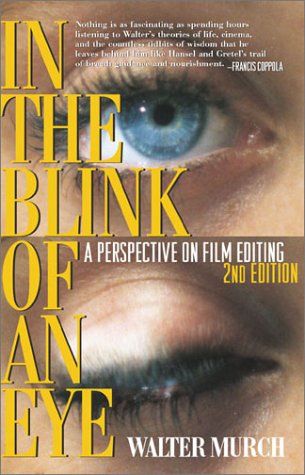
In the blink of an eye
A Perspective on Film Editing
Introduction
Nova: Have you ever noticed that when you are talking to someone, or even just thinking to yourself, you blink at very specific moments? It is not just about keeping your eyes moist. It is actually a physical punctuation mark for your thoughts.
Nova: In a way, yes! And that is exactly the insight that Walter Murch uses to unlock the entire mystery of film editing in his legendary book, In the Blink of an Eye. Murch is basically the godfather of modern editing. He worked on Apocalypse Now, The Godfather, and The English Patient. He is the only person to ever win Oscars for both sound and editing on the same film.
Nova: That is the point! Murch calls it the invisible art. If he does his job right, you do not even know he was there. But today, we are going to pull back the curtain and look at how a single blink can change the way a story is told. We are diving into the mind of Walter Murch and his philosophy on why movies even work in the first place.
Key Insight 1
The Rule of Six
Nova: Let us start with Murch's most famous concept: The Rule of Six. When an editor is deciding where to cut, they are balancing six different factors. But here is the kicker: they are not all equal. Not even close.
Nova: You would think so, right? But Murch puts Emotion at the very top. It accounts for a massive 51 percent of the decision. If the emotion is right, the audience will forgive almost anything else.
Nova: After Emotion, you have Story at 23 percent, and Rhythm at 10 percent. Then it drops down to the technical stuff: Eye-trace is 7 percent, the two-dimensional plane of the screen is 5 percent, and the three-dimensional space of the action is a tiny 4 percent.
Nova: Murch’s argument is that if you have the emotional truth of the moment, the audience’s brain will bridge the gap. He calls it a sort of misdirection, like a magician. If I make you feel what the character is feeling, you are not going to notice that their hand was on their chin in the wide shot but at their side in the close-up.
Nova: Exactly. He says that if you have to sacrifice one of these things, you start from the bottom. You can mess up the 3D space to save the rhythm. You can mess up the rhythm to save the story. But you never, ever sacrifice the emotion.
Key Insight 2
The Biology of the Cut
Nova: He is being incredibly literal. Murch noticed something fascinating while watching raw footage. He realized that an actor will blink at the exact moment they finish a thought or an emotional beat.
Nova: Yes! It is like a mental reset. Murch believes that we blink to separate one thought from the next. And here is the genius part: he realized that a film cut is essentially a collective blink for the audience.
Nova: Precisely. He actually talks about how he would watch a scene over and over, and he would mark the film right where he felt a natural urge to blink. More often than not, that was the perfect place for the cut. It is about finding the rhythm of human thought.
Nova: Even then, the eye-trace rule comes in. Murch talks about how an editor has to manage where the audience is looking. If the explosion is on the left in shot A, the next important thing in shot B should probably be on the left too, or your eye has to hunt for it. That hunting takes time, and it breaks the spell.
Key Insight 3
The Physicality of the Craft
Nova: One of the most surprising things about Walter Murch is how he actually works. Most people imagine an editor sitting in a dark room, hunched over a computer screen for twelve hours a day.
Nova: Not Murch. He edits standing up. He has been doing it for decades. He compares the editor to a cook or a surgeon. You do not see a chef sitting down to prepare a meal, right?
Nova: He says it keeps him physically engaged with the rhythm of the film. If you are standing, your whole body is involved in the pace. You can feel the dance of the images. He even has this analogy about the editor being like a shadow.
Nova: Sort of! He says the editor is the only person who sees the film the way the audience will, but they also know all the secrets. They are the shadow of the director's vision. He spent a year and a half editing Apocalypse Now. He had over 230 miles of film to go through. That is like 1.2 million feet of celluloid.
Nova: He used a system of still photos. He would take a single frame from every shot and pin them to the walls of his editing room. He called it his gallery. It allowed him to see the whole movie at a glance, to see the patterns and the colors before he ever made a cut.
Key Insight 4
The Digital Revolution
Nova: That is actually what the second edition of the book focuses on. He was one of the first big-name editors to embrace digital systems like Avid and Final Cut Pro. But he had some warnings about it.
Nova: That is exactly his point! He calls it the problem of infinite choice. In the old days, making a cut was a physical commitment. You had to be sure because it was a pain to change it. Now, you can generate fifty versions of a scene with a click.
Nova: Exactly. But Murch also points out a huge benefit: the density of information. Digital allows you to layer sound and image in ways that were impossible before. He worked on The English Patient using digital tools and won the Oscar for it, proving that the soul of the craft is not in the tools, but in the philosophy.
Nova: Always. He actually says that the faster the technology gets, the more important it is to slow down your brain and remember the blink. The technology changes, but the human eye and the human heart stay the same.
Conclusion
Nova: We have covered a lot of ground today, from the hierarchy of the Rule of Six to the biological connection between our thoughts and our eyelids. Walter Murch’s In the Blink of an Eye is not just a manual for film editors; it is a meditation on how we perceive reality.
Nova: That is the magic of it. The next time you are watching a film and you feel a surge of emotion, remember that it is likely because an editor like Murch found the perfect moment to blink with you. If you want to dive deeper, I highly recommend picking up the book. It is short, it is punchy, and it will change the way you see the world—literally.
Nova: This is Aibrary. Congratulations on your growth!