

The Lost Art of Shadow
Introduction
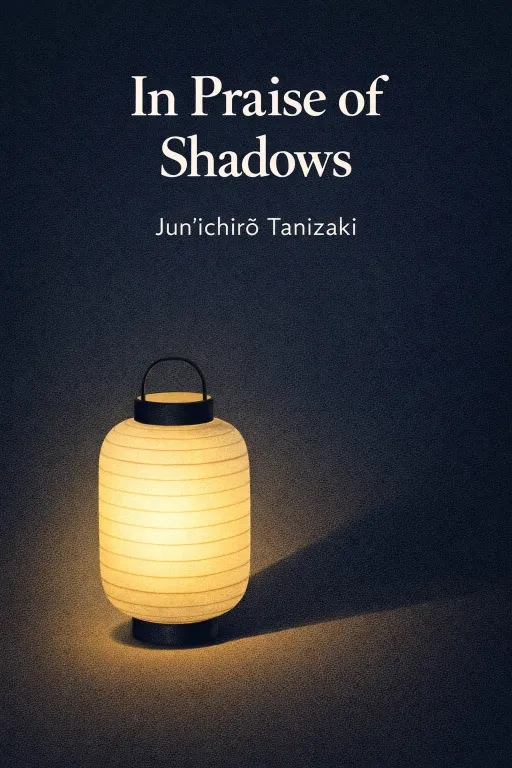
Narrator: What if our modern obsession with brightness is a mistake? We live in a world of floodlit stadiums, glaring phone screens, and sterile, white-walled rooms, constantly pushing back the darkness. But what if, in our relentless pursuit of light, we've accidentally erased a whole dimension of beauty? What if the things we consider flaws—tarnish, age, and shadow—are actually where true elegance resides? This is the provocative question at the heart of a short but profound 1933 essay by one of Japan's greatest modern writers. In In Praise of Shadows, Jun'ichirō Tanizaki presents a powerful lament for a world of nuanced beauty that is being systematically bleached away by the harsh glare of Western modernity. It’s an exploration of an entire aesthetic sensibility built not on light, but on its absence.
The Awkward Clash of Modernity and Tradition
Key Insight 1
Narrator: Tanizaki begins not with a philosophical treatise, but with a deeply personal and relatable frustration: the struggle to build a traditional Japanese house in the modern age. He details the “incredible pains” one must take to integrate modern conveniences without destroying the room's harmony. This isn't just about aesthetics; it's a fundamental conflict of principles.
He recounts his own experience, a series of frustrating compromises. He wanted traditional paper shoji screens for their soft, gentle light, but needed glass for security and insulation. His solution was a clumsy, expensive double-paned system that satisfied neither need perfectly and was, in his words, “far from pleasing.” The same battle occurred with heating. He found Western stoves ugly and noisy, clashing with the quiet austerity of a Japanese room. His solution was to build a custom, sunken hearth with an electric brazier—an elegant but costly fix.
The most telling example is the simple light switch. Where do you put it? Hiding it in a closet or behind a screen feels fussy and contrived. Yet leaving it exposed on a traditional wooden pillar is an eyesore. Tanizaki observes that sometimes, the most honest approach is a single, naked bulb hanging from a cord in a rustic farmhouse. Its unpretentious simplicity is more elegant than any strained attempt to hide it. This struggle illustrates his core point: Western technology wasn't designed for a world of shadows. It’s an intruder, and its presence, no matter how cleverly concealed, creates an inescapable sense of discord.
The Transformative Power of Darkness
Key Insight 2
Narrator: For Tanizaki, darkness is not an empty void; it’s an active, essential ingredient for beauty. He argues that many of Japan’s most treasured objects were created to be seen in dim, flickering light, and their magic is lost in the flat, even glare of electricity. The most powerful example he offers is lacquerware.
He asks the reader to imagine a bowl of soup, served in a black lacquer bowl, in a room lit only by a single candle. Under electric light, lacquerware can seem gaudy or plain. But in the faint, wavering candlelight, its true nature is revealed. The darkness outside the bowl makes its deep, rich blackness seem to sink into an infinite, silent depth. The gold maki-e designs on its surface don't glitter brightly; they emit a soft, pensive glow, as if collecting the last rays of dying light. The soup itself, nestled in the shadowy vessel, appears mysterious and profound.
Tanizaki recounts visiting a famous Kyoto restaurant, the Waranjiya, which was once known for its candlelight. Upon returning after many years, he found they had switched to electric lamps shaped like old lanterns. The reason? Customers had complained the candlelight was too dim. For Tanizaki, this change destroyed the experience. The lacquerware looked shallow, its beauty gone. He understood that the restaurant had to adapt, but it proved his point: the aesthetic of lacquerware is inseparable from the world of shadows it was born from. Without the darkness, there is no beauty.
The Beauty of Grime and the Sheen of Antiquity
Key Insight 3
Narrator: The Western aesthetic often prizes the new, the brilliant, and the polished. Tanizaki presents a compelling counter-vision: a love for the marks of time and use. He notes that Westerners polish their silver to a brilliant shine, but the Japanese have always preferred the "dark, smoky patina" that silver and tin acquire with age. They would scold maids for polishing it away, as the tarnish was seen as a sign of character.
He provocatively calls this the "glow of grime." This sheen isn't from polishing, but from the oils of human hands touching an object over and over for decades. It's the luster of a well-loved teapot, the darkened wood of a temple floor, the softened edges of a stone lantern. This aesthetic extends to other materials as well. He notes that Japanese and Chinese connoisseurs prefer jade and crystal that are not perfectly clear but have a "cloudiness" or opaque veins, giving them a deeper, more pensive quality than a "shallow brilliance."
This isn't a love for dirt, but an appreciation for the story that an object tells. The grime is evidence of a life lived. It connects the object to the generations of people who have held it, creating a sense of peace and continuity. For Tanizaki, an object gleaming with a "sheen of antiquity" possesses a quiet, profound beauty that no brand-new, perfectly polished item can ever match.
An Architecture Designed to Capture Shadows
Key Insight 4
Narrator: The traditional Japanese aesthetic of shadow is not an accident; it's a deliberate architectural choice. Tanizaki explains that the beauty of a Japanese room is created by a careful modulation of light and dark. He compares it to an ink wash painting.
The design starts with the roof. Unlike in the West, the traditional Japanese roof is massive and its eaves are incredibly deep, acting like a giant parasol. This structure is designed to block the direct sun, plunging the interior into a world of soft, indirect light. The light that does enter filters through paper shoji screens, which act like the thinnest, most luminous part of the ink wash painting.
From there, the shadows deepen. The walls are often a neutral, sandy texture that absorbs light rather than reflecting it. The shadows pool in the corners and collect most intensely in the tokonoma, the decorative alcove. This alcove, Tanizaki argues, is the focal point of the room's beauty precisely because it is the darkest space. Any scroll or flower arrangement placed within it is not meant to be seen clearly, but to be half-glimpsed, its details dissolving into the profound darkness that surrounds it. This interplay—from the bright paper screen to the deep, inky blackness of the alcove—creates a visual and spiritual depth that a uniformly lit room could never achieve.
The Resigned Mind Versus the Progressive Drive
Key Insight 5
Narrator: Why did these different aesthetics develop? Tanizaki offers a philosophical explanation. He suggests that "we Orientals" tend to seek satisfaction in our given surroundings. If a room is dark, we don't immediately seek to flood it with light. Instead, we "resign ourselves to it as inevitable" and then "immerse ourselves in the darkness and there discover its own particular beauty." It’s an aesthetic of acceptance.
In contrast, he characterizes the "progressive Westerner" as someone who is "determined always to better his lot." If a space is dark, the immediate impulse is to fix it, to invent brighter lamps, to paint the walls white, to eradicate every last shadow. This relentless drive for improvement, while leading to incredible technological and scientific gains, comes at an aesthetic cost. It leaves no room for the beauty of ambiguity, imperfection, or the quiet contemplation found in a dimly lit space.
This fundamental difference, Tanizaki argues, is why the West has been able to move forward in ordered steps, while the East has had to surrender its own path. The essay is a lament for what has been lost in that surrender—a world where beauty was found not by conquering nature, but by finding one's place within its shadows.
Conclusion
Narrator: The single most important takeaway from In Praise of Shadows is that beauty is not a universal constant, but a fragile quality that "must always grow from the realities of life." It is profoundly contextual, dependent on the very environment it inhabits. By changing our environment from one of candlelight and shadow to one of electricity and glare, we have not merely upgraded our technology; we have rendered an entire world of beauty obsolete. The deep, resonant glow of lacquerware, the subtle power of a Nō actor's mask, the quiet repose of a traditional room—these things cannot survive in the harsh light of the modern world.
The book ends on a note of poignant resignation. In an anecdote shared by his wife, an architect once proudly told Tanizaki he had read In Praise of Shadows and knew exactly how to build the author's next house. Tanizaki's reply was simple: "But no, I could never live in a house like that." This reveals the essay for what it truly is: not a practical guide for a return to the past, but a eulogy for a sensibility that, even for its greatest champion, was already irretrievably lost. It leaves us with a challenging question: In our own relentless drive for clarity, efficiency, and perfection, what subtle, irreplaceable beauties are we unknowingly erasing from our world?