

Personalized Podcast
Golden Hook & Introduction
SECTION
Albert Einstein: Imagine, Ashley, a universe of absolute, blinding light. No corners, no crevices, no relief. Just a relentless, uniform glare. It sounds like a perfect, clean ideal, doesn't it? But in reality, in such a world, you would see absolutely nothing. Without the contrast of darkness, light itself becomes invisible.
Ashley: That is a fascinating way to put it, Albert. It’s like looking at a dataset with zero variance. If every single data point is identical, if there’s no deviation, no highs, no lows, no noise... you actually have no information at all. You need the variance—the deviations—to see the pattern.
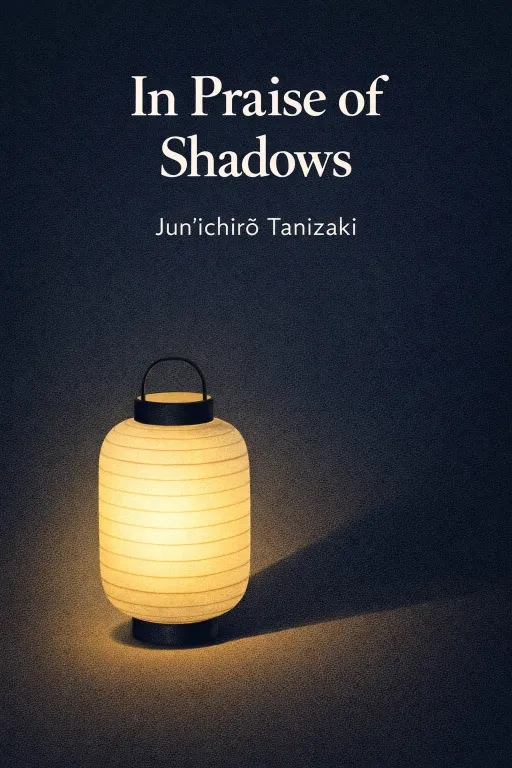
Albert Einstein: Exactly! The variance is where the story lives. And that is precisely the beautiful, provocative argument at the heart of Jun'ichirō Tanizaki’s classic essay,. Written back in 1933, it’s this gorgeous, wandering meditation on how traditional Japanese aesthetics found deep, spiritual beauty not in the bright, polished, and explicit, but in the dim, the tarnished, and the shadowed.
Ashley: I have to admit, when I first picked up the book, I wondered how a decades-old essay on Japanese architecture and design would connect to my life. But as I read, I realized Tanizaki is talking about something much deeper than just home decor. He’s challenging us to look at how we perceive ourselves.
Albert Einstein: Yes, it is a guide for the soul disguised as a design manual! Today, we are going to dive into this extraordinary text from three distinct angles. First, we’ll explore the concept of "patina" and why the marks of time and wear are actually where true character resides. Second, we’ll look at the "architecture of shadows"—how the quiet, unseen spaces in our lives give shape to our visible achievements. And finally, we’ll discuss how to apply this "shadow aesthetic" to our own personal growth, learning to admire the unpolished parts of who we are becoming.
Deep Dive into Core Topic 1 - The Patina of Growth
SECTION
Albert Einstein: Let us start with a thought experiment. Think of a highly polished, brand-new silver spoon. It reflects everything perfectly, glittering under the electric lights. Now, compare that to a piece of silver that has been allowed to age naturally. It has darkened, taking on a smoky, deep luster. Tanizaki writes about how Westerners love to polish their silver until it shines with a shallow brilliance, whereas in the East, they cherish what they call the "sheen of antiquity." They actually scold maids who try to polish away that dark tarnish!
Ashley: That part of the book really jumped out at me. Tanizaki uses this wonderful phrase—he calls it the "glow of grime." Now, "grime" sounds dirty to our modern ears, but he explains that it’s actually the oil from human hands, the touch of time, the physical record of an object being handled, loved, and used over generations. It’s a history made visible.
Albert Einstein: Ah, the "glow of grime!" It is a marvelous paradox. In physics, we know that everything in the universe is subject to entropy—things naturally move from order to disorder, they wear down. But Tanizaki suggests that this wearing down is not a defect; it is the birth of beauty. The object accumulates a soul.
Ashley: It makes me think about how we treat our own lives, especially in a culture that is so obsessed with presenting a polished, flawless exterior. We want our resumes to look perfect, our social media feeds to be immaculate, our career paths to be completely linear. We try to polish away every mistake, every setback, every period of confusion. But if you polish away all the tarnish, don't you lose the depth?
Albert Einstein: You lose the very essence of the journey! If a mountain were perfectly smooth, you could never climb it. It is the jagged rocks, the crevices, the rough patches that give you purchase. Tanizaki talks about Chinese jade and how they prefer jade that is slightly cloudy, with opaque veins running through it, rather than a crystal-clear stone. The cloudiness gives it a pensive, mysterious depth.
Ashley: That cloudiness is such a great metaphor for our own minds. As an analyst, I spend my days trying to clean up messy data, to find the signal in the noise. But in life, some of the most valuable insights come from the "messy" phases—the times when we don't have all the answers, when our direction is cloudy. Those aren't wasted periods; they are the times when our internal "patina" is forming.
Albert Einstein: Yes! Think of a young tree. If it grows in a greenhouse with perfect light and no wind, its wood remains soft and weak. But if it grows in the wild, exposed to storms, bent by the wind, scarred by frost... the wood becomes incredibly dense and strong. The scars are not blemishes; they are the structural integrity of the tree.
Ashley: Exactly. And Tanizaki contrasts this with the Western drive for constant improvement and the eradication of shadows. He notes that the progressive Westerner is always determined to better their lot, to bring in more light, to build bigger, brighter, more efficient systems. But in doing so, we often run away from the quiet, reflective spaces where we actually integrate our experiences.
Albert Einstein: We become afraid of the dark, quite literally! We install bright streetlights, flood our homes with fluorescent glare, and keep our screens glowing late into the night. We have banished the shadows, but in doing so, we have also banished the silence. We have made it very difficult to just.
Deep Dive into Core Topic 2 - The Architecture of Shadows
SECTION
Albert Einstein: This brings us to our second theme: the architecture of shadows. Tanizaki spends a lot of time analyzing the traditional Japanese house. He points out that the beauty of these buildings doesn't come from the walls or the ornaments themselves, but from the massive, heavy roofs and deep eaves that cast vast pools of shadow inside the rooms. He writes, "A Japanese room might be likened to an ink wash painting, the paper-paneled shoji being the expanse where the ink is thinnest, and the alcove where it is darkest."
Ashley: I loved that imagery. He’s saying that the room isn't designed to be lit up; it’s designed to darkness. The paper screens, the shoji, don't let in direct sunlight—they filter it, turning it into a soft, indirect, almost liquid light. And then you have the tokonoma, the alcove, which is kept deliberately dark. You hang a scroll there, or place a simple flower, and because it’s enveloped in shadow, your imagination has to fill in the details.
Albert Einstein: Ah, the imagination! The mind is a wonderful instrument that abhors a vacuum. When you give it a perfectly lit, explicit space, it becomes lazy. But when you give it shadows, it begins to play. It is like the silence between the notes in a symphony. If a composer wrote a piece with only continuous, loud notes, it would not be music; it would be noise. The silence is what gives the notes their power.
Ashley: That’s a beautiful analogy, Albert. It reminds me of a case Tanizaki mentions about traditional lacquerware. He explains that if you look at gold-patterned lacquerware in a brightly lit modern room, it can look gaudy, even vulgar. But if you place that same lacquerware in a dimly lit, candlelit room, something magical happens. The dark, glossy surface of the lacquer seems to absorb the darkness, and the gold patterns suddenly catch the flickering candlelight, gleaming with a deep, mysterious warmth. It was designed specifically to be seen in the dark.
Albert Einstein: Yes! The gold is not there to be flashy; it is a practical reflector of light in a dark space. It is a functional aesthetic. The creators of that lacquerware understood the environment it would live in. They didn't try to fight the darkness; they collaborated with it.
Ashley: "Collaborating with the darkness." I love that phrase. In our careers, we often feel like we always have to be "on," always visible, always producing. We treat our lives like a brightly lit showroom. But some of our best work—our deepest creative insights, our most profound self-reflections—happens in the quiet, low-visibility phases. The times when we are working behind the scenes, studying, resting, or even failing in private. Those are our "shadow spaces."
Albert Einstein: And they are absolutely essential! Think of the creative process. If you force a seed into the light too early, it dies. It needs the dark, damp earth to germinate, to grow its roots before it ever breaks the surface. If we do not allow ourselves those quiet, hidden periods of germination, our public achievements will be shallow and fragile.
Ashley: It’s so true. I think about my own transition into data analysis. There was a long period where I felt completely in the dark, struggling to learn complex programming languages and statistical models. It felt like I wasn't making any visible progress. But looking back, that "shadow phase" was where the real foundation was laid. It shaped my analytical mindset in ways that a quick, easy win never could have.
Albert Einstein: You were building your roots in the dark, Ashley! And now, those roots support the visible tree of your career. Tanizaki even applies this to the most mundane aspects of life. He has this incredibly famous, almost poetic passage about the traditional Japanese toilet. He describes it as a place of "spiritual repose," built away from the main house, surrounded by the smell of green moss and the sound of rustling leaves, lit only by the soft light filtering through paper screens.
Ashley: It’s hilarious but also deeply profound how he elevates something so basic to a high art form! He contrasts it with the Western-style bathroom, which is all white porcelain, sparkling metal, and harsh, sterile light. He says the Western bathroom is designed for clinical efficiency, while the Japanese version is designed to connect you with nature and your own quiet thoughts.
Albert Einstein: It is about creating a sanctuary for contemplation. Even in the most earthy, physical aspects of our existence, we can find a space for beauty if we allow the shadows to remain. It is a refusal to let the clinical, hyper-rational, and overly bright aspects of modern life colonize every corner of our experience.
Synthesis & Takeaways
SECTION
Albert Einstein: As we begin to weave these threads together, let us look at the big picture. Tanizaki’s essay is, at its heart, a gentle rebellion. He is not saying that light is bad, or that modern technology is evil. He is simply warning us that in our rush to illuminate everything, we are losing something irreplaceable. We are losing the nuance, the depth, the mystery, and the peace that can only be found in the shadows.
Ashley: And for me, as someone who is still early in my career and figuring out who I want to become, this book is a permission slip. It’s permission to stop trying to be perfectly polished all the time. It’s permission to value my mistakes, my quiet periods, and my unresolved questions as essential parts of my personal landscape.
Albert Einstein: Yes! Your "shadows" are not your weaknesses, Ashley. They are the contours of your character. They are what make you a three-dimensional human being rather than a flat, two-dimensional image.
Ashley: So, how do we practically apply this? How do we "admire our shadows" as they shape who we become? I think it starts with changing our relationship with our past mistakes and struggles. Instead of trying to polish them away or hide them, we can look at them as our "patina"—the tarnish that proves we have lived, learned, and grown.
Albert Einstein: Beautifully said. And second, we must actively protect our "shadow spaces" in daily life. We must carve out times and places that are free from the harsh glare of constant connectivity, constant productivity, and constant self-promotion. We need to allow ourselves to sit in the quiet, filtered light of contemplation, letting our thoughts drift and our imaginations play.
Ashley: It’s about finding our own "tokonoma"—that quiet alcove within ourselves where we don't have to show off, where we can just let things settle in the dimness.
Albert Einstein: Let us leave our listeners with a thought experiment to carry with them. Tonight, when the sun goes down, do not immediately reach for the light switch. Sit for just five minutes in the gathering dusk. Watch how the shapes of your room soften, how the details fade, and how your mind begins to quiet down. Ask yourself: What beautiful things are waiting to be discovered in the shadows of my own life?
Ashley: Because, as Tanizaki so beautifully reminds us, "Were it not for shadows, there would be no beauty." Thank you, Albert, for this wonderful conversation.
Albert Einstein: Thank you, Ashley. Keep embracing your patina, and let your shadows shine!