

The Glow of Grime
Golden Hook & Introduction
SECTION
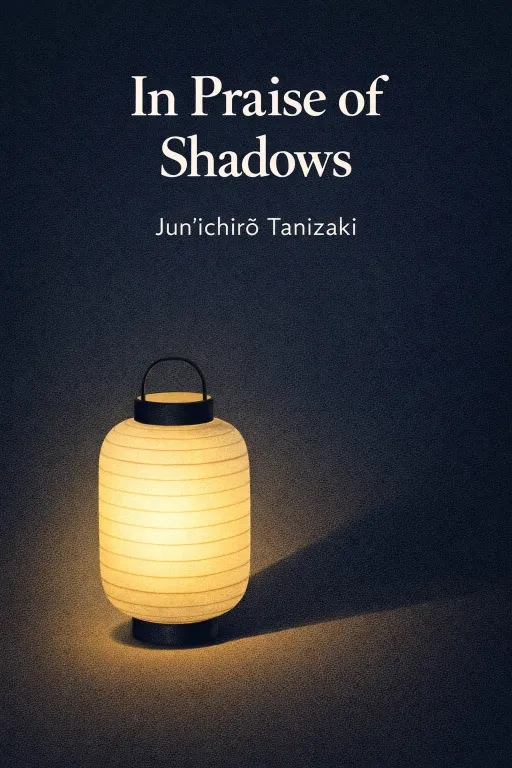
Olivia: Our entire modern world is built on a lie: that brighter is better. We flood our homes with light, polish every surface, and chase a sterile perfection. But what if true beauty, real comfort, actually lives in the shadows we’re so desperate to eliminate? Jackson: That hits home. I mean, my entire social media feed is just people showing off their blindingly white kitchens and using ring lights to erase every possible shadow from their face. We are obsessed with brightness. It feels like a moral good, almost. Olivia: Exactly. We equate light with clarity, with progress, with cleanliness. But an incredible essay from 1933 argues this is a profound mistake, a cultural wrong turn that has cost us something irreplaceable. Today, we’re diving into the slim but monumentally influential book, In Praise of Shadows, by Jun'ichirō Tanizaki. Jackson: And it’s important to know, Tanizaki wasn't just some designer with a quirky opinion. This was one of Japan's most celebrated novelists of the 20th century. He was even shortlisted for the Nobel Prize in Literature. So when he writes about aesthetics, it’s coming from a place of deep cultural and artistic reflection. Olivia: It absolutely is. And this essay is now considered a classic, a foundational text for anyone in architecture, design, or anyone just interested in a completely different way of seeing the world. He argues that for centuries, Japanese culture cultivated an entire aesthetic around darkness. And he starts his argument in the most unexpected, and frankly, provocative place imaginable. Jackson: Okay, I'm intrigued. Where does he begin this grand theory of beauty? Olivia: The toilet. Jackson: Come on. The toilet? You’re telling me the grand theory of Japanese aesthetics starts in the bathroom? Olivia: He says, and this is a direct quote, that "of all the elements of Japanese architecture, the toilet is the most aesthetic." Jackson: Wow. Okay. You have my full attention. This is already not what I expected.
The Beauty of Grime: Why Shadows and Imperfection Matter
SECTION
Olivia: Right? It’s a deliberate shock to our Western sensibilities. We think of the bathroom as a purely functional, sterile space that we want to be as bright and clean as possible. We want gleaming white porcelain and shiny chrome fixtures. Tanizaki finds that horrifying. Jackson: Horrifying is a strong word. What’s his ideal, then? Olivia: He describes the traditional Japanese toilet, which was often a separate structure in the garden, away from the main house. You’d walk down a covered veranda to get there. Inside, it's dim, even in the middle of the day. The light that filters through the shoji paper screens is soft and indirect. The room is silent, impeccably clean, but made of natural materials—unvarnished wood that has aged over time. Jackson: So it’s more like a little meditation hut than a bathroom. Olivia: Precisely. He calls it a place of "spiritual repose." He talks about gazing out the window at the garden, listening to the sound of the rain, and how the dim light makes you appreciate the beautiful grain of the wooden ceiling. It’s a place designed for contemplation, a stark contrast to our brightly lit, noisy, tiled rooms where we just want to get in and get out. Jackson: I can see the appeal, honestly. It sounds peaceful. But it’s still a wild place to start a theory of beauty. It feels like he’s making a bigger point. Olivia: He is. The toilet is the perfect example of an aesthetic that embraces darkness and natural materials over artificial brightness and sterile surfaces. And this principle extends to everything. He argues that the entire Japanese sense of beauty was born from accepting the shadows that their architecture, with its deep eaves and heavy roofs, naturally created. He says, "our ancestors, forced to live in dark rooms, presently came to discover beauty in shadows, ultimately to guide shadows towards beauty’s ends." Jackson: That’s a fascinating way to put it. Instead of fighting the darkness, they leaned into it. They made it the main event. Olivia: Exactly. And this is where we get to my favorite example in the book: lacquerware. Have you ever seen a traditional Japanese lacquer soup bowl? They’re often a deep, dark red or black. Jackson: Yeah, I think so. They’re beautiful, but in a restaurant, under bright lights, they just look like… dark bowls. Olivia: That’s his point! He says under a bright, modern electric light, they can look garish or just flat. But he asks you to imagine that same bowl in a dimly lit room, with only the flickering light of a single candle. He describes how you can’t see the soup inside clearly. You bring the bowl to your mouth, and in that moment, as you glimpse the dark, silent liquid in the bottom of the bowl, you get a sense of its profound depth. The candlelight catches the gold dust sprinkled on the lacquer, and it doesn't glitter—it gives off a soft, heavy gleam. Jackson: Whoa. You’re describing a bowl of soup like it’s a portal to another dimension. Olivia: He basically is! He says the experience is a "wordless, silent poetry." The darkness isn't hiding the bowl's beauty; it's revealing it. The shadows create a sense of mystery and depth that bright light would completely obliterate. The beauty isn’t in the object itself, but in the play of light and shadow upon it. Jackson: That makes me think of the concept of patina. You know, how we value an old leather jacket or a worn-in wooden table more than a brand new one. Is that related? Olivia: It’s the exact same idea, but he takes it a step further. He talks about the Japanese preference for silver that has tarnished, that has a "dark, smoky patina," over brilliantly polished silver. He says Westerners are obsessed with polishing away any sign of age, any sign of use. Jackson: Guilty as charged. Olivia: But Tanizaki says the Japanese love the "sheen of antiquity." And then he delivers this incredible line: this sheen is, in fact, "the glow of grime." Jackson: The glow of grime? Okay, now that sounds a bit much. Is he just romanticizing being dirty? I can hear people thinking, 'I don't want grime in my house.' Olivia: It sounds provocative, but he clarifies. He’s talking about the sheen that comes from an object being touched over and over again for years, the oils from human hands slowly permeating the surface. It’s the mark of time and human contact. It’s not about a lack of hygiene; it’s about a love for things that show their history. He says a brand new, glittering object has a "shallow brilliance," but an old object has a deep, pensive luster. It has a story. Jackson: Okay, put that way, it makes more sense. It's the beauty of a life well-lived, but for an object. It’s the opposite of our disposable, upgrade-every-year culture. This all sounds incredibly beautiful, almost like a fantasy world. Can you even find this today?
The Lost World: A Pessimistic Aesthetic for a Modern Age
SECTION
Olivia: And that question, Jackson, gets to the tragic, beating heart of this essay. The answer is… mostly no. And Tanizaki knew it. He was writing this in 1933, and he was already writing a lament. He saw that the world he was praising was being systematically destroyed by the relentless march of Western technology, especially the electric light. Jackson: So it’s not a celebration, it’s a eulogy. Olivia: It’s a eulogy. He gives this poignant example of a restaurant he loved in Kyoto, the Waranjiya, which was famous for its candlelit dining rooms. He went back after a long absence and found they’d replaced the candles with electric lamps designed to look like old lanterns. Jackson: Oh, that’s the worst. The fake old-timey look. Olivia: He was devastated. He asked why, and the owner said customers had complained that the candlelight was too dim. The modern world demanded brightness. The restaurant even offered to bring him candles if he preferred, which he accepted, but the point was made. The default had changed. The world of shadows was already an exception, a special request. Jackson: That’s actually heartbreaking. The very thing that made the place special was being erased by popular demand. It’s progress eating its own tail. Olivia: And this is where the afterword of the book, written by the translator Thomas J. Harper, provides the most stunning piece of context. It’s an anecdote that reframes the entire essay. Years after the book was published, Tanizaki was planning to build a new house. Jackson: Okay, I can see where this is going. An architect is going to show up with a copy of the book. Olivia: You nailed it. An eager young architect came to him and said, "Mr. Tanizaki, I’ve read your In Praise of Shadows, and I know exactly what you want." And Tanizaki’s reply was devastating. He said, "But no, I could never live in a house like that." Jackson: Wait. What? The author of In Praise of Shadows wouldn't want to live in a house of shadows? My mind is blown. Why? What does that even mean? Olivia: It’s the ultimate paradox, isn't it? And it’s the key to the whole book. Harper, the translator, explains that Tanizaki’s aesthetic is fundamentally pessimistic. He knew that the beauty he described wasn't just about dim lighting and old wood. It was tied to an entire way of life that no longer existed. A life without electricity, without modern plumbing, without the constant demand for efficiency and convenience. Jackson: So to build a "shadows" house in the modern world would be… a costume. A theme park. Olivia: "Mere posturing," is the phrase Harper uses. Tanizaki understood that you couldn't just recreate the aesthetic without the life that produced it. It would be a cold, sterile copy. An art form, he believed, must be part of daily life, or it's dead. A museum piece. And he had no interest in living in a museum. Jackson: Wow. That adds such a layer of sadness to the whole thing. He’s not giving us a 'how-to' guide for a more beautiful life. He's documenting a world that is already lost and explaining why we can't go back. Olivia: Exactly. He contrasts the Oriental mindset with the Western one. He says, "we Orientals tend to seek our satisfactions in whatever surroundings we happen to find ourselves... If light is scarce then light is scarce; we will immerse ourselves in the darkness and there discover its own particular beauty. But the progressive Westerner is determined always to better his lot." Jackson: And that’s us. We are the progressive Westerners, always trying to "better our lot." We can’t just accept a dim corner; we have to install a brighter bulb. We can’t accept a slow process; we have to optimize it. We see a shadow and our first instinct is to eradicate it. Olivia: And Tanizaki’s essay is a quiet, powerful question: What have we lost in that relentless pursuit? What subtle beauties have we paved over in our rush to make everything brighter, faster, and clearer?
Synthesis & Takeaways
SECTION
Jackson: This is so much deeper than just a book about design. It’s a philosophy of life. It makes you look at your phone, your bright white office, the LED streetlights outside, and wonder what we're erasing. What subtle, quiet, 'grimy' beauty are we systematically eliminating in the name of efficiency and so-called progress? Olivia: That’s the core of it. The book isn't really telling us to go live in unlit houses. It's asking us to reconsider our values. It’s a critique of the relentless, unquestioning drive for "improvement." Tanizaki offers another path: the path of acceptance, of finding beauty in what is, rather than constantly striving for what could be. It's about appreciating the imperfections, the patina of age, the quiet moments. Jackson: It’s a call to pay attention to a different frequency of beauty. The kind that doesn't shout, but whispers. The kind you can only perceive when you turn down the noise and the lights. Olivia: Perfectly put. And that’s why this essay, written almost a century ago, feels more relevant than ever in our hyper-illuminated, digitally-saturated world. It’s a powerful reminder that not everything that is valuable can be measured, optimized, or brightly lit. Some of the most profound experiences in life happen in the shadows. Jackson: It’s a beautiful and slightly melancholic thought. It’s not about rejecting modernity wholesale, but maybe about carving out our own little pockets of shadow. Olivia: I think so. The book ultimately forces you to ask a very personal question: what shadows in your own life—what imperfections, what quiet moments, what 'glow of grime'—are you trying too hard to illuminate and polish away? Jackson: That is a question to sit with. We'd genuinely love to hear your thoughts on this. Does this idea of praising shadows resonate with you, or does it just sound impractical and romantic? Find us on our socials and let us know what you think. Olivia: This is Aibrary, signing off.