The Ikigai Blueprint: Engineering a Life of Purpose and Flow
Golden Hook & Introduction
SECTION
Nova: Brian, we're all so busy. Our calendars are packed, our to-do lists are endless. But how often do we pause and ask, 'Is any of this my actual?' The book suggests that many of us are running on a treadmill, mistaking activity for meaning.
Brian: That's a powerful way to put it, Nova. It really hits home. In my work as a project manager, especially in the non-profit world, the big 'why'—the mission—is always there. But on a tough Tuesday afternoon, when you're buried in spreadsheets and logistics, it's easy to lose the connection between your daily tasks and that larger purpose. The question of 'how' to stay motivated and feel that purpose is a constant challenge.
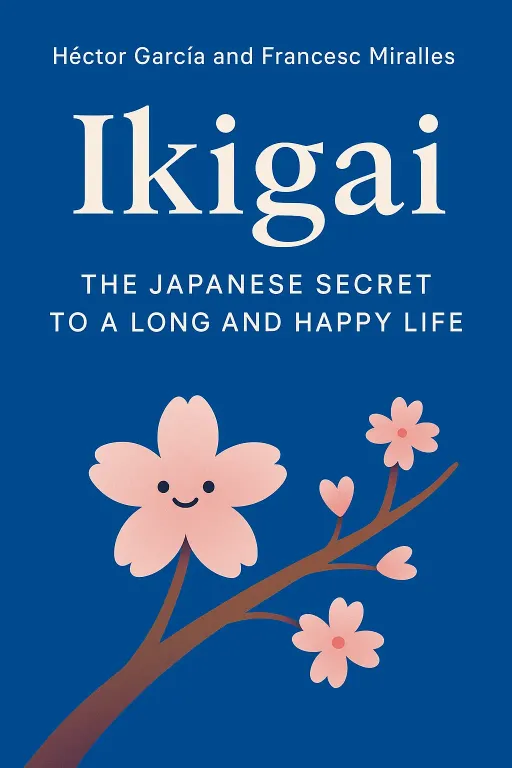
Nova: Exactly. And that's why I'm so excited to talk about this book, by Héctor García and Francesc Miralles. It’s not some mystical text; it’s a practical compass. It draws wisdom from the world's longest-living people to help us answer that very question. Today, we're going to unpack this from two powerful angles.
Brian: I'm ready. An analytical approach to purpose sounds right up my alley.
Nova: Perfect. First, we'll explore how to find our purpose not by thinking, but by —a radical shift from a lot of Western psychology. Then, we'll discuss the unmistakable feeling that tells you you're on the right track, and how embracing imperfection is the secret to keeping that feeling alive.
Brian: Fantastic. Let's dive in.
Deep Dive into Core Topic 1: The Action-Based Compass
SECTION
Nova: Okay, so let's start with that first idea. We're often taught to 'find our passion' as if it's a hidden treasure we have to unearth through deep thought. The book begins by acknowledging a cornerstone of this thinking: the work of Viktor Frankl and his Logotherapy.
Brian: Right, Frankl's. The idea that "He who has a why to live for can bear with almost any how."
Nova: Precisely. And the book shares his powerful origin story. Frankl, a psychiatrist, was a prisoner in Auschwitz. Upon arrival, the manuscript for his life's work was confiscated and destroyed. He was stripped of everything. Yet, in the midst of unimaginable horror and despair, he found a new purpose: to rewrite that book. He would scribble fragments on scraps of paper. That singular 'why'—the need to reconstruct his work—gave him a reason to survive each day. It’s the ultimate testament to the power of having a purpose.
Brian: It’s an incredible story of resilience. That 'why' becomes an anchor in the storm.
Nova: It does. But here's where the authors of introduce a fascinating Japanese counterpoint. They argue that while finding a 'why' is crucial, we can get stuck just about it. The Japanese approach, particularly through something called Morita therapy, is less about analyzing your feelings and more about focusing on your actions.
Brian: So, less introspection, more... doing?
Nova: Exactly. Shoma Morita, the therapy's founder, believed you should accept your feelings—anxiety, doubt, frustration—as natural, like the weather. You don't try to control the rain, you just grab an umbrella. His core mantra was simple: "What do we need to be doing right now?" The idea is that purpose isn't found in a moment of grand revelation; it's built, brick by brick, through your actions.
Brian: You know, that's a complete game-changer for someone in my field. In project management, you're dealing with huge, complex problems. If you're running a program to improve literacy in a community, you can get paralyzed by the scale of it all. This 'Morita' idea is the very soul of agile methodology.
Nova: How so? Tell me more about that connection.
Brian: Well, in agile, you don't try to build the entire, perfect software or solve the whole problem at once. You ask, "What's the one small, valuable thing we can accomplish in the next two weeks?" You build a tiny piece, you deliver it, you get feedback. That action creates momentum. And ironically, that momentum builds the very purpose and morale you were looking for. It’s not about feeling motivated to start; it’s about starting in order to feel motivated.
Nova: Wow. So purpose isn't a destination you navigate to, it's the momentum you build from taking the next right step.
Brian: Exactly! It reframes purpose from a noun to a verb. It’s not something you, it’s something you. And that feels so much more empowering and less intimidating.
Nova: I love that framing: 'purpose as a verb.' It’s active, it’s alive. And that leads us perfectly to our second big question: If you're busy 'doing' your purpose, how do you actually you're on the right path? How do you recognize the feeling?
Brian: The million-dollar question. What's the signal?
Deep Dive into Core Topic 2: The Signature of Purpose
SECTION
Nova: The book gives us a very clear signal: the state of 'flow.' It’s a term from psychologist Mihaly Csikszentmihalyi. Flow is that magical state of total immersion in an activity. Your sense of self vanishes, time distorts, and the action itself becomes its own reward. It’s the signature of your Ikigai in motion.
Brian: I think we've all felt that at some point, even in small ways. When you're so absorbed in a task that you look up and hours have passed.
Nova: Yes! And the book gives these beautiful examples of Japanese, or master artisans, who live in a state of flow. There's this one story about a visit to Kumano, a town famous for making makeup brushes. The authors couldn't figure out who was putting the bristles in the brush heads. Finally, the company president led them to a small, separate building.
Brian: A secret workshop?
Nova: Almost. Inside, in a quiet, sunlit room, a single woman sat, sorting individual bristles by hand. Her movements were a blur—quick, precise, and utterly focused. She was completely one with her task. The world outside, the noise, the distractions, it all disappeared for her. That was her Ikigai in action. That was her flow.
Brian: That's a beautiful image. The dedication to a craft at that level is awe-inspiring. But let's be honest, most of us aren't master artisans. My job involves a lot of emails and meetings. Can you find flow in that?
Nova: That's the brilliant next step the book takes. It says you don't have to be a. It even tells a story of an elevator operator in Tokyo who turned her repetitive job into a performance, with a songlike greeting and graceful movements. She found 'microflow.' But here’s the real twist, and I think this is crucial for anyone in a leadership role. The 's work is about achieving perfection. What about the rest of us, whose work and lives are inherently messy?
Brian: You're speaking my language now.
Nova: The book introduces the concept of. It's a core Japanese aesthetic centered on finding beauty in the flawed, the imperfect, and the incomplete. It’s the art of appreciating a cracked ceramic bowl or a weathered wooden gate. It's a profound idea that you don't need a perfect outcome to experience flow or find meaning.
Brian: Okay, that… that resonates so much. No project is ever perfect. There are always budget cuts, unexpected problems, compromises you have to make. If your happiness is tied to a flawless result, you're signing up for a life of misery.
Nova: So how does that idea of change things?
Brian: It changes everything. It means you can find 'flow' in the of solving those messy, unexpected problems. And then, when you're done, you can look at the imperfect but impactful result—the program that helped 80% of its target, not 100%—with a 'wabi-sabi' lens. You can see the beauty in what was actually achieved, given the real-world constraints. That's not failure; that's resilience. That's sustainability in a purpose-driven career.
Nova: So it's about appreciating the 'good enough' that makes a real difference?
Brian: Yes, and appreciating the unique story the imperfections tell! The book also mentions, right? 'One time, one meeting.'
Nova: Yes, the idea that every moment is a once-in-a-lifetime encounter.
Brian: That's it. Every project, every team, every challenge is unique and will never happen in exactly the same way again. Seeing the beauty in that specific, fleeting, imperfect journey... that feels like a much healthier and more profound way to live and work than just chasing some abstract ideal of perfection.
Synthesis & Takeaways
SECTION
Nova: I think you've just perfectly synthesized the whole philosophy. What we've really uncovered here is a two-part blueprint for a life of purpose. First, find your direction through action, not just abstract thought. Let what you guide you.
Brian: The 'Action-Based Compass.'
Nova: Exactly. And second, recognize you're on the right path when you hit that state of 'flow,' and you sustain that feeling by letting go of perfectionism and embracing the messy, beautiful, imperfect reality of the journey.
Brian: It’s a framework that’s both deeply spiritual and incredibly practical. It gives you a way to start and a way to keep going.
Nova: So, for everyone listening, especially those who, like you, Brian, are analytical and want a concrete first step, what's the takeaway? What's the one thing we can do tomorrow?
Brian: I think the most practical advice here is to become a 'flow detective' in your own life. Forget about finding your one grand purpose for a moment. Just for the next week, notice—don't judge, just collect the data—one activity where you lose track of time. It could be organizing a spreadsheet, mentoring a colleague, planning a trip, or even just weeding the garden.
Nova: Just observe it.
Brian: Just observe. That's your data point. That's your compass needle twitching. And it might be pointing somewhere you never expected. It’s a small, analytical first step on the path to a much bigger discovery.
Nova: A beautiful, analytical way to start. Brian, thank you for these incredible insights and for helping us build this blueprint today.
Brian: It was my pleasure, Nova. This has been a fantastic conversation.