

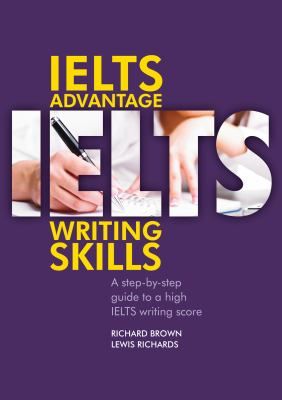
Ielts Advantage Writing Skills
Writing Skills
Introduction
Nova: Welcome back to Aibrary! Today, we're diving into a book that has quietly become something of a legend in the world of English language testing. Picture this: you speak fantastic English, you can hold a fluent conversation about politics, philosophy, even the offside rule in football. But then you sit down to write an academic essay under timed conditions, and suddenly, your brain goes blank. That's the IELTS Writing test, and for millions of test-takers around the world, it's the hardest part of the entire exam.
Nova: : And that's exactly the problem this book was built to solve, right? IELTS Advantage Writing Skills. I've heard the name floating around IELTS forums and classrooms for years.
Nova: Exactly. Published in 2011 by Delta Publishing, this book was co-written by Richard Brown and Lewis Richards, two English teachers who spent a combined 15 years teaching IELTS at a language school in Portsmouth, England. And here's the thing that makes their story fascinating: they didn't set out to write a bestseller. They were just frustrated teachers.
Nova: : Frustrated teachers? That sounds like the beginning of every great innovation story.
Nova: It really is. Lewis Richards said in an interview that they searched and searched for a single book that made it easy to teach IELTS writing, and they just couldn't find one. So over the years, they created their own exercises, tested them on hundreds of real students, and watched those students achieve consistently high writing scores. Eventually, they thought: why don't we put all of this into a book?
Nova: : And the rest is history. A book that apparently once outranked Raymond Murphy's English Grammar in Use on Amazon. That is no small feat.
Nova: It isn't. And today, we're going to unpack what makes this little orange-covered book so special, who it's really for, what's inside its nine carefully structured units, and whether it still holds up more than a decade after publication. Let's get into it.
Two Teachers, One Big Frustration
The Story Behind the Book
Nova: So let's start with the authors, because their backgrounds actually explain a lot about why this book works the way it does. Richard Brown is a fascinating character. He studied English Language and Linguistics at the University of Surrey, then spent four years as a news and sports journalist covering, in his own words, chip pan fires in Eastbourne and goalless draws by Portsmouth Football Club.
Nova: : Wait, he was a journalist before he became an English teacher? That's not the typical path.
Nova: Not at all. He then moved to New York, worked as a personal assistant, and somehow ended up in Bogota, Colombia, in 2005, visiting a friend who was teaching English. He started teaching there too, and he admits that at first, he felt like a bit of a fraud, clutching a copy of Murphy's grammar book and posing as a teacher. But he realized teaching let him genuinely help people in a way journalism never did.
Nova: : So he went from fake-it-till-you-make-it to becoming a DELTA-qualified expert. That's quite a journey.
Nova: It is. He completed his DELTA at International House London in 2008, which is one of the most prestigious teacher training institutions in the world. And that's where he encountered a tutor named Nick Hamilton, whose teaching philosophy became the guiding principle behind this book. Hamilton used to say: don't mind the gap, get in it.
Nova: : Don't mind the gap, get in it. What does that mean exactly?
Nova: It means that when a student is struggling to express something, you don't gloss over the gap in their knowledge. You dive right into it. You address the missing vocabulary, the unclear grammar point, the structural confusion, and you fix it right there. That's exactly what this book does. It identifies the gaps that IELTS candidates typically have in their writing and fills them systematically.
Nova: : And what about Lewis Richards, the co-author?
Nova: Lewis Richards was the Assistant Director of Studies at LSI Portsmouth, the language school where both authors taught. He was the one who mentored Richard when he first arrived. Between them, they had over 15 years of IELTS teaching experience, and crucially, both worked as IELTS writing examiners. So they knew exactly what examiners are looking for when they assign those band scores.
Nova: : That examiner insight seems like a huge advantage. It's like having the person who designs the test also teaching you how to pass it.
Nova: Exactly. And that's why the book includes something you rarely see in test-prep materials: real student writing samples with actual examiner comments and band scores. You can see a 6.5 essay side by side with a 7.0 essay and understand the tangible differences.
Nova: : So this isn't some academic theorizing about writing. It's built from the classroom floor up.
Nova: Literally. Every single exercise in the book was tested in real classrooms before it made the final cut. When Richards was asked why they wrote the book, he said it was because the materials worked. Their students kept getting high scores, especially in writing, which is the section most people struggle with. They knew they were onto something.
Nine Units, One Clear Philosophy
What's Inside the Book
Nova: Let's open the book now and look at its structure, because the organization of IELTS Advantage Writing Skills is one of its most distinctive features. The book has nine units spread across 128 pages, but here's the first surprise: it starts with Task 2.
Nova: : Wait, it starts with Task 2? Most IELTS books I've seen begin with Task 1 because it seems more straightforward. You know, describe a graph, compare some numbers.
Nova: That's exactly what makes this book different. The authors made a deliberate choice to spend six full units on Task 2 before even touching Task 1. Their reasoning is smart: Task 2 is worth twice as many marks as Task 1, and the skills you develop writing a coherent essay, structuring arguments, using academic vocabulary, those skills transfer directly to Task 1 anyway.
Nova: : So they're building a foundation first. That makes sense. What do those six Task 2 units actually cover?
Nova: They're organized by essay type and by theme. Units 1 and 4 cover advantages and disadvantages essays, first on the topic of living abroad, then on work. Units 2 and 5 tackle problem and solution essays, looking at education and then cities. Units 3 and 6 focus on opinion essays, with crime and running a business as the themes. So you get two passes at each essay type, each time with a different topic and fresh vocabulary.
Nova: : I like that paired structure. You learn the essay type once, then reinforce it with new content. What about Task 1?
Nova: Units 7, 8, and 9 cover the three major Task 1 question types. Unit 7 deals with graphs showing trends over time. Unit 8 covers comparative graphs, like bar charts and pie charts where you're comparing categories. Unit 9 tackles processes and maps, which are often the most intimidating for students because they require a completely different kind of descriptive language.
Nova: : And inside each unit, there's a consistent structure, right? I've read that the book follows a kind of template.
Nova: Yes, and this template is brilliant for self-study. Each unit opens with something called Try It First, a set of introductory questions that get you thinking about the topic before you've even seen the lesson. It's like a warm-up that also reveals your own knowledge gaps.
Nova: : So you're primed to learn before the teaching even starts.
Nova: Exactly. Then you get an interesting text, which might be a news article, an interview, or even a social media comment thread, all related to the unit's theme. These texts serve a dual purpose: they build your background knowledge about common IELTS topics and they introduce academic vocabulary in context.
Nova: : That's clever. Instead of just giving you a word list, you encounter the vocabulary embedded in real reading.
Nova: Right. Then come the grammar exercises, specifically targeting structures that IELTS examiners reward, like complex sentences, passive voice for Task 1, conditional forms for speculative essays. After grammar, there's a dedicated section on academic vocabulary and collocations.
Nova: : Collocations seem to be a big focus of this book.
Nova: They're arguably the book's superpower. The authors don't just teach you the word decision. They teach you that in academic English, you make a decision, you reach a decision, you arrive at a decision. These chunks of language are what separate natural academic writing from writing that feels translated or awkward. Every unit drills collocations, and this focus is what many reviewers say helped them most.
Nova: : And then the model essay?
Nova: After all that preparation, you finally see the model essay. But here's what's clever: by the time you get to it, you've already learned the vocabulary, the grammar structures, and the organizational framework that the model essay uses. So you're not just reading and copying. You're reading with understanding. You recognize the techniques.
Nova: : That must be incredibly satisfying as a learner. You see the puzzle pieces click together.
Nova: And then, perhaps the most unique feature: sample student answers with examiner comments. These are real essays written by real IELTS candidates, graded and annotated by the authors in their capacity as examiners. You can see a band 6.0 essay with comments explaining why it didn't reach 6.5, and a band 7.0 essay with notes on what pushed it over the threshold. It demystifies the scoring process entirely.
Nova: : That transparency is rare. Most books just show you a perfect model essay and leave you wondering how your own imperfect attempt would actually be judged.
The Right Reader at the Right Time
Who Is This Book For and Not For?
Nova: So now we need to talk honestly about who should and shouldn't pick up this book. IELTS Advantage Writing Skills is not for everyone, and the authors are quite clear about this.
Nova: : That's refreshing. Most test-prep books claim to be for everybody from beginner to expert.
Nova: Exactly. This book is explicitly designed for students who are already at approximately band 5.0 in writing and want to reach 6.5 to 7.0 or higher. It assumes you can already write a basic paragraph without major grammatical errors. If you're still struggling with subject-verb agreement or you can't construct a simple sentence, this book will be overwhelming.
Nova: : So it's an intermediate-to-advanced resource, not a beginner's guide.
Nova: Right. Lewis Richards said in an interview that they had a very specific reader in mind: the professional who speaks excellent English, maybe scores 7.5 or 8.0 in speaking, but keeps getting stuck at 6.0 in writing. That person doesn't need to learn English from scratch. They need to learn the specific, technical skills of academic writing under exam conditions.
Nova: : The nurse or the doctor who needs a high IELTS score for professional registration but can't take two months off work to attend a language school.
Nova: That's exactly the profile. And for those people, the self-study design of the book is a lifeline. It includes an answer key, so you can check your own work. The step-by-step structure means you can work through it at your own pace, in the evenings or on weekends.
Nova: : But the book is also designed for classroom use, right?
Nova: Yes, and the authors are proud that every exercise has been classroom-tested. A teacher can open any unit and know that the activities have been refined through real student feedback. The book is actually used as a coursebook in IELTS preparation programs around the world, including at universities in Vietnam and other countries.
Nova: : Are there any notable gaps in what the book covers?
Nova: There's one notable omission: the book doesn't cover the Two Questions essay type for Task 2. This is a format where the prompt asks two separate but related questions, like What are the causes of this problem and what measures can be taken to solve it? Some reviewers have pointed this out as a limitation.
Nova: : So a student solely relying on this book might be caught off guard if that question type appears on their exam.
Nova: Potentially, yes. Another criticism is that some of the model essays exceed the recommended word count. IELTS suggests 250 words for Task 2, but one model essay in the book runs to 344 words. A beginner might think they need to match that length, which isn't realistic under timed conditions.
Nova: : That could create some unrealistic expectations. What about the book's design and usability?
Nova: The table of contents is quite sparse, just unit titles and page numbers without any content summaries. So it's not the easiest book to navigate if you want to quickly find a specific grammar point or vocabulary set. And some editions, particularly the lower-price Indian edition, are missing page 129, which contains answer key material.
Nova: : Those feel like minor quibbles compared to what the book offers though.
Nova: They are. And the overwhelming consensus from hundreds of reviews is that this book delivers results when used properly. One reviewer on Amazon called it the most reliable book for IELTS writing. Another said it's the best writing guide for IELTS, better even than the official Cambridge books, which they felt had neglected the writing section.
Why This Book Still Matters in 2026
The Collocation Revolution and Lasting Impact
Nova: Let's zoom in on what I think is the book's most important contribution to IELTS preparation: its focus on collocations and academic chunks.
Nova: : This is the thing everyone raves about. But for someone who's never studied a language intensively, what exactly is a collocation?
Nova: A collocation is a pair or group of words that habitually appear together. In English, we say heavy rain, not strong rain. We say make a mistake, not do a mistake. These combinations aren't governed by strict grammar rules. They're just how the language works. And for IELTS writing, mastering academic collocations is often the difference between a 6.0 and a 7.0.
Nova: : So instead of teaching you to write I think this is a big problem, the book teaches you to write This issue is of considerable significance.
Nova: Exactly. Each unit introduces collocations in context through the reading texts, then drills them through exercises, and then shows them deployed in the model essays. By the time you finish a unit, those chunks should feel natural. One reviewer said that collocations and phrases are the main characteristic of this excellent reference.
Nova: : And this approach was quite innovative in 2011, wasn't it?
Nova: It was. At that time, most IELTS books were organized around either grammar syllabi or topic-based vocab lists. The idea of making collocations the backbone of a writing course, organizing units around the language chunks that students actually need to produce, it was ahead of its time. The lexical approach to language teaching was gaining ground in academia, but Brown and Richards were among the first to apply it systematically to IELTS preparation.
Nova: : More than a decade later, does the book still hold up?
Nova: The IELTS exam format hasn't fundamentally changed. The question types are the same. The scoring criteria are the same. So the core methodology remains perfectly relevant. What has changed is the ecosystem around the book. There are now video walkthroughs, supplementary materials, and even full PDFs circulating online. The book has become a kind of anchor text that other resources orbit around.
Nova: : I've also seen it recommended in combination with other books from the same series, like IELTS Advantage Reading Skills.
Nova: Yes, Delta Publishing developed the Advantage series to cover all four skills: Writing, Reading, Speaking and Listening. But the Writing Skills book remains the flagship. It's the one that teachers consistently name as essential.
Nova: : Are there any competitors that have caught up or surpassed it?
Nova: There are excellent alternatives now. Rachel Mitchell's IELTS Writing Task 1 and 2 guides are popular. Simon, the former IELTS examiner, has a well-regarded writing course. Cambridge's own official guides have improved their writing sections. But IELTS Advantage Writing Skills still occupies a unique position because of its step-by-step, classroom-tested, examiner-informed approach.
Nova: : And the fact that it was born from genuine teaching frustration rather than a publisher's market analysis probably gives it more authenticity.
Nova: That authenticity matters. When you work through this book, you can feel that the authors have been in the trenches. They've watched students struggle, they've identified the exact pain points, and they've designed exercises to address those specific struggles. The real student essays with examiner comments, that feature alone is worth the price of the book, because it closes the gap between what students think examiners want and what examiners actually reward.
Conclusion
Nova: So what should our listeners take away from this deep dive into IELTS Advantage Writing Skills?
Nova: : First, context matters. This book was born from two experienced teachers at a language school in Portsmouth who couldn't find the resource they needed, so they built it themselves. Richard Brown, the former journalist turned teacher, and Lewis Richards, the examiner who mentored him. Their combined experience as both teachers and examiners is baked into every page.
Nova: Second, the structure is the secret. Nine units, with Task 2 getting six of them because it's worth twice the marks. Each unit follows a consistent template: warm up with Try It First, build vocabulary through interesting texts, drill grammar, focus on collocations, study a model essay, and then critically, examine real student answers with examiner feedback. It's a complete learning cycle.
Nova: : Third, this book is not for everyone. If you're below band 5.0, you need to build foundational skills first. But if you're that professional who speaks great English yet can't crack the writing section, if you need 6.5 or 7.0 for university admission or professional registration, this book was literally designed for you.
Nova: Fourth, the collocation focus is the book's superpower. By teaching language in chunks rather than isolated words, it trains you to produce writing that sounds natural and academic, which is exactly what IELTS examiners reward under the lexical resource criterion.
Nova: : And here's the thing I find most inspiring. Richard Brown once wrote that he felt like a fraud when he first started teaching English. He was clutching a grammar book, pretending to know what he was doing. But he leaned into that gap, got proper training, became a DELTA-qualified expert, and co-wrote a book that has helped hundreds of thousands of students worldwide achieve their dreams of studying or working abroad.
Nova: That's the don't mind the gap, get in it philosophy in action. And it's a reminder that the best educational resources often come from teachers who have struggled alongside their students, not from distant academics.
Nova: : If you're preparing for the IELTS writing test, consider whether IELTS Advantage Writing Skills by Richard Brown and Lewis Richards might be the guide you need. Work through it systematically, do every exercise, study the examiner comments carefully, and pay special attention to those collocations. The book won't write your essay for you, but it will show you exactly what a high-scoring essay looks like and how to build one yourself.
Nova: This is Aibrary. Congratulations on your growth!