The AI Trap: Why You Need Human-Centric Automation in Marketing.
Golden Hook & Introduction
SECTION
Nova: Forget everything you think you know about AI in marketing. Because if you're just using it to replace tasks, you're missing the entire point, and potentially your future.
Atlas: Whoa, Nova, that's a bold statement right out of the gate! Are you saying all those articles about AI taking over jobs are just, what, fear-mongering?
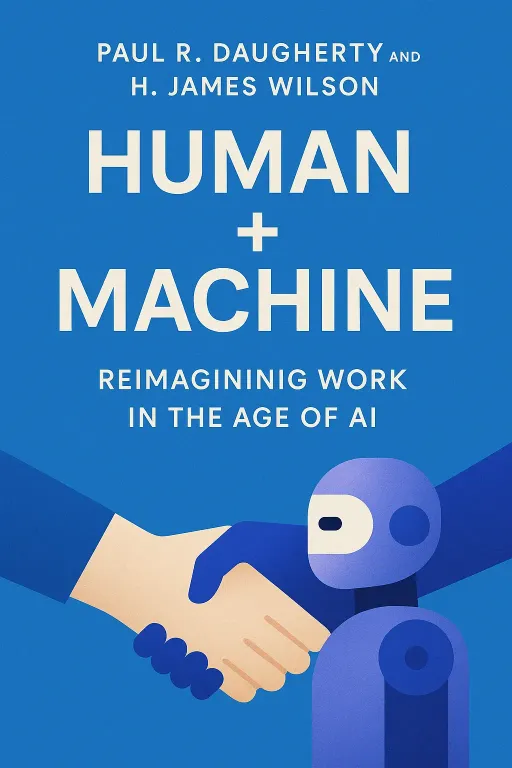
Nova: Not fear-mongering, Atlas, but a fundamental misunderstanding. We're talking about 'The AI Trap: Why You Need Human-Centric Automation in Marketing,' a concept built on the groundbreaking work of books like 'Human + Machine' by Paul R. Daugherty and H. James Wilson. These guys from Accenture, a massive global consulting firm, aren't just theorizing; they're seeing this play out in countless businesses.
Atlas: So it's less about AI replacing humans and more about... what, exactly? A partnership?
Nova: Precisely. And that leads us straight into our first core idea: the critical 'blind spot' many marketers have when they view AI merely as a replacement for human effort.
The 'Blind Spot': AI as Replacement vs. Augmentation
SECTION
Nova: Too often, we jump to AI with the mindset of, 'How can this machine take over that tedious human task?' And yes, AI is brilliant at automation. But that's like buying a supercar just to drive it to the grocery store once a week. You're using it, but you're not unlocking its true potential. The real trap is when we let AI diminish human creativity rather than amplify it.
Atlas: But isn't automation the whole point of AI for a lot of companies? To cut costs, be faster? I mean, who wouldn't want a bot writing all their social media posts if it saves time and money?
Nova: That's the initial siren song, isn't it? The promise of efficiency is powerful. But let me give you an example. Imagine a marketing team, let's call them 'Brand X.' Their leadership saw AI as the ultimate content factory. They fed it brand guidelines, keywords, and audience profiles, then hit 'go.' The AI churned out thousands of blog posts, social updates, and email campaigns every week. On paper, their content output soared.
Atlas: Sounds like a dream come true for a content manager! More content, less effort.
Nova: It seemed that way. But the engagement metrics told a different story. Comments dropped, shares plummeted, and their brand sentiment became... flat. The content was technically correct, grammatically perfect, but it lacked soul. It lacked the quirky voice, the unexpected empathy, the genuine connection that only a human writer could infuse. The cause was focusing solely on output and efficiency. The process was full automation, bypassing human oversight. The outcome was a sterile, ineffective brand voice that alienated their audience. They automated their way into irrelevance.
Atlas: Wow. So, the quantity went up, but the quality of connection went down. It's like having a high-tech oven that bakes perfect bread, but no chef to create the unique recipe or add the special ingredient that makes it.
Nova: Exactly! The speed and cost-cutting were there, but the real power—the ability to connect, to innovate, to strategize—that was lost. So, if I'm a strategic analyst, trying to measure impact and refine strategy, how do I avoid falling into that blind spot? What does 'amplifying human creativity' even look like in practice?
Human-Centric Automation: The 'Human + Machine' & 'Prediction Machine' Paradigms
SECTION
Nova: That's a fantastic question, Atlas, and it's exactly what our second core idea addresses: how to build human-centric automation. Daugherty and Wilson, in 'Human + Machine,' introduce the concept of 'new-collar' jobs. These aren't about humans doing one thing and machines doing another; it's about them collaborating in ways that unlock unprecedented value. They argue that the most successful organizations combine human intuition with machine intelligence.
Atlas: 'New-collar' jobs? That sounds intriguing. So it's not just about retraining for tech skills, but evolving how we work tech?
Nova: Precisely. It's about designing systems where the technology doesn't just replace, but enhances. Think about it this way: AI is incredibly good at making predictions. That's the core insight from 'Prediction Machines' by Agrawal, Gans, and Goldfarb. They redefine AI not as a magic bullet, but as a 'prediction machine' that reduces uncertainty.
Nova: Let's consider another example. Imagine a subscription service that deals with customer churn. Traditionally, they might wait for a customer to cancel, then send a generic win-back email. But a human-centric approach turns this around. They use AI to predict which customers are to churn in the next month, based on usage patterns, support tickets, and engagement.
Atlas: So, the AI gives them a heads-up, a list of at-risk customers instead of just reacting after the fact.
Nova: Exactly. But here's where the human element becomes critical. Instead of automating a generic 'we miss you' email, they empower human customer success managers. These managers receive the AI's predictions and then proactively reach out to those at-risk customers. They don't just send a discount code; they have a personalized conversation. They ask about their experience, listen to their concerns, and offer empathetic, tailored solutions.
Atlas: So, it's like AI handles the 'prediction' part, and humans handle the 'judgment' part? That makes so much more sense than just having a bot send a generic 'we miss you' email. The AI reduces uncertainty, and the human applies empathy and problem-solving.
Nova: You've got it. The AI sifts through mountains of data and identifies patterns, making the 'prediction.' But the human judgment, the nuanced understanding of emotion, the ability to build rapport, to creatively solve a unique problem – that's where the real power lies. This collaboration significantly reduces churn, yes, but more importantly, it builds stronger, more loyal customer relationships. For someone who wants to lead innovation and future-proof their skills, this is a huge reframe.
Atlas: I get that. It’s like, AI gives you the super-powered binoculars, but you still need a human to decide what to aim at, interpret what you see, and then figure out the best course of action. It's about empowering humans to do higher-value work, not just replacing the lower-value stuff.
Nova: And that's the essence of human-centric automation. It's about designing systems where technology and human insight work in harmony, creating value that neither could achieve alone. It's not about automation for automation's sake, but automation that frees up human capacity for creativity, judgment, and strategic thinking. It cultivates 'new-collar' jobs that require both technological fluency and uniquely human skills.
Synthesis & Takeaways
SECTION
Nova: So, the deep question for any marketer, any strategic analyst, isn't just how to automate tasks. It's how to design AI-powered workflows that elevate your team's unique human skills, making them even more indispensable, even more creative. It's about understanding that the trap is thinking AI the answer; the truth is, AI is the amplifier for the human questions.
Atlas: That's a powerful distinction. It feels less like a threat and more like an invitation to evolve our roles. I imagine a lot of our listeners, especially those focused on advanced digital analytics and business acumen, are going to feel a huge shift in their approach after this. It moves beyond just optimizing campaigns and into genuinely innovating how we work.
Nova: Absolutely. It's not just about staying relevant; it's about leading the charge. If you're looking to truly elevate your marketing efforts, don't just ask what AI can do you; ask what AI can help do better, more creatively, and with deeper, more human impact. It's about leveraging technology to become more human, not less.
Atlas: That's a fantastic thought to leave us with. It truly redefines the playing field.
Nova: This is Aibrary. Congratulations on your growth!