The AI-Human Partnership: Beyond Tool, Towards True Collaboration
Golden Hook & Introduction
SECTION
Nova: Forget everything you you know about AI. It's not just a fancy calculator, and it's certainly not just coming for your job. We're talking about something far more profound today: a partnership that redefines what it means to be truly intelligent, truly creative, and truly human in the modern age.
Atlas: Whoa, that's a bold claim, Nova. I think a lot of people are still caught between seeing AI as a shiny new toy or, frankly, as a looming threat. What makes this partnership so "profound"?
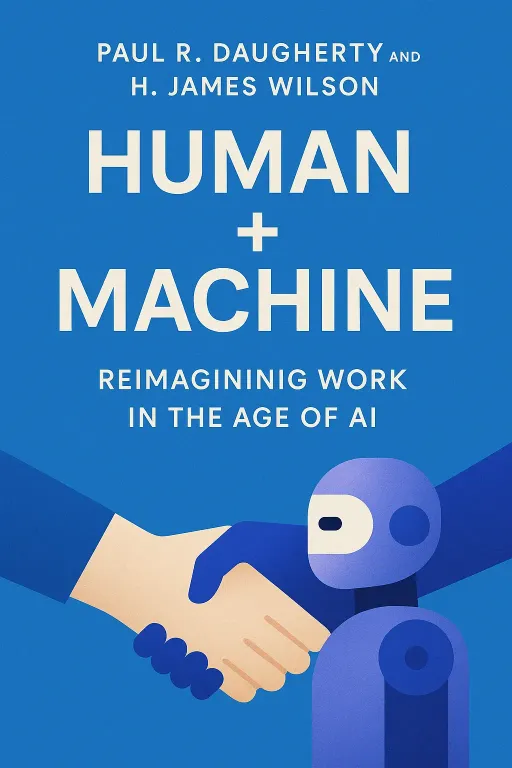
Nova: Because it challenges the very foundation of how we've traditionally viewed intelligence and work. Today, we’re diving into the groundbreaking insights from two incredibly impactful books: first, "Human + Machine" by Paul R. Daugherty and H. James Wilson, and then "Prediction Machines" by Ajay Agrawal, Joshua Gans, and Avi Goldfarb. What’s fascinating is that these authors aren't just theorists; Daugherty and Wilson come from the heart of strategic business consulting, and Agrawal, Gans, and Goldfarb are economic thinkers who profoundly understand market dynamics. They're showing us that the real power isn't in AI humans, but in a deep, symbiotic fusion that amplifies both.
Atlas: That's interesting, especially for anyone trying to build for impact and longevity, not just chasing the next tech trend. It sounds like they're offering a blueprint for something sustainable.
Nova: Exactly! And that leads us to our first deep dive: how successful organizations are literally redesigning their entire operational DNA to make this partnership thrive.
Deep Dive into Core Topic 1: Redesigning Processes for Collaboration (Human + Machine)
SECTION
Nova: So, Daugherty and Wilson, in "Human + Machine," make a powerful argument: the most successful organizations aren't just layering AI on top of old processes. They're fundamentally redesigning how work gets done, creating new forms of value that weren't possible before. Think of it like this: imagine a global logistics company. Traditionally, human planners would pour over spreadsheets, trying to optimize routes and schedules, reacting to disruptions. It was complex, slow, and prone to human error.
Atlas: That sounds like a monumental task, and probably a source of constant stress for those planners. I imagine a lot of our visionary listeners, who are building intricate systems, can relate to that feeling of being overwhelmed by data.
Nova: Absolutely. Now, introduce AI. It's not just about automating the existing planning. It's about a complete overhaul. The AI could analyze real-time weather data, traffic, political unrest, even social media sentiment, to predict disruptions they happen. It could generate thousands of optimal routes in seconds.
Atlas: Okay, so the AI does the heavy lifting of prediction. But what about the human? Does the human planner just sit there and watch the AI work? Because that sounds like the replacement scenario everyone fears.
Nova: Not at all! This is where the comes in. The human planner's role evolves from to. They take the AI's optimized routes and predictions, but then they apply their unique human judgment: their understanding of a specific client's quirky needs, their long-standing relationship with a particular freight company, their intuition about a last-minute political shift in a region. They're no longer just planning; they're innovating, mitigating truly unforeseen risks, and building robust, resilient supply chains. This is a crucial distinction that Daugherty and Wilson emphasize—it's about creating new roles, not just filling old ones with robots.
Atlas: That’s actually really inspiring. So, instead of being buried in data, the human is elevated to a higher-level strategic function. It gives me chills to think about how that could transform industries, especially for those focused on conceptual synthesis and building innovative frameworks. But how do you actually that redesign? Is it just a top-down mandate?
Nova: It's rarely just a mandate. It's an iterative process, often starting with identifying specific tasks where AI can augment human capability, not just automate it. The authors highlight that this isn't about replacing humans, but about amplifying human strengths. The AI processes the vast, complex data, and the human applies the nuanced understanding, the empathy, the ethical considerations, and the creativity that AI simply can't replicate. It's about consciously designing workflows where each partner plays to its unique strength, building for impact, yes, but also for longevity.
Deep Dive into Core Topic 2: AI as Prediction, Human as Judgment (Prediction Machines)
SECTION
Nova: And this idea of redesigning processes becomes even clearer when we understand AI truly is at its core, which the authors of "Prediction Machines" brilliantly reframe for us. They argue that AI is fundamentally a.
Atlas: So you're saying AI isn't really "thinking" or "reasoning" in the human sense? It's just predicting? That feels… almost too simple for something so powerful.
Nova: It is simple, yet profoundly insightful. Think about it: when AI recognizes your face, it's predicting that the pixels on screen match the pixels of your stored image. When it suggests the next word in your email, it's predicting the most likely word based on patterns. When it recommends a movie, it's predicting what you'll like. The authors, through their economic lens, show how this ability to make predictions incredibly cheaply and accurately changes everything.
Atlas: Okay, so if predictions become cheap, what happens to human judgment? If AI can predict the outcome of a medical test, or the success of a marketing campaign, or even the stock market, what's left for us? That's a huge question for anyone driven by a quest for profound meaning and elevating the human experience.
Nova: That's the crucial pivot! When prediction becomes cheap, human becomes incredibly valuable. The "Prediction Machines" authors explain that judgment is about deciding with those predictions. AI tells you; humans decide.
Atlas: Can you give me an example? Because for someone who's strategic and rigorous, understanding that distinction is key to making this actionable.
Nova: Absolutely. Imagine a doctor using AI. The AI can predict, with incredible accuracy, the likelihood of a patient developing a certain disease based on their genetic markers, lifestyle, and medical history. That's the AI's prediction. But the human doctor's judgment comes in deciding the: considering the patient's personal values, their family situation, their financial constraints, their emotional resilience. The AI gives the probability; the human provides the personalized, empathetic, ethical decision. Or take a lawyer: AI can predict the likely outcome of a court case based on precedents. But the human lawyer decides the strategy, crafts the arguments, understands the human element of the jury, and negotiates with empathy. The human judgment becomes the ultimate differentiator.
Atlas: Wow. So our uniquely human capacities—empathy, ethical reasoning, creativity, understanding context, setting goals—these aren't just preserved, they're actually and become in an AI-driven world. It's not about replacing, but enriching. That feels like a crucial point for anyone interested in philosophical AI ethics.
Nova: Precisely. It's about shifting our focus from tasks AI can do better to tasks, and then designing systems where these strengths complement each other. It’s about understanding the 'how' of learning transformation, not just the 'what' of the data.
Synthesis & Takeaways
SECTION
Nova: So, pulling these threads together, the symbiotic AI-human partnership isn't just a hopeful vision; it's a strategic imperative. It's about fundamentally redesigning our processes, as Daugherty and Wilson suggest, by leveraging AI's incredible predictive power, as Agrawal, Gans, and Goldfarb illustrate, to elevate our uniquely human capacity for judgment and creativity. It's a partnership where 1+1 equals far more than 2.
Atlas: I love that. It moves us past the fear and into a space of genuine co-creation. For our listeners who are visionaries and architects, eager to empower others, what's one immediate, tiny step they can take to start engaging with this profound idea?
Nova: The "Tiny Step" from our content today is this: identify one task you currently do that AI could predict better, and then identify one task where your human judgment is absolutely irreplaceable. Then, consider how they could work together. This isn't about throwing out your current processes entirely, but about starting to see the potential for this powerful collaboration.
Atlas: That's brilliant. It's not just an intellectual exercise; it's an invitation to dedicate that specific, non-negotiable time for deep, unstructured thinking, as our growth recommendations often suggest. It's about building resilience by consciously leveraging strengths.
Nova: Exactly. It's about transforming insight into sustained growth, one thoughtful partnership at a time.
Atlas: This is Aibrary. Congratulations on your growth!