The AI-Human Partnership: Beyond Tool, Towards True Collaboration
Golden Hook & Introduction
SECTION
Nova: We hear it all the time: AI is either coming for our jobs, a looming threat to human employment, or it’s just another fancy Excel spreadsheet, a mere tool to automate the mundane. But what if both of those ideas are fundamentally missing the point? What if the real revolution isn't about AI replacing us, but about AI completing us?
Atlas: Completing us? Wow, that's not the usual narrative we get bombarded with. Most of the conversations are still stuck in that binary of 'tool' or 'threat.' That sounds… optimistic, almost utopian.
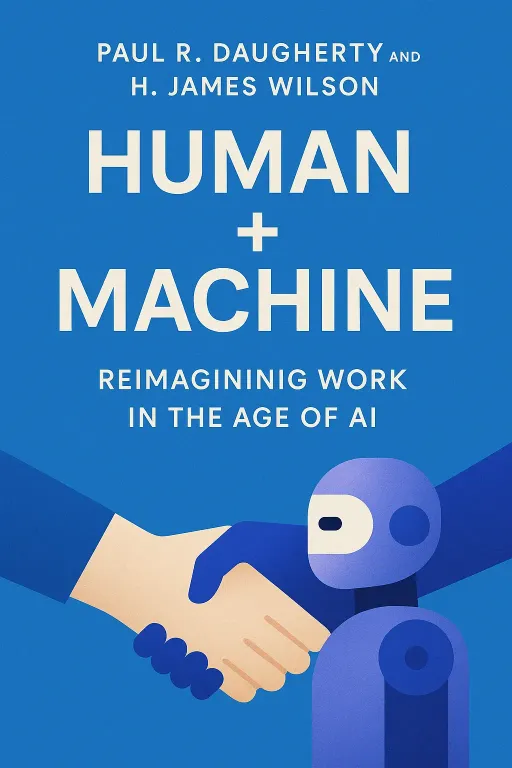
Nova: It’s not utopian, Atlas, it’s strategic. And it’s the profound potential we often miss. Today, we’re unpacking this transformative idea, heavily inspired by two seminal works that really shifted our understanding of technology and labor. We’re talking about "Human + Machine: Reimagining Work in the Age of AI" by Paul R. Daugherty and H. James Wilson, and the groundbreaking "The Second Machine Age" by Erik Brynjolfsson and Andrew McAfee. "The Second Machine Age" in particular, when it first hit the scene, became a touchstone for understanding how digital technologies are fundamentally reshaping not just work, but society itself, sparking widespread debate and influencing countless leaders in business and policy.
Atlas: Right, so it’s not just theoretical; these are books that have genuinely impacted how we think about the future.
Nova: Exactly. And the "cold fact" that both these works illuminate, in different ways, is that we've been looking at AI through too narrow a lens. The real power, the unprecedented levels of innovation and efficiency, lies in synergistic collaboration. It’s where human creativity and AI's analytical strength don't just coexist, but truly merge.
AI: Beyond Tool or Threat – The Collaboration Paradigm
SECTION
Nova: So let's start there, Atlas. This idea that AI is either a tool or a threat. Why is that such a limiting perspective?
Atlas: I mean, that makes sense on the surface, right? We’ve always used tools to extend our capabilities, from hammers to spreadsheets. And the threat part, that’s just human nature, a fear of the unknown, of something powerful that could disrupt our livelihoods. But if it’s limiting, what are we missing?
Nova: We're missing the of the relationship. A hammer is a tool. It doesn't learn, it doesn't adapt to your skill level, it doesn't suggest a better way to drive a nail based on millions of previous attempts. AI can. And a threat implies inevitable replacement. But what Daugherty and Wilson highlight in "Human + Machine" is that the most successful companies aren't just automating tasks from humans; they're designing entirely new categories of jobs – what they call "new-collar jobs" – where human judgment and AI's speed and scale are intrinsically linked.
Atlas: Okay, new-collar jobs. Can you give me an example that makes it tangible? What does that like on the ground? Isn't it just a fancy way of saying AI helps us work faster, but we’re still doing the same old thing, just with a digital assistant?
Nova: Not at all. Think of it this way: imagine a data analyst. Traditionally, they spend countless hours sifting through massive datasets, looking for patterns, cleaning data. It's vital but often tedious. Now, in a "new-collar" scenario, an AI system handles that initial sifting and identifies potential anomalies or correlations in seconds. The human analyst then steps in, not to verify every single data point, but to those patterns, to apply their nuanced understanding of the business, ethics, and human behavior to formulate strategic insights. The AI provides the speed and scale; the human provides the context, the creativity, the judgment that the AI simply doesn't possess.
Atlas: So, the AI frees the human from the grunt work, allowing them to focus on the higher-level, more uniquely human aspects of the job. That’s actually really compelling. But what about the fear of job loss? If AI is so good at the tedious stuff, doesn’t that still mean fewer jobs, just different ones? Or is it more about we choose to collaborate, rather than a predetermined outcome?
Nova: That’s the critical question, Atlas. And it's precisely where Brynjolfsson and McAfee's work in "The Second Machine Age" comes into play. They argue that the biggest gains from digital technologies, including AI, come from innovations that, rather than replace, human skills. It's about designing systems and roles that leverage what humans are uniquely good at – creativity, emotional intelligence, complex problem-solving, ethical reasoning – and augmenting those with AI's strengths in data processing, pattern recognition, and rapid computation. The fear isn't completely unfounded if we focus on automation, but it shifts when we focus on and.
Architecting Synergy: Principles and Practice of Human-AI Partnership
SECTION
Atlas: Okay, so if we accept this collaborative mindset, this idea of augmentation, how do we actually it? What are the blueprints for this human-AI synergy? Because it sounds great in theory, but putting it into practice, especially in complex organizations, seems like a massive challenge.
Nova: That's where the concept of "intelligent automation" truly shines, a term Daugherty and Wilson explore deeply. It’s not just about automating a process; it's about creating a system where each side enhances the other. Think of it like a highly skilled dance partnership. The AI takes the lead in certain steps, moving with incredible precision and speed, but the human partner brings the artistry, the improvisation, the connection with the audience. Each side makes the other better.
Atlas: So it's not just about giving AI the boring tasks; it's about making humans better at the tasks? How do we ensure that balance, especially when the goal in business is often just "efficiency" at any cost? Are we always building for impact and longevity, or just the next quarterly report?
Nova: That's a profound point, and it ties into the philosophical AI ethics that I know you’re interested in. The design of these partnerships is crucial. If we design only for raw efficiency, we risk de-skilling humans or creating systems that are brittle. But if we design for human —for elevating our capabilities, for enabling deeper insights—then AI becomes a force multiplier for creativity and meaning. Brynjolfsson and McAfee emphasize this with their focus on complementarity. The most innovative breakthroughs happen when we identify a uniquely human skill and then ask: how can AI make that skill even more powerful?
Atlas: Can you give me another example? Something that really illustrates how AI amplifies human skills rather than just takes over?
Nova: Absolutely. Think about a creative designer. They have an artistic vision, an understanding of aesthetics, brand, and audience emotion. AI can now generate hundreds, even thousands, of design variations based on their initial input in minutes. The designer doesn't become obsolete; they become a super-designer, able to explore vastly more options, refine their vision faster, and focus their human creativity on the most impactful elements, rather than the repetitive steps of iteration. Or consider a radiologist. AI can quickly scan medical images for anomalies, flagging areas of concern. This doesn't replace the radiologist; it allows them to dedicate their highly trained human judgment and diagnostic expertise to the most complex cases, reducing burnout and improving accuracy.
Atlas: That’s a perfect example. It sounds like the human is still very much in the driver’s seat, but with a supercharger. But what about bias? If we're building these systems, and they're learning from historical data, how do we ensure the 'synergy' doesn't just amplify existing human flaws or biases that are embedded in that data? That seems like a critical ethical consideration for anyone trying to build something sustainable.
Nova: That's precisely why human oversight and ethical design are paramount. The collaboration isn't passive. It requires humans to actively interrogate the AI's outputs, to understand its limitations, and to consciously build systems that are fair and robust. It's about bringing our human values – our quest for clarity and profound meaning, as you often say – to the forefront of AI development and deployment. The synergy isn't just about output; it's about responsible and ethical innovation.
Synthesis & Takeaways
SECTION
Nova: So, what we’re really talking about today isn't just technology; it's a profound shift in how we conceive of work, innovation, and even humanity's role in an increasingly intelligent world. It's moving from AI as a standalone entity to AI as a true partner that unlocks unprecedented levels of innovation and efficiency, by designing symbiotic relationships.
Atlas: It sounds like the real tiny step isn't just picking an AI tool for a task, but consciously designing the between you and the AI. It's about asking, "How can this AI not just something for me, but how can it make better at what I do?" That’s a powerful reframing. It connects the analytical prowess with the human element.
Nova: Absolutely. And that leads us to our tiny step for you, our listeners. Identify one task you currently do that could be significantly enhanced by an AI tool. Then, explore not just how you'd it, but how you'd work it. How would that AI elevate your unique human capabilities? How would it free you to think more deeply, create more boldly, or connect more profoundly? It's about trusting your intuitive wisdom alongside your analytical prowess, designing for impact and longevity, not just speed.
Atlas: That’s a fantastic challenge. It's not about being replaced, it's about being amplified. It's about elevating the human experience in an AI-driven world.
Nova: Precisely. This is Aibrary. Congratulations on your growth!