

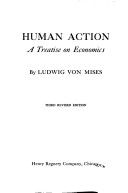
The Logic of Choice: Deconstructing Human Action with Mises
Golden Hook & Introduction
SECTION
Orion: Lucas, here's a question for you, as someone who enjoys breaking down big ideas. What is the most fundamental difference between a person and, say, a boulder rolling down a hill?
Lucas Molina: Hmm, that’s a great starting point. The obvious answer is consciousness, or maybe intelligence. A person is aware, they think. The boulder is just an object subject to physics. It doesn't have an inner world.
Orion: Exactly. And a 20th-century economist named Ludwig von Mises took that exact idea and built an entire system of thought around it. For him, the key difference wasn't just consciousness, it was. The boulder moves, but a human. That purposeful action is the subject of his massive, and I mean massive, book,.
Lucas Molina: So it’s not really an economics book in the way we think of charts and graphs, is it? It sounds more like a philosophy of human behavior.
Orion: That's the perfect way to put it. Mises believed that before you can understand the economy, you have to understand the logic of a single human choice. And that's what we're going to deconstruct today. Today we'll dive deep into this from two perspectives. First, we'll explore the fundamental 'grammar' of all human action, a concept Mises called praxeology. Then, we'll discuss what fuels that action: the radical idea of subjective value and how it defines the crucial role of the entrepreneur in society.
Lucas Molina: I'm in. It sounds like a powerful mental model. Let's get into it.
Deep Dive into Core Topic 1: Praxeology
SECTION
Orion: Alright. So let's start with that first, slightly intimidating word: praxeology. Mises defines it as the science of human action. But the core idea is beautifully simple. He argues that every single conscious action we take, without exception, follows the same logical structure.
Lucas Molina: Okay, so what is that structure?
Orion: It has three parts. One: It begins with a state of 'felt uneasiness.' You're dissatisfied with some aspect of your current reality. You're thirsty, you're bored, you're cold, you feel you don't understand a topic. Two: You imagine a more satisfactory state. A future where you are not thirsty, not bored, not cold. Three: You employ means to try to get from your current state to that imagined future state. Action, for Mises, is simply this: purposeful behavior aimed at alleviating a felt uneasiness.
Lucas Molina: That's really clear. So it's not just random behavior. A reflex, like pulling your hand from a hot stove, wouldn't be 'action' in this sense, right? Because it's not a chosen purpose.
Orion: Precisely. That's a physiological reaction. Action requires a chosen end. Let’s make it concrete. You're sitting on your couch and you feel thirsty. That's the uneasiness. You picture yourself with a cool glass of water, no longer thirsty. That's the imagined better state. So, you engage in a series of actions—the means. You push yourself off the couch, you walk to the kitchen, you take a glass, you turn the tap, you fill the glass, you drink. All of that is 'human action.'
Lucas Molina: It's fascinating how you can take something so mundane and reveal a complex, logical structure underneath. What I find interesting is that it's a teleological framework. It's all about the. It's not concerned with the psychological or historical reasons I became thirsty. It just states that, the thirst, my action will be purposeful.
Orion: You've hit on the most crucial and controversial point. Mises argued that this is an truth. It's something you can know through logic alone, without needing to run a single experiment. You can't even conceive of a human action that doesn't fit this structure. Try to think of a purposeful act that wasn't aimed at replacing a less satisfactory state with a more satisfactory one.
Lucas Molina: You can't. Even an act of self-harm, tragically, fits the model. The person is in a state of extreme mental anguish—the uneasiness—and they are acting in a way they believe will, in some way, alleviate it. The logic holds, even if the outcome is terrible. It's a very stark, powerful framework. It almost sounds like an engineering principle for human behavior—you're constantly identifying a problem state and acting to move to a desired state.
Orion: It's a universal operating system. And what's so powerful, and why this is so relevant for an analytical thinker, is that Mises says this is the bedrock. Everything else—prices, markets, complex social phenomena—is just the emergent result of billions of these individual actions, all running on this same basic software.
Lucas Molina: Okay, that makes sense. It's the foundational axiom. But an operating system needs applications, it needs data to process. If praxeology is the 'how' of action, what determines the 'what' and 'why'? Why do I want water and not, say, sand?
Orion: Fantastic question. And that is the perfect transition to our second core idea. If praxeology is the engine of action, the fuel for that engine is our own personal, and this is the key word, value.
Deep Dive into Core Topic 2: Subjective Value and the Entrepreneurial Function
SECTION
Orion: Mises argues that value is not inherent in things. There is no such thing as 'objective' or 'intrinsic' value. Value exists only in the mind of the person making the choice. The classic example to illustrate this is the diamond-water paradox.
Lucas Molina: I think I've heard of this. Lay it out.
Orion: Okay. Picture a wealthy banker in his office in London. On his desk is a flawless one-carat diamond and a simple glass of tap water. Which is more valuable to him?
Lucas Molina: The diamond, obviously. By a factor of thousands.
Orion: Right. He would trade thousands of glasses of water for that one diamond. Now, take that same banker and magically transport him to the middle of the Sahara desert. He's been walking for three days. He's on the verge of death from dehydration. An oasis vendor appears and offers him the same choice: a flawless one-carat diamond or a single, cool glass of water. Now which is more valuable?
Lucas Molina: The water. It's not even a choice. The diamond is a useless rock in that context. The water is life itself.
Orion: And there you have it. That is subjective value theory in a nutshell. The diamond didn't change. The water didn't change. The and the of the actor changed. Value is not in the object; it's a relationship between the object and a human purpose. For Mises, every price, every trade, every economic decision is rooted in this radical subjectivity.
Lucas Molina: So there's no 'correct' price or 'true' value for anything. A price is just a temporary meeting point between the subjective values of two or more people at a specific moment in time. This explains fads, bubbles, crashes... it's not that the underlying assets necessarily changed, it's that our collective, subjective valuation of them changed, sometimes dramatically.
Orion: You've got it. And this leads us to Mises's very special definition of the 'entrepreneur.' For him, an entrepreneur isn't necessarily a founder with a slick pitch deck. The entrepreneurial function is a core component of all human action. It is the act of bearing uncertainty about the future.
Lucas Molina: How so? Unpack that.
Orion: Well, if all value is subjective, and the future is uncertain, then every action is a speculation. When you choose a career, you are speculating that you will subjectively value that work in the future, and that others will subjectively value your output enough to pay you for it. The entrepreneur, in the more common sense, is just a specialist in this. A coffee shop owner is an entrepreneur because she is speculating. She is betting her capital that, in the future, enough people in her neighborhood will subjectively value a cup of coffee and a nice place to sit more than they value the three dollars in their pocket.
Lucas Molina: That's a brilliant expansion of the term. It democratizes the idea of an entrepreneur. A film director is an entrepreneur, betting millions of dollars that, two years from now, millions of people will subjectively value two hours of light and sound in a dark room. A scientist pursuing an unpopular theory is an entrepreneur, betting their time and reputation that the future scientific community will value their discovery.
Orion: Yes! They are all acting to rearrange the present in order to better serve the anticipated future needs—the future subjective values—of other people. The profit or loss they make is society's signal, telling them whether their speculative bet was correct or not.
Lucas Molina: So the entrepreneur is the agent of the future, constantly trying to bridge the gap between how the world is now and how it could be better, based on a guess about what 'better' will mean to other people down the line.
Synthesis & Takeaways
SECTION
Orion: Exactly. And that really ties our two ideas together. We have this universal, logical structure of action—praxeology. That's the form, the grammar. And then we have the dynamic, personal, and ever-changing content that fills that structure—our subjective values.
Lucas Molina: It's a powerful combination. The first gives you a stable framework for analysis, and the second accounts for all the dynamism, creativity, and chaos of human life. It’s a system that has both order and freedom built into it.
Orion: So, as our analytical thinker in the room, what's the big takeaway for you from Mises's?
Lucas Molina: The real insight here for me is a new way of seeing. It’s like being given a special pair of glasses. You stop seeing the social world as a collection of static things and institutions, and you start seeing it as a shimmering, dynamic web of individual human actions. You see every price, every product, every company, every social trend as the emergent outcome of millions of people trying to alleviate their own uneasiness.
Orion: I love that image. A shimmering web of action. So what's the final thought, the call to action for our listeners who enjoy making these kinds of connections?
Lucas Molina: I'd say, don't just take this as a theory. Try it out. For one day, be a praxeologist. When you're in a supermarket, don't just see aisles of products. See the crystallized results of millions of entrepreneurial bets on your future subjective values. When you see people in a cafe, don't just see people drinking coffee. See individuals purposefully acting to move from a state of tiredness or boredom to a state of alertness or social connection. Watch yourself. Notice the constant, low-level hum of uneasiness that prompts you to check your phone, or get a snack, or switch tasks. See the world through this lens. It doesn't just explain economics; it reveals the very engine of the human world.
Orion: A fantastic and challenging thought to end on. See the action, not just the things. Lucas, this was great.
Lucas Molina: A pleasure. My brain is buzzing with new connections.