

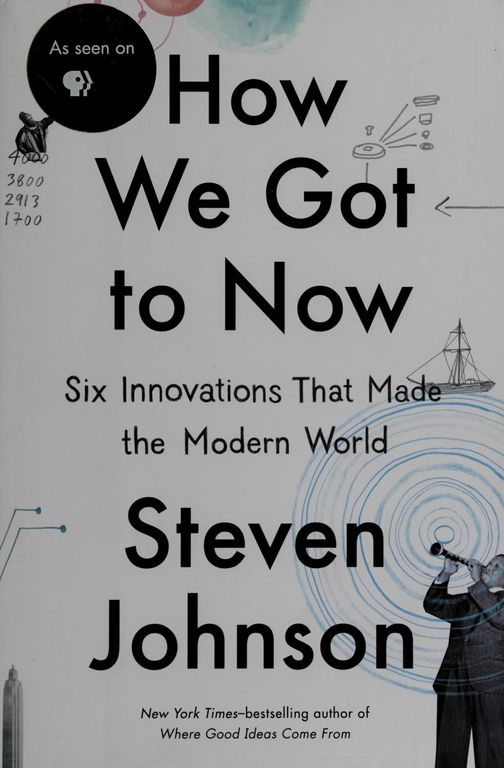
How we got to now
Six Innovations That Made the Modern World
Introduction
Nova: What if I told you that the invention of the printing press is the reason we have vaccines today? Or that a teenager daydreaming in a cathedral in 1583 eventually gave us GPS and the internet? These aren't random connections. They're what Steven Johnson calls the "hummingbird effect," and they're at the heart of his book How We Got to Now: Six Innovations That Made the Modern World.
Nova: That's exactly what Johnson does across six beautifully researched chapters, each one tracing a different innovation — glass, cold, sound, clean, time, and light. And what he shows is that the way we think about invention is mostly wrong. We love the myth of the lone genius having a eureka moment. But Johnson argues that innovation is fundamentally a network — ideas remixing other ideas. Breakthroughs happen when the right building blocks are in place, and then they ripple outward in directions nobody could have predicted.
Nova: Exactly. And that's what makes this book so thrilling. Johnson doesn't just tell you who invented what. He shows you the strange, beautiful, and sometimes tragic chains of influence that connect a lump of desert glass to the smartphone in your pocket. We're about to trace six of those chains right now.
Why Innovation Is Never a Solo Act
The Hummingbird Effect
Nova: Let's start with the big idea that ties the whole book together — the hummingbird effect. Johnson opens the book not with technology, but with biology. During the Cretaceous period, flowers evolved bright colors and scents to attract insects. The insects adapted to extract pollen, the flowers started producing nectar, and eventually, hummingbirds evolved a completely unique wing mechanism — one that generates lift on both the upstroke and the downstroke — just so they could hover and drink that nectar.
Nova: That's the hummingbird effect. Johnson uses it as a metaphor for how innovation actually works. An advance in one field ends up triggering changes that seem to belong to a completely different domain. And here's the key difference from the famous butterfly effect. The butterfly effect is about chaos — you can't trace the causal chain. But hummingbird effects, Johnson says, are traceable. You can follow the breadcrumbs across decades and centuries.
Nova: Right. And Johnson argues that most historians haven't been telling these stories. They've focused on kings and wars and political movements. But Johnson practices what he calls "long-zoom history" — stepping back to see how technologies shaped human behavior over centuries. He writes that we're surrounded by objects enchanted with the creativity of thousands of people who came before us. We turn on a tap and never worry about dying from cholera forty-eight hours later. That's a miracle we take completely for granted.
Nova: In part, yes. But it's also a corrective to the myth of the solo genius. Johnson writes, "Ideas are fundamentally networks of other ideas. We take the tools and metaphors and concepts and scientific understanding of our time, and we remix them into something new." If you don't have the right building blocks, you can't make the breakthrough, no matter how brilliant you are.
From Desert Sand to Fiber Optics
Glass: The 26-Million-Year Journey
Nova: We start with glass. And the story begins not in a laboratory, but in the Libyan Desert roughly 26 million years ago. Extreme heat melted silica sand into a natural glass. A piece of this desert glass was eventually carved into a scarab brooch and buried with King Tutankhamun. That's how long glass has been fascinating humans.
Nova: The real turning point came around 1204, when Constantinople fell to the Crusaders. Among the many consequences — maps redrawn, religious allegiances shattered — one went completely unnoticed by most historians: a wave of Turkish glassmakers fled to Venice. They brought skills that transformed the Venetian economy. But glassmaking required furnaces reaching over a thousand degrees — a serious fire hazard in a city built of wood.
Nova: They relocated them to the island of Murano, just offshore. And that concentration of talent created an innovation hub — competition and collaboration in one dense network. The breakthrough came from a Murano glassmaker named Angelo Barovier, who burned seaweed rich in potassium oxide and manganese, mixed the ash with molten glass, and produced cristallo — the world's first perfectly transparent glass. That changed everything.
Nova: Exactly. The first spectacles appeared in Northern Italy. But here's where the hummingbird effect kicks in beautifully. In the 1440s, Johannes Gutenberg invented the printing press. Suddenly, books became affordable and portable. Literacy rates soared across Europe. And all those new readers realized something — they were farsighted. They couldn't see the words clearly. The market for spectacles exploded.
Nova: And that eyewear industry created a pool of expertise in shaping lenses. A few decades later, spectacle makers in the Netherlands started experimenting with lining up two lenses. They invented the microscope. Robert Hooke then used a microscope to discover the cell. That led to germ theory, which led to modern vaccines and antibiotics.
Nova: And the chain doesn't stop. Galileo improved the telescope and spotted Jupiter's moons, which shattered the idea of an Earth-centered universe. The lenses led to photography and film. Charles Vernon Boys invented fiberglass in the late 19th century by shooting glass with a crossbow. That led to insulation, circuit boards, and eventually fiber-optic cables in the 1970s — hair-thin strands of ultra-pure glass that transmit data as pulses of light. The entire backbone of the global internet is made of glass.
Nova: A huge deal. Coating glass with tin and mercury created the first reliable mirrors. Before mirrors, most people had literally never seen their own face clearly. Johnson argues that mirrors triggered a profound shift in human self-consciousness. Artists used them to develop linear perspective in painting and to create self-portraits. The psychological novel emerged. The Renaissance emphasis on individualism — the very idea of the self as something distinct and worth examining — was amplified by the simple fact that people could finally see themselves.
How Temperature and Illumination Redrew the Map
Cold & Light
Nova: Let's move to cold. And this story starts with a young entrepreneur from New England named Frederic Tudor. In the early 1800s, Tudor had a crazy idea: take ice from frozen Massachusetts ponds and ship it to the Caribbean, where people had literally never seen ice before.
Nova: That was exactly the problem. His first shipments were a disaster. People in Martinique had no idea what to do with the blocks of ice. Tudor went broke, went to debtors' prison, and kept trying. He developed double-barriered chambers to insulate the ice during transit. Eventually, it worked. By the time he died in 1864, Tudor was worth the equivalent of about 200 million dollars today.
Nova: Henry David Thoreau actually wrote about watching Tudor's workers haul ice blocks out of Walden Pond, marveling that people in Calcutta and Bombay would soon be drinking its waters. But the real hummingbird effects were just beginning. Gustavus Swift used Tudor's techniques to build the first refrigerated rail cars, which could transport fresh beef across the continent. That transformed Chicago into a meatpacking powerhouse and reshaped the entire American food system.
Nova: Multiple people, around the same time — which illustrates Johnson's point that ideas become thinkable at specific moments when enough building blocks are in place. And then in 1902, a young engineer named Willis Carrier invented the first air conditioning unit. He wasn't trying to cool people. He was trying to remove humidity from a Brooklyn printing plant because the moisture was making the ink smear.
Nova: It took until the late 1940s for AC to reach American homes, but when it did, the consequences were seismic. Places that had been intolerably hot and humid — the American South, the Sun Belt — suddenly became livable year-round. Millions of people migrated. Florida, Texas, and Southern California swelled with new residents, including many conservative retirees. Johnson points out that this population shift changed the electoral college map and therefore American political history. Willis Carrier, trying to fix smeared ink, helped reshape the political destiny of the United States.
Nova: Johnson's chapter on light begins with a reality most of us never consider: for the vast majority of human history, when the sun went down, the world went dark. The only artificial light came from fire — candles, oil lamps, whale blubber. Then in the early 1800s, Humphry Davy demonstrated the first electric arc light. Decades of incremental improvements followed. Thomas Edison did not invent the light bulb alone — Johnson emphasizes that dozens of inventors were working on the same problem. Edison's genius was building an entire system: the bulb, the generator, the wiring, the meters.
Nova: Johnson quotes him directly: there was no lightbulb moment in the story of the lightbulb. But the consequences of electrified light were staggering. Sleep patterns changed. Nightlife emerged. The 24-hour economy became possible. And the hummingbird effects kept cascading — the laser, LED technology, and eventually fiber-optic communication, which brings us right back to glass. Light and glass together built the internet.
The Invisible Infrastructures of Modernity
Sound, Clean & Time
Nova: The final three innovations Johnson explores — sound, clean, and time — are so embedded in daily life that we barely register them as technologies at all. But each has a stunning hummingbird chain.
Nova: Alexander Graham Bell's telephone was revolutionary, but the real breakthrough came later from a largely forgotten figure named Lee de Forest. In 1906, de Forest invented the triode — a vacuum tube that could amplify electrical signals. Suddenly, faint telephone signals could travel across continents. But the triode had a hummingbird effect that changed the twentieth century: it made radio broadcasting possible. Then sonar. Then the ultrasound that lets us see babies before they're born. Then the electric guitar and rock and roll.
Nova: And here's the haunting part Johnson includes. De Forest also pioneered technology for recording sound on film. But one of his earliest inventions — a device meant to record audio — was tragically used to create the first sound recordings of World War I battlefields. Johnson calls it one of the most astonishing, and tragic, hummingbird effects: someone builds a machine to capture sound, and it ends up preserving the screams of soldiers.
Nova: Which brings us to clean — maybe the most life-saving innovation in human history. In 1854, a London physician named John Snow mapped cholera deaths in his Soho neighborhood and traced them to a single water pump on Broad Street. At the time, the prevailing theory was that disease spread through bad air — miasma. Snow's map was revolutionary evidence that contaminated water was the real killer.
Nova: Yes, though it took decades for the implications to fully sink in. Once cities understood that separating drinking water from sewage prevented disease, massive infrastructure projects began. Chlorination was introduced. Child mortality plummeted. Johnson makes the point that clean drinking water has saved more lives than any medical intervention in history. And it has hummingbird effects nobody anticipated. Women, freed from the constant labor of fetching water and caring for the sick, entered the workforce. Cities became viable at enormous scale. And in a twist Johnson loves, modern computer chip fabrication requires ultra-clean environments — the kind of purity standards that trace directly back to the sanitation revolution.
Nova: Exactly! Now, time. This chapter opens with a beautiful image. In 1583, a nineteen-year-old Galileo is kneeling in the Pisa cathedral, supposed to be praying, but instead he's daydreaming, watching an altar lamp sway back and forth. He notices something odd: regardless of how wide the arc is, the lamp seems to take the same amount of time to complete each swing. He measures it against his own pulse.
Nova: Decades later, yes. Galileo sketched a pendulum clock design. After his death, Christian Huygens built the first working version. Accurate timekeeping exploded. And now the hummingbird effects cascade: pendulum clocks enabled ships to determine longitude at sea, which opened global trade routes. Factory shifts were synchronized. Time zones were standardized. The entire industrial economy runs on precise time. Then in the twentieth century, we put atomic clocks on satellites for GPS — and Einstein's relativity showed that time literally moves differently depending on gravity and velocity. The GPS in your phone has to correct for relativity, or it would be off by miles within hours.
Conclusion
Nova: So let's pull the lens back. What Steven Johnson really gives us in How We Got to Now is a new way of seeing — a long-zoom perspective that reveals the hidden architecture of modern life. The glass in your screen traces back to Venetian refugees on the island of Murano. The cold drink in your hand traces back to a stubborn New Englander who refused to give up on frozen pond water. The clean water from your tap traces back to a doctor with a map and a hunch about a pump handle.
Nova: Johnson's message is both humbling and empowering. It's humbling because it shows that the lone genius myth is mostly fiction. Great breakthroughs happen when the right building blocks accumulate, often through the work of thousands of forgotten contributors. But it's empowering because it means innovation isn't some magical lightning strike. It's something we can cultivate — by creating spaces where ideas can collide, by investing in basic infrastructure, by staying curious about the unexpected connections.
Nova: As Johnson writes, we are indebted to the inventors and hobbyists and reformers who came before us every bit as much as we are to the kings and conquerors of traditional history. Maybe more. So the next time you flip a light switch, or look through a window, or check the time on your phone — remember that you're holding a story millions of years in the making, shaped by countless minds across centuries, all connected in ways we're only beginning to understand.
Nova: Congratulations on your growth!