

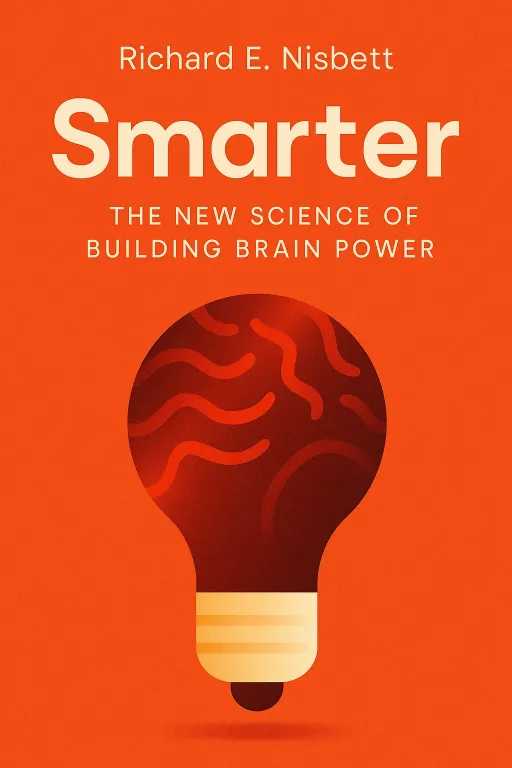
A Cognitive Toolkit for Rational Living
Golden Hook & Introduction
SECTION
Nova: You've heard the one about the lottery winner who lost it all? It’s a great story, a vivid cautionary tale. But that single, compelling narrative might be costing you better decisions every single day.
Atlas: Oh, I know that feeling. It's the drama, the human element, right? It grabs you way more than a dry statistic. But you're saying that very allure can be a trap when we're trying to think clearly?
Nova: Exactly! And that’s precisely what we’re diving into today. We’re talking about how to stop letting those captivating anecdotes hijack your judgment and build a genuinely rational mind.
Atlas: Fascinating. So, where do we start unpacking this?
Nova: We’re going to explore some incredible insights from two powerful sources. First up, Richard E. Nisbett’s, which dives deep into the statistical and economic principles that can help us sidestep common cognitive biases.
Atlas: Nisbett, the psychologist who’s spent decades mapping our mental shortcuts? I’ve heard his work is foundational.
Nova: Absolutely. And then we'll layer on the wisdom from The School of Life’s, which brings a crucial philosophical and emotional perspective to the table, highlighting barriers like emotional logic that can cloud even the sharpest minds.
Atlas: So, it's the head the heart, or rather, how the heart can sometimes betray the head?
Nova: Precisely. Our core of our podcast today is really an exploration of how to build a more rational mind by understanding our inherent cognitive biases and emotional tendencies, and equipping ourselves with practical tools to make better, more grounded decisions.
Atlas: Today we'll dive deep into this from three perspectives. First, we'll explore the hidden cognitive traps that lead us astray. Then, we'll discuss the powerful, often deceptive, influence of our emotions and philosophies on our thinking. And finally, we'll focus on a powerful principle that helps us bridge these worlds for truly grounded decision-making.
Unmasking Our Cognitive Blind Spots
SECTION
Nova: Let’s start with Nisbett and. He’s a pioneer in showing us that our brains, while brilliant, often rely on heuristics – mental shortcuts – that can lead us astray. He pulls from behavioral economics and statistics to illuminate these pitfalls. Think about that lottery winner story. It's memorable, it evokes emotion, and we might think, "Wow, that could happen to anyone!"
Atlas: Right, it feels very real, very present. It’s easy to picture.
Nova: But Nisbett would urge us to pause and ask: what’s the actual statistical probability of that happening? What’s the? He argues that we tend to overweight vivid, recent, or easily recalled information – what he calls the "availability heuristic" – and underweight general statistical information.
Atlas: So, if I hear about one person who succeeded wildly after taking a huge, unconventional risk, I might be more inclined to take that same risk myself, even if the vast majority of people who take that risk fail spectacularly?
Nova: Exactly! It’s like a doctor who sees a patient with a rare but dramatic set of symptoms. Their mind might immediately jump to the rare disease because it’s so striking, so memorable from a textbook case. But Nisbett would say, hold on. What’s the prevalence of that rare disease in the general population? What’s the prevalence of more common conditions that present with some similar symptoms?
Atlas: Ah, so the "base rate" is essentially the general statistical frequency of something happening. It’s the background reality versus the foreground anecdote.
Nova: You’ve got it. And the danger is that our intuition, our gut feeling, is often drawn to the anecdote. It’s more engaging, more story-like. Nisbett points out that we have a tendency towards "representativeness" – we judge the probability of an event by how well it represents our existing stereotypes or schemas, rather than by its actual base rate.
Atlas: This sounds like it touches on confirmation bias too, doesn't it? We seek out and remember information that confirms what we already believe or what we've just experienced vividly.
Nova: Absolutely. Confirmation bias is a huge player. If we’ve just heard that incredible story of the lottery winner, we might start noticing other stories about people taking risks, and our belief that risk-taking leads to massive rewards gets reinforced, while the overwhelming statistical evidence of failure gets conveniently overlooked. Nisbett’s work is a call to arms against this selective perception. He’s essentially giving us the statistical glasses to see the world more clearly, behind the dazzling, often misleading, curtain of vivid examples.
Atlas: So, for us, the curious learners, this means we need to actively cultivate a habit of questioning the vivid. Not dismissing it entirely, but asking for the statistical context before letting it sway our decisions. It’s about grounding ourselves in broader reality, not just the loudest story.
Nova: Precisely. It’s about recognizing that the most compelling narrative isn't always the most probable one. And this is where the second book comes in, because it explains we’re so susceptible to those narratives in the first place.
The Heart's Influence on the Head
SECTION
Atlas: So, if Nisbett is giving us the statistical tools, The School of Life is showing us the emotional and philosophical terrain where these biases play out. What are some of the biggest hurdles they highlight?
Nova: One of their key concepts is "emotional logic." This is the idea that we sometimes believe something is true, or should be true, not because of evidence, but because of how we about it. We might feel that a certain outcome happen, or that a person be good or bad, based on a strong emotional reaction, and then we construct a logic that supports that feeling.
Atlas: Oh, that’s potent. It’s like, "I this is right, therefore it right." It bypasses critical evaluation entirely. For someone striving for resilience, like our "Resilient Achiever" profile, this must be a massive roadblock. If you feel like you to succeed, you might ignore signs that you're on the wrong path, or that the path itself is flawed.
Nova: Exactly! It’s the romanticization of struggle, or the belief that because you've suffered, you're therefore owed success. That’s emotional logic at play. Or, consider the flip side: "I feel so strongly that this person is untrustworthy, therefore they be untrustworthy," even if all objective evidence points to them being reliable. We’re swayed by the intensity of our internal state.
Atlas: And what about the "philosophical barriers" they mention? How does philosophy get in the way of thinking effectively?
Nova: Philosophy, in this context, isn't about academic debate, but about our underlying, often unexamined, life philosophies. These are the deep-seated beliefs we hold about how the world works, about ourselves, about success, failure, and happiness. For example, someone might operate under a philosophy that "true happiness comes from external validation." This deeply held belief will inevitably color their decisions, making them prioritize actions that garner approval over those that might lead to genuine, internal satisfaction.
Atlas: So, if your core philosophy is "I must always be liked," then any decision that risks social disapproval, even if it’s the rational, beneficial choice, will feel wrong. It creates an internal conflict.
Nova: Precisely. And The School of Life points out that these philosophical frameworks can be incredibly rigid. They become lenses through which we view everything, and if the lens is warped, our perception will be too. It’s like wearing tinted glasses – you might see the world, but you’re not seeing its true colors. They might also fall into the trap of "emotional reasoning," where they let their current mood dictate their understanding of reality. If they're feeling down, they might conclude that life is inherently bleak, or that their efforts are futile, regardless of evidence to the contrary.
Atlas: That’s a heavy one. It means our entire worldview can be dictated by a bad mood or an ingrained, unhelpful belief system. It’s not just about individual biases, but about the very architecture of how we interpret reality. It speaks to that desire for meaningful progress – how can you make meaningful progress if your underlying philosophy is sabotaging you?
Nova: It’s a profound challenge. And what’s so interesting is how these two perspectives – Nisbett’s statistical/cognitive and The School of Life’s emotional/philosophical – often work in tandem to lead us astray. Our emotional logic might make us a vivid, unlikely success story to be true, and our cognitive biases make it easy to and just enough information to support that feeling, while ignoring the statistical base rate.
Atlas: It’s a double whammy! So, we’re bombarded with compelling stories that appeal to our emotions, and our brains are wired to latch onto them, while our deeper philosophical outlook might be subtly guiding us towards these very traps. It sounds almost inescapable!
The Art of Grounded Judgment
SECTION
Nova: Almost, but not quite! This is where the real power of these insights comes in, and it’s beautifully encapsulated by the "Base Rate" principle that Nisbett champions. It's the practical takeaway that bridges these two worlds.
Atlas: So, how do we actually this? How do we break free from the allure of the anecdote and the pull of emotional logic?
Nova: The core idea is to consciously, deliberately, incorporate the base rate – the general statistical probability – into your decision-making process, when you’re faced with vivid, emotionally charged information or a compelling narrative.
Atlas: Okay, give us an example. Let’s say I’m looking at starting a new business. I meet someone who had incredible success with a similar venture, and their story is incredibly inspiring. My gut is telling me, "This is it! I can do this!"
Nova: Right. That’s the vivid anecdote and potentially the emotional logic kicking in – you it to be true, you inspired. Now, Nisbett’s advice is to pump the brakes. Before you commit significant resources, ask: What is the general success rate for new businesses in this sector? What percentage of startups actually fail in their first three years?
Atlas: So, instead of focusing solely on the one person who made it, I need to find out how many make it. The statistical reality.
Nova: Exactly. And it’s not about dismissing the success story entirely. That person’s journey might still offer valuable lessons about strategy, perseverance, or specific tactics. But it shouldn’t be the driver of your decision. The base rate provides the essential context. It grounds your judgment in reality, preventing you from being swept away by a compelling, but potentially unrepresentative, narrative.
Atlas: This sounds like it requires a conscious effort, especially for someone like me, who values growth and wants to make informed choices, but also has a busy life and might not have hours to research every single decision. The recommendation is to schedule 15 minutes daily for focused learning or listening to summaries. This feels like it fits perfectly into that. Those 15 minutes could be dedicated to understanding a bias, or looking up a base rate for a decision you're contemplating.
Nova: Absolutely. It’s about building a of seeking the base rate. It’s a tool for the "Curious Learner" to constantly refine their understanding, and for the "Resilient Achiever" to avoid making decisions based on wishful thinking or emotional reasoning that could lead to significant setbacks.
Atlas: So, it’s a practical countermeasure. When that exciting, vivid story comes along, the immediate internal response is, "Okay, that’s a great anecdote. Now, what’s the base rate? What’s the statistical reality here?"
Nova: Precisely. And The School of Life’s perspective reminds us this is hard. Our emotional logic wants to believe in the exceptional story. Our philosophical outlook might even be geared towards romanticizing the underdog or the bold risk-taker. Applying the base rate principle is a way of consciously overriding those ingrained tendencies for the sake of more effective, rational living.
Atlas: It’s like adding a crucial layer of objective analysis to our subjective experience. It doesn’t negate the feeling or the story, but it contextualizes it. It helps us make choices that are both informed by reality and, ultimately, more likely to lead to meaningful progress. It’s about being discerning, not just receptive.
Nova: And it’s a journey, right? As our growth recommendations suggest, not every book or every insight needs to be a marathon. Small steps build momentum. So, perhaps today’s step is simply to become more aware of the stories you encounter and to ask that one simple question: "What's the base rate?"
Atlas: That’s a fantastic, actionable takeaway. It doesn't require a complete overhaul, just a slight shift in our internal questioning. It’s about empowering ourselves to make those informed choices, not just react to the most compelling input. It’s about building that cognitive toolkit.
Synthesis & Takeaways
SECTION
Nova: So, we’ve journeyed from the statistical landscape of, uncovering how easily we’re swayed by vivid anecdotes and cognitive biases, through the emotional and philosophical barriers highlighted by The School of Life, like emotional logic, and finally arrived at the powerful, grounding principle of the "Base Rate."
Atlas: It’s a potent combination. Recognizing our inherent susceptibility to compelling stories and emotional reasoning is the first step. Then, armed with the "Base Rate" principle, we have a practical tool to inject statistical reality into our decision-making, helping us move beyond surface-level impressions towards more informed, grounded judgments. It’s about ensuring our quest for growth is built on solid ground, not just captivating narratives.
Nova: And this process itself embodies the advice to embrace the journey. It’s not about instantly becoming a perfect rational thinker, but about consistently practicing these small steps, like asking about the base rate, to build momentum and refine our thinking over time. It’s about making progress, one informed choice at a time.
Atlas: For anyone listening who feels overwhelmed by the complexity of decision-making, or wonders how to integrate continuous learning into a busy life, remember that even a few minutes of focused reflection, like considering the base rate of a situation, can make a significant difference. It’s about quality over quantity in our cognitive efforts.
Nova: It’s about transforming how we perceive the world and ourselves within it, allowing for more clarity, more resilience, and ultimately, more meaningful progress.
Atlas: This has been incredibly insightful, Nova. Thank you for guiding us through these essential concepts.
Nova: My pleasure, Atlas. And thank you to our listeners for joining us on this exploration.
Atlas: This is Aibrary. Congratulations on your growth!









