The Dual Engine of Emotional Regulation and Self Mastery
Golden Hook & Introduction
SECTION
Nova: We spend about ninety percent of our mental bandwidth solving problems that haven't happened yet, and usually, never will. It is the single most expensive habit in modern life, costing us not just time, but our actual capacity to function.
Atlas: That is a staggering way to put it, but honestly, it rings true. We treat our anxiety like it is a productive activity. We think that if we worry hard enough, we are somehow preparing for the worst-case scenario. But most of the time, we are just burning fuel while parked in the driveway.
Nova: Exactly. And that is the trap we are going to dismantle today. We are looking at two very specific, very sharp tools for emotional regulation. First, we have the No Worries Method from Sarah Knight’s book, Calm the Fuck Down. Sarah Knight became a household name for her direct, no-nonsense approach to setting boundaries, and here she applies that same laser focus to the chaos of our own minds.
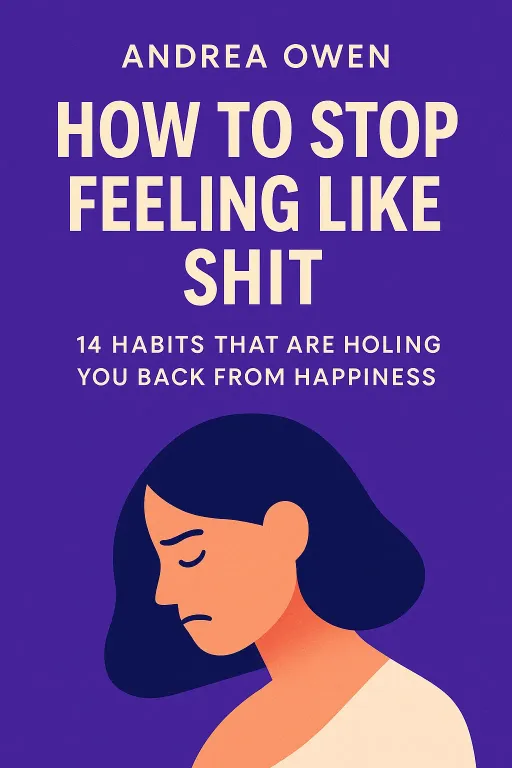
Atlas: And to pair with that, we are bringing in Andrea Owen’s work, How to Stop Feeling Like Shit. Owen is a powerhouse in the coaching world, and she identifies fourteen specific habits—think of them as self-sabotaging glitches in our software—that keep us stuck in that loop of worry and frustration.
Nova: It is a perfect pairing. Knight gives us the strategy for the external world—how to partition what we can control—and Owen gives us the tactics to handle the internal world, where those pesky habits like catastrophizing live. By the end of this, we are going to have a clear, actionable way to stop the spiral.
The Art of Partitioning Control
SECTION
Atlas: Let’s start with that idea of partitioning, because it sounds simple on paper but feels incredibly difficult when you are in the middle of a stressful week. Sarah Knight talks about dividing problems into things you can control and things you cannot. But how do we actually do that without lying to ourselves? Because everything feels like it’s within our control when we are stressed.
Nova: That is the core challenge. When we are in a state of high emotion, our brain tends to view every single outcome as something we are personally responsible for. The method Knight proposes is about creating a deliberate, almost mechanical separation. You literally have to force your brain to categorize. She suggests you look at a problem and ask: Is this an action I can take, or is this an outcome I am waiting for?
Atlas: That is a great distinction. The action is the input, the outcome is the result.
Nova: Precisely. If I am worried about a project at work, the action is drafting the proposal, checking the data, and hitting send. The outcome is the boss’s reaction, the timing of the feedback, or the budget approval. I can control the draft. I cannot control the budget cycle. The No Worries Method is about identifying where your agency actually ends.
Atlas: It sounds like a boundary issue. We are essentially setting a boundary with ourselves.
Nova: That is exactly it. We are setting a boundary on where our energy is allowed to go. If you spend your energy on the outcome, you are wasting it. If you spend your energy on the action, you are investing it. The problem is that we often feel like if we care enough, or worry enough, we can influence the outcome.
Atlas: I think that is the biggest lie we tell ourselves. We think worry is a form of productivity. Like, if I am not losing sleep over this, I am not taking it seriously enough.
Nova: That is a cultural myth. We equate anxiety with diligence. But Knight argues that anxiety is actually just noise. It is static. When you partition your problems, you are effectively turning down the volume on the noise so you can hear the signal. The signal is the task in front of you.
Dismantling Self-Sabotage
SECTION
Atlas: So, we have the strategy for external chaos. But what happens when the chaos is coming from inside the house? That leads us to Andrea Owen’s work. If Knight is about the situation, Owen seems to be about the reaction. She talks about fourteen habits that cause us to feel like, well, like shit.
Nova: And these habits are sneaky. They do not feel like sabotage in the moment. They feel like being a good person or being prepared. Take people-pleasing, for example. We frame that as being kind or collaborative. But Owen points out that people-pleasing is often a way to avoid conflict or rejection, which actually erodes our own boundaries.
Atlas: Oh, that hits home. I have definitely caught myself doing that. I agree to something I do not have time for because I do not want to let someone down, but then I end up resentful and stressed.
Nova: And that resentment is a classic sign of the habit. Owen is brilliant at exposing the hidden cost of these behaviors. Another big one she tackles is catastrophizing. This is the brain’s tendency to jump from a small mistake to a total disaster. You send an email with a typo, and suddenly you are convinced you are going to get fired and lose your apartment.
Atlas: It is like a runaway train. The brain just builds the track as it goes.
Nova: Exactly. And the reason we do it is that we think by anticipating the worst, we are somehow protecting ourselves. If I imagine the worst-case scenario, it cannot surprise me. But all that does is drain your cortisol levels and leave you exhausted for the actual challenges of the day.
Atlas: It is a defense mechanism that has become a liability. How does Owen suggest we dismantle those? Because stopping a thought pattern like that feels like trying to stop a physical reflex.
Nova: She emphasizes the importance of behavioral scripts. You cannot just tell yourself to stop worrying. You have to replace the behavior with a new, programmed response. When you catch yourself catastrophizing, you don’t just say, stop it. You say, okay, what is the evidence for this? What is the most likely outcome? You force your brain to engage the logical cortex instead of the emotional center.
Atlas: It is like interrupting a loop. You are putting a physical barrier in the path of the thought.
Nova: Precisely. And that is where the combination of these two approaches becomes so powerful. Knight gives you the structure to organize your reality, and Owen gives you the tools to manage your internal narrative. You are cleaning up the workspace and you are training the worker.
The Practical Implementation
SECTION
Atlas: This is all very logical, but let’s get to the brass tacks. We have listeners who are probably looking at their calendar right now, thinking they do not have time for a new self-help regimen. How do we make this a habit? How do we stop this from just being another good idea that gets filed away and forgotten?
Nova: The answer is in the tiny step, the one that requires almost zero overhead. It is a physical exercise. You take a piece of paper, you draw a line down the middle. On the left, you write down every single thing that is currently triggering that sense of anger, anxiety, or overwhelm. Everything.
Atlas: Just a brain dump.
Nova: Exactly. Just get it out. No filtering. Then, you look at the left side, and you move the items over to the right side based on one criterion: Is this something I can actively change today? If the answer is yes, it goes on the right. If the answer is no, it stays on the left, and you label it as something you must accept and let go.
Atlas: That is deceptively simple. Why does writing it down matter? Why can’t I just do this in my head?
Nova: Because the brain is not designed for storage; it is designed for processing. When you try to hold those problems in your head, you are using your working memory to keep them active. You are literally holding the anxiety in your mind. Putting it on paper offloads that cognitive burden. It allows you to see the problem objectively, rather than experiencing it subjectively.
Atlas: It turns the abstract worry into a concrete list. It is much harder to be irrational about a piece of paper than it is to be irrational about a feeling.
Nova: And the beauty is in the action. Once you have that right column, you have a to-do list. You are no longer worrying; you are executing. You have transformed the energy of anxiety into the energy of action. And for the left column, the things you cannot change, you are practicing the discipline of acceptance. You are acknowledging that you are powerless over those things, and that is a profound relief.
Atlas: It feels like a form of mental hygiene. We brush our teeth every day to take care of our physical health, but we rarely do a daily sweep of our mental clutter.
Nova: That is the perfect analogy. This is just mental hygiene. If you do this for fifteen minutes a day—or even once a week when things get heavy—you are preventing that accumulation of stress. You are clearing the pipes.
Synthesis & Takeaways
SECTION
Atlas: I love that because it respects the user’s time. We are not talking about hours of meditation or a complex journaling practice. We are talking about fifteen minutes of triage.
Nova: And that is the point. We are not trying to eliminate all stress from your life. That is impossible. We are trying to eliminate the unnecessary suffering caused by trying to control the uncontrollable and getting trapped in those self-sabotaging loops.
Atlas: It really comes down to focus. By narrowing our field of vision to only what we can influence, we actually become more powerful. We stop diluting our impact across a hundred things we cannot change and pour it all into the few things we can.
Nova: Exactly. It is the difference between casting a net and using a laser. You want the laser. You want to be able to identify the specific behavior or the specific problem that matters right now. And remember, this is a practice. You are not going to be perfect at it. You will still catastrophize. You will still try to control the outcome. The goal is not perfection; it is a faster recovery time. It is noticing the pattern sooner and pulling yourself out of it faster.
Atlas: I think that is a very freeing thought. We don't have to be perfect; we just have to be observant.
Nova: That is the key to mastering your own emotional landscape. It is not about silencing the emotions; it is about managing the response.
Atlas: This has been a great breakdown. I am definitely going to try that page-divider exercise tonight because I have a few things on my mind that are currently sitting in the wrong column.
Nova: That is the best way to start. Take those triggers, put them on paper, and see what you can actually do with them. If you can change it, act on it. If you cannot, give yourself permission to let it go. It is a simple, effective, and profoundly liberating way to live.
Atlas: A simple, effective way to reclaim our focus and our peace. I think that is a win for everyone.
Nova: This is Aibrary. Congratulations on your growth!