

Dismantling Self-Sabotage and Ego Friction
Golden Hook & Introduction
SECTION
Nova: We spend so much time trying to fix our internal problems that we accidentally become the most important thing in our own lives.
Atlas: That is a brutal way to start a podcast, Nova. But I think you are right. We treat our own growth like a high-stakes renovation project where we are both the architect and the crumbling foundation.
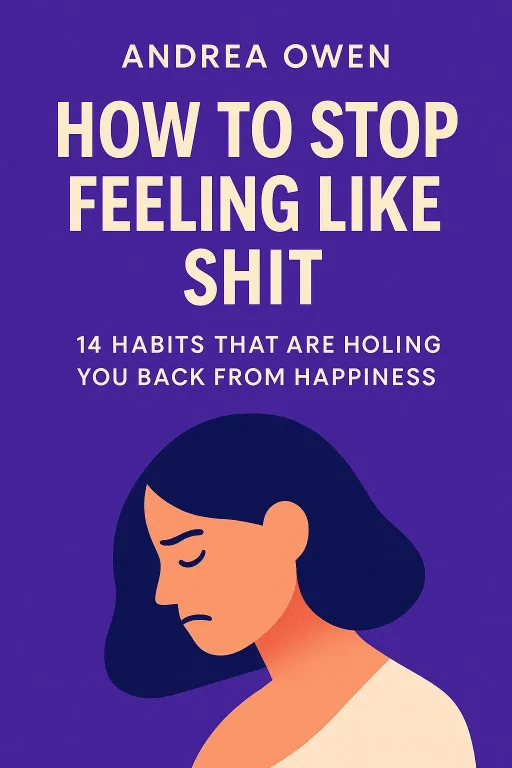
Nova: Exactly. And that creates this strange paradox where the harder we work on ourselves, the more self-obsessed we actually become. Today we are exploring that trap by looking at two very different books that actually point toward the same exit. We are diving into How to Stop Feeling Like Shit by Andrea Owen and The Freedom of Self-Forgetfulness by Timothy Keller.
Atlas: These are two very different writers. Andrea Owen is known for her no-nonsense, coach-like approach to emotional health, often dealing with the gritty reality of how we sabotage our own happiness. And Timothy Keller, coming from a completely different philosophical and theological background, wrote this short, punchy book that challenges the modern obsession with self-esteem.
Nova: That is the perfect setup. Owen identifies the mess we make, and Keller offers a surprisingly radical way to walk away from it.
The Trap of Self-Sabotage
SECTION
Atlas: Let’s start with the mess. I’ve read Andrea Owen’s work, and she has this way of calling you out on your own behavior without making you feel like a total failure. What is the core mechanism she identifies for why we feel like, well, you know, the title of her book?
Nova: She focuses heavily on defense mechanisms. These are the habits we develop to shield ourselves from pain, rejection, or the feeling of being inadequate. Think of catastrophizing or people-pleasing. When you are constantly scanning for the next disaster or bending over backward to make sure everyone else is happy, you are not actually serving the world. You are building a fortress around your ego.
Atlas: I can relate to that. The people-pleasing angle is a classic. It feels like you are being nice, or selfless, or a good team player. But you are saying that is actually a defense mechanism?
Nova: That is exactly what Owen argues. It is a way to control how others perceive you. If I keep everyone happy, then no one will criticize me, and my ego remains safe. It is a survival strategy. But the cost is that you lose touch with what you actually want or need. You are essentially outsourcing your sense of self-worth to other people’s opinions.
Atlas: That hits hard. It turns your life into a performance. You are constantly checking the audience to see if they are applauding. And if they aren't, you panic.
Nova: Precisely. And that is where the catastrophizing comes in. If you are not getting that validation, your brain jumps to the worst-case scenario. You think, if I don't get this promotion, I am a failure, and if I am a failure, I will be alone forever. It is a feedback loop where the ego is constantly trying to prevent a threat that, in reality, might not even exist.
Atlas: So, the ego isn't just about being arrogant or loud. It’s about being scared. It’s this fragile thing that needs constant maintenance.
Nova: That is the most accurate way to put it. The ego is a needy roommate. It wants constant reassurance. It wants to be special, or at least safe from judgment. And Owen’s point is that until you recognize that these behaviors—the over-apologizing, the perfectionism, the constant worry—are just defense mechanisms, you will stay trapped in that loop.
The Ego and the Antidote
SECTION
Atlas: This is where I want to pivot to Timothy Keller. Because if the ego is a needy roommate that needs to be managed, Keller seems to suggest we should just evict it entirely.
Nova: That is a great way to put it. Keller’s The Freedom of Self-Forgetfulness is a short book, but it packs a punch because he dismantles the modern obsession with self-esteem. We are constantly told to think better of ourselves, to build up our self-image. Keller argues that this is actually the wrong direction.
Atlas: Wait, I need to stop you there. We are always told that low self-esteem is the root of all evil. Are you saying we should stop trying to feel good about ourselves?
Nova: Keller differentiates between thinking less of yourself and thinking of yourself less. That is the crucial distinction. He suggests that true humility is not about beating yourself up or having a low opinion of your talents. It is about reaching a state where you are so focused on things outside of yourself that you simply stop thinking about your own ego.
Atlas: Okay, that sounds like a relief. Because constantly monitoring my own self-esteem sounds exhausting. It is like looking in a mirror every five minutes to check if my hair is still perfect.
Nova: Exactly! And that is the problem with the modern focus on self-esteem. It requires you to be constantly self-conscious. You are always judging yourself, comparing yourself to others, measuring your worth. Keller argues that the ego is like a very noisy, demanding person. Whether it is telling you that you are the greatest, or telling you that you are the worst, it is still talking about.
Atlas: So whether you are arrogant or insecure, you are still obsessed with yourself.
Nova: You nailed it. Both arrogance and insecurity are forms of self-obsession. When you are arrogant, you are obsessed with how great you are. When you are insecure, you are obsessed with how inadequate you are. In both cases, the center of your universe is still you. Keller is suggesting that the path to freedom is to stop making yourself the center of the story.
Atlas: That feels counterintuitive. We are taught that we need to define our identity, build our personal brand, and curate our self-image. You are suggesting that the healthiest move is to let go of that project entirely?
Nova: It is not about having no identity. It is about having an identity that is so secure that you don't need to constantly defend it or advertise it. When you are truly humble, you are not worried about how you are perceived. You are free to be present. You are free to fail, to look silly, to be wrong, because your worth isn't tied to your performance in that moment.
Synthesis and Practical Application
SECTION
Atlas: I can see how these two books fit together now. Andrea Owen helps us identify the defense mechanisms we use to protect our ego, and Timothy Keller helps us understand that the ego is the thing we need to stop protecting in the first place.
Nova: That is the synthesis. Once you realize that the panic, the people-pleasing, and the catastrophizing are all just the ego trying to survive, you can start to step back. You can ask yourself the deep question: Am I trying to protect my ego, or am I focusing on serving the person in front of me?
Atlas: That is a practical, brutal, and beautiful question. I can imagine using that in a high-stakes meeting. If I feel defensive because someone criticized my work, I can pause and ask, is my reaction coming from a desire to do better work, or is it coming from a desire to protect my image?
Nova: And usually, if we are honest, it is the latter. The defense kicks in because we feel exposed. But if you can switch your focus to the work itself, or to the team, or to the person you are talking to, the ego loses its power. You become self-forgetful.
Atlas: It’s interesting, because this sounds like it would make you more productive, not less. When I stop worrying about how I look, I have way more brainpower to actually solve the problem.
Nova: That is the irony. The more you focus on yourself, the less you can actually accomplish. The more you focus on the task or the people around you, the more effective you become. You stop being the protagonist of a drama where you are constantly under attack, and you become a participant in a world that needs your contribution.
Atlas: I think about the people who are truly great at what they do. They often don't seem to be thinking about themselves. They are just lost in the work. They are in that flow state.
Nova: They are the definition of self-forgetful. They are not checking the mirror; they are looking at the canvas, or the code, or the patient, or the student. They have moved past the need for validation.
Atlas: So, how do we start? If I am a chronic people-pleaser, I can't just flip a switch and become a Zen master overnight. What is the first step in this process?
Nova: You start by noticing. That is the first step. The next time you feel that surge of anxiety—that need to apologize, or that need to defend yourself, or that need to be right—just label it. Say to yourself, my ego is trying to protect itself right now. Just naming it takes the power away. You don't have to act on it. You can acknowledge the feeling and then choose to focus on something else.
Atlas: I like that. It’s not about suppressing the feeling; it’s about acknowledging it and choosing not to let it drive the bus.
Nova: Exactly. You are observing the ego, not obeying it. And the more you practice that, the more space you create. You start to see that you are not your ego. You are the one who is watching the ego.
Atlas: That creates a lot of breathing room. It changes the goal from "becoming perfect" to "becoming present."
Nova: And that is a much more sustainable way to live. The goal isn't to be a flawless version of yourself. The goal is to be a human being who is free enough to stop worrying about the self and start engaging with the world.
Atlas: This has been a great conversation, Nova. We covered the defense mechanisms that keep us stuck and the philosophical shift that sets us free. It feels like a roadmap for getting out of our own way.
Nova: I’m glad you think so. It really is about reclaiming the energy we waste on ego-protection and redirecting it toward things that actually matter.
Atlas: If our listeners want to take one thing from this today, it is that question: Am I protecting my ego, or am I serving the person in front of me?
Nova: That is the compass. Keep that question handy for your next meeting, your next tough conversation, or even your next moment of self-doubt. It changes everything.
Atlas: Thanks for walking through this with me. This is Aibrary. Congratulations on your growth!









