

Breaking Patterns of Self Sabotage and Isolation
Golden Hook & Introduction
SECTION
Nova: You know that feeling of pride when you finally solve a complex problem all on your own? It turns out, that exact moment of triumph might be the single biggest obstacle to your long-term success.
Atlas: That is a harsh way to start the episode, Nova. Are you saying that being capable and independent is actually a liability? I feel like that goes against everything we are taught about building a career or a life.
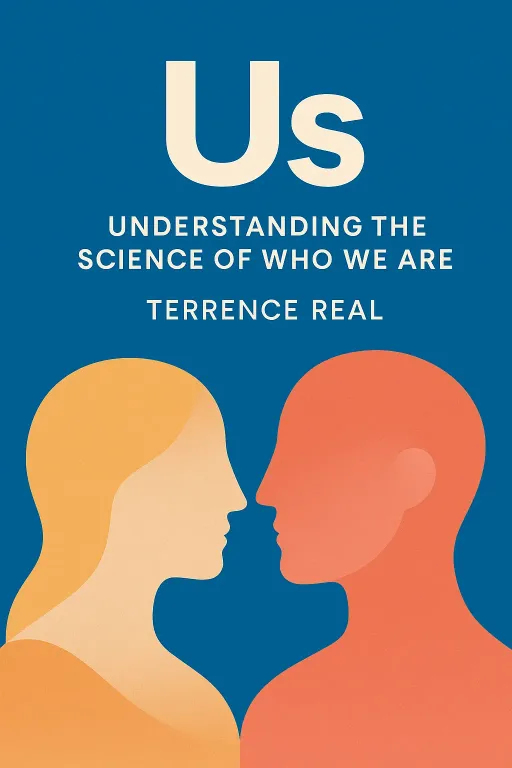
Nova: I am saying that we have been sold a bill of goods. We are taught that the ultimate goal is to become an island—a rugged individualist who needs no one. But today, we are going to dismantle that idea. We are looking at two incredible books that challenge the very foundation of how we relate to ourselves and others. We are diving into Us by Terrence Real, a master of relationship therapy, and How to Stop Feeling Like Shit by Andrea Owen.
Atlas: I have heard of Terrence Real. He is a heavyweight in the world of family therapy, right? I think he spent years working with high-profile families who were falling apart despite having every resource in the world.
Nova: Exactly. He brings this clinical, no-nonsense depth to the concept of relationships. And then we have Andrea Owen, who takes a much more direct, almost punchy approach to the internal stuff—those self-sabotaging behaviors that keep us stuck. The core of our conversation today is really an exploration of how we move from the ego of me to the ecosystem of we, while simultaneously cleaning up the internal mess that stops us from getting there.
Atlas: That sounds like a heavy lift. We are talking about fixing our relationships and our internal software at the same time. I am ready. Where do we start?
The Myth of the Rugged Individualist
SECTION
Nova: We start by killing the hero. Or at least, the myth of the hero. Terrence Real, in Us, argues that the cultural narrative of the rugged individualist is actually a form of pathology. He suggests that our obsession with independence is a defense mechanism. We think that if we don't need anyone, we can't be hurt.
Atlas: I see that all the time. In the corporate world, or even in high-stakes creative environments, the person who says, I will just do it myself, is often treated like the MVP. They are the ones who get things done. Are you suggesting that this person is actually dysfunctional?
Nova: That is the tricky part. They are high-functioning, but they are often relationally starving. Real proposes a shift to what he calls relational mindfulness. It is the idea that we are not solitary units bouncing off each other. We are an ecosystem. Think of it like a biological system. If you remove the trees from the forest, the soil changes, the water table shifts, and the whole environment suffers. When you act as a rugged individualist, you are essentially trying to be a tree that refuses to interact with the forest.
Atlas: Okay, that makes sense on a metaphorical level. But let us bring this down to earth for our listeners who are managing teams or trying to build a career. If I am in a high-pressure situation, and I rely on the team instead of just taking control, I risk failure. How does this relational mindfulness actually help me? Does it not just slow everything down?
Nova: It feels like it slows things down, but that is the illusion. Real argues that the rugged individualist approach creates a fragile stability. You are holding everything up by yourself. The moment you get tired, or sick, or overwhelmed, the whole structure collapses because you have not built the connective tissue of the team. Relational mindfulness is about valuing the ecosystem of we over the ego of me. It means that when you are in a meeting, you are not just thinking about your own defense or your own output. You are thinking about the health of the collective.
Atlas: So, it is about shifting the focus from individual performance to systemic health. That is a strategic shift. It is like the difference between a player who wants to score the most points and a player who wants the team to win. But how do you handle the ego part? Because let’s be honest, we are all wired to want to be the one who saves the day. That feels good.
Nova: That is the ego of me. It is addictive. Real points out that we get a hit of dopamine from being the one who figured it out. But that hit is fleeting. The long-term gain comes from building a system that sustains itself. The rugged individualist is always racing to the finish line, but relational mindfulness is about laying a foundation that lasts.
Atlas: I am thinking about a scenario where this would be incredibly difficult. Let’s say you have a colleague who is dropping the ball. The rugged individualist response is to step in, take the work, and fix it. You get the result, you look like the hero, and you stay in control. What is the relational move there?
Nova: That is a perfect example. The rugged individualist move is to take the work. The relational move is to have the difficult conversation. It is to go to that person and say, I see what is happening here, and it is affecting the collective. How can we fix this so the system works? That is harder. It requires vulnerability, it requires communication, and it requires you to let go of the immediate satisfaction of fixing it yourself. But it solves the systemic issue rather than just patching the symptom.
Dismantling Self-Sabotage
SECTION
Atlas: That is a profound distinction. It is the difference between a quick fix and a long-term solution. But let us pivot to the internal side, because even if I want to be relationally mindful, I have my own internal baggage. That brings us to Andrea Owen and her book, How to Stop Feeling Like Shit. If the first book is about our external ecosystem, is this the manual for our internal operating system?
Nova: Exactly. Owen identifies 14 common self-sabotaging behaviors. And honestly, she does not mince words. She calls out things like people-pleasing, imposter syndrome, and the need for control. These are the behaviors that keep us stuck in that rugged individualist loop.
Atlas: I want to focus on people-pleasing for a second. It sounds like a nice trait. Why would someone call that self-sabotage? Is it not just being a good team player?
Nova: That is the trap. People-pleasing is not about being kind. People-pleasing is about managing how other people feel so that you can feel safe. It is a manipulation tactic, albeit an unconscious one. You are essentially editing yourself to fit the mold that you think the other person wants. You are not showing up as your full self because you are terrified of the potential conflict or rejection.
Atlas: That hits home. It is like when you are in a negotiation or a high-stakes meeting, and you agree to a timeline that you know is impossible because you do not want to be the person who says no.
Nova: Precisely. You are sacrificing your integrity and the quality of the work to avoid a moment of discomfort. And what is the result? You end up resentful, burnt out, and the project eventually fails anyway because the timeline was never realistic. Owen argues that the way to stop feeling like shit is to stop the behaviors that cause the suffering. And the first step is recognizing that these behaviors are survival strategies.
Atlas: Survival strategies? That makes them sound like they were useful at some point.
Nova: They were. Think about it. When you were a child, or perhaps early in your career, people-pleasing might have kept you safe. It kept the peace. It made you liked by the people who had power over you. But you are not a child anymore. You are a builder. You are a strategic architect. These survival strategies are now outdated software running on a new computer. They are causing glitches.
Atlas: So, how do we update the software? If I am a chronic people-pleaser, or if I struggle with imposter syndrome—which I think is just a fancy way of saying I am terrified of being exposed as a fraud—what is the straight-talking strategy Owen suggests?
Nova: She suggests a radical form of self-honesty. You have to start by calling the behavior what it is. You are not being helpful when you people-please; you are being dishonest. That sounds harsh, but it is the kind of honesty that creates change. When you feel that urge to agree to something you do not want to do, you have to pause. You have to ask yourself, Am I doing this because it is the right move for the collective, or am I doing this because I am afraid of how they will perceive me?
Atlas: That connects directly back to Terrence Real’s relational mindfulness. It is the same question, just applied to the self. It is asking, Is this move for the ego, or is it for the system?
Nova: You nailed it. It is the bridge between the two. When you stop people-pleasing, you are actually being more relational. You are giving people the truth. You are showing up as a real person, not as a chameleon. And that allows for authentic connection.
Atlas: I have to admit, that is a scary thought. If I stop people-pleasing, people might not like me as much.
Nova: They might not. But the people who stay? They will be the ones who respect you. And that is a much higher quality of relationship. The same goes for imposter syndrome. Owen suggests that we have to stop waiting for permission to feel confident. Confidence is not a feeling that descends from the heavens. It is the result of action. You take the action, you survive the consequences, and then you build the confidence.
Synthesis & Takeaways
SECTION
Atlas: This is starting to form a very clear picture. We have the external system, which requires us to move from the ego of me to the ecosystem of we, and we have the internal system, which requires us to dismantle the survival strategies that keep us small. It seems like the common thread is the pause.
Nova: The pause is everything. It is the space between the stimulus and the response. Most of us live our lives in a reactive loop. Something happens, we feel a trigger, and we immediately default to our rugged individualist or our people-pleaser persona. We have to create space in that loop.
Atlas: So, for our listeners who want to put this into practice, what is the one concrete thing they can do today? We talked about the tiny step in the intro. Let us flesh that out.
Nova: The tiny step is this: Next time you feel defensive in a professional or personal setting, stop. Just stop. Take a breath and ask yourself, What is the relational move here that serves the collective, rather than just my immediate defense?
Atlas: That is powerful. It forces you to get out of your own head and look at the bigger picture. It is a strategic move. It is not just being nice; it is being effective.
Nova: Exactly. And if you find yourself slipping into one of those behaviors—like agreeing to something you hate or trying to do everything yourself—call it out. Say to yourself, Okay, this is my old survival strategy kicking in. I am trying to keep myself safe. But I do not need to do that anymore. I can choose a different path.
Atlas: It sounds like we are building a new foundation. We are not racing to the finish line; we are building a life of substance. We are trading the short-term hit of being the hero for the long-term strength of being a part of a healthy ecosystem.
Nova: That is the goal. It is a shift from winning to thriving. And thriving is not something you can do alone. It is something you do in connection with others, and in alignment with yourself.
Atlas: This has been a fantastic conversation. I feel like I have a much clearer blueprint for how to handle these moments of friction.
Nova: I am glad to hear that. Remember, this is a practice. You will mess up, you will revert to old patterns, and that is okay. The key is to notice it and come back to the relational move. That is how you grow.
Atlas: Well, that is all the time we have for today. We have covered a lot of ground, from the myth of the rugged individualist to the practical steps for dismantling self-sabotage. I hope our listeners take that pause and really look at their own systems.
Nova: Absolutely. Keep building, keep learning, and keep connecting. This is Aibrary. Congratulations on your growth!









