

Stop Guessing, Start Measuring: The Guide to Data-Driven Accommodation.
Golden Hook & Introduction
SECTION
Nova: What if your gut feeling, that trusty inner voice, is actually sabotaging your best intentions when you're trying to make a real difference?
Atlas: Oh man, that's a loaded question right out of the gate, Nova. Because for so many of us, that gut feeling is what sparks our passion, right? It's what tells us something's wrong and needs fixing.
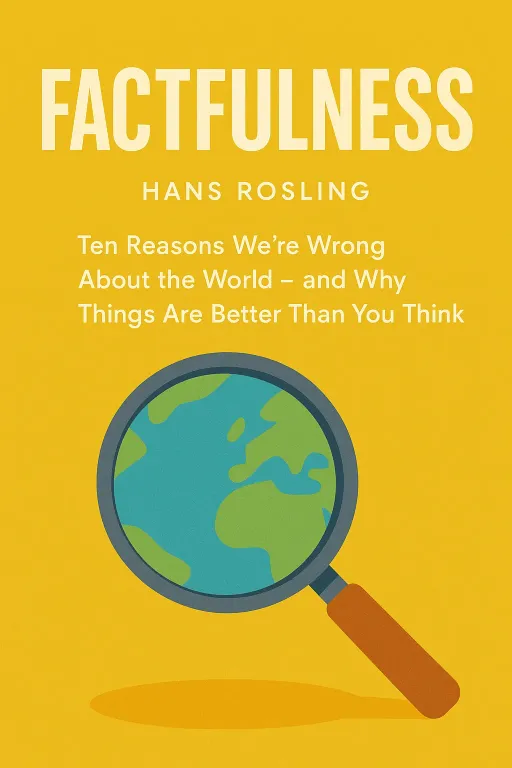
Nova: Absolutely! And that passion is vital. But today, we're diving into a powerful idea that challenges that very notion, drawing insights from Hans Rosling's groundbreaking work, "Factfulness," and the timeless classic, "How to Lie with Statistics" by Darrell Huff.
Atlas: Oh, those titles alone make me want to grab a calculator and a skepticism shield. Especially for anyone trying to navigate really complex situations, where the stakes are incredibly high for the people they're trying to help.
Nova: Exactly! Rosling, a physician, statistician, and public speaker, dedicated his life to battling devastating global misconceptions with data, showing us how to see the world as it truly is, not as our biases paint it. His work was a global phenomenon, winning accolades for its clear, hopeful, and fact-based approach to understanding progress. He literally shifted how millions understood global health and poverty.
Atlas: Wow. So he wasn't just talking numbers; he was talking about changing minds on a massive scale. That's a huge shift from just relying on what feels right, or what we've always been told.
Factfulness in Advocacy: Overcoming Intuitive Traps with Data
SECTION
Nova: It’s a massive shift. And it leads us directly to our first core idea: how to cultivate factfulness in advocacy. Because often, our intuition, while well-meaning, actually fails us in complex fields, leading to missed opportunities for impactful change.
Atlas: But how do you even begin to untangle those instincts when you're deeply passionate about a cause, when your entire drive comes from seeing an injustice? I imagine a lot of our listeners, who are championing dignity and fairness, feel that pull very strongly.
Nova: That’s a brilliant point, Atlas. Rosling helps us understand that our brains are wired with certain instincts – like the negativity instinct, where we tend to focus on the bad news, or the fear instinct, which makes us overestimate dangers. These instincts served us well in simpler times, but in a complex, interconnected world, they can create a distorted view of reality.
Atlas: So you're saying our very human empathy, our desire to fix things, can actually blind us to the real facts if we’re not careful?
Nova: Precisely. Let me give you a hypothetical example. Imagine an advocate, deeply concerned about what they perceive as a dramatic decline in access to a specific accommodation for a vulnerable community in their city. They've heard stories, seen a few alarming headlines, and their gut screams that things are getting worse, fast. So, they pour all their energy into a campaign, pushing for a specific, costly policy based on this urgent narrative.
Atlas: Okay, I can totally visualize that. It’s a powerful, emotionally driven approach.
Nova: It is. But then, if they applied Rosling's factfulness framework, they might dig into the actual, reliable data. They might find that while individual stories are heartbreaking, the overall trends, when viewed across a broader demographic or over a longer timeline, show a different picture. Perhaps access isn't declining across the board, but is shifting to a different type of service, or has actually improved in some areas, while new, previously unaddressed challenges are emerging elsewhere.
Atlas: Oh, that's incredibly nuanced. So the initial policy, based on that gut feeling, might have been completely misdirected. Wasting precious resources, and potentially even harming the community by fixing the wrong problem.
Nova: Exactly. The cold, hard data, while perhaps less emotionally charged than an anecdote, provides a much more accurate map of the territory. It allows the advocate to pivot, to channel their passion into solutions that address the needs, not just the perceived ones. It builds stronger, evidence-based arguments that are much harder to refute.
Atlas: That makes perfect sense. For our listeners navigating intricate regulations, this isn't just academic; it's about making sure every effort, every policy proposal, truly hits its mark. So, how do we train our brains to look beyond those instincts, to truly embrace this fact-based worldview?
The Ethics of Data: Guarding Against Manipulation and Persuading with Integrity
SECTION
Nova: It starts with conscious effort, with asking for actual numbers, comparing them, and being open to challenging our own assumptions. And that naturally leads us to the second key idea we need to talk about, which often acts as a counterpoint to what we just discussed. Because once we've trained our brains to look for facts, Atlas, how do we know the facts we're looking at aren't, well, lying to us?
Atlas: That's the million-dollar question, isn't it? Because in the world of advocacy, data is power, and power can be misused. I imagine a lot of ethical architects are constantly on guard against that.
Nova: They should be. That's where Darrell Huff's "How to Lie with Statistics" comes in. It's a classic for a reason – it reveals the many subtle and not-so-subtle ways statistics can be manipulated or misinterpreted, often unintentionally, but sometimes with clear intent.
Atlas: So it's like a user's guide to spotting statistical trickery?
Nova: Precisely. Huff dissects things like biased samples, where the data collected isn't truly representative of the whole, or misleading graphs, where a simple change in the Y-axis can make a minor fluctuation look like a catastrophic decline or a dramatic improvement. He also highlights the classic trap of confusing correlation with causation – just because two things happen together doesn't mean one caused the other.
Atlas: Give me an example of that. How does that play out in the real world of advocacy?
Nova: Let's say an organization is trying to gain support for a new accommodation measure. They might conduct a survey, but only send it to people who have previously expressed strong support for similar measures. That's a biased sample. They then present the results, saying "85% of people surveyed support this new measure!" It sounds incredibly compelling, but it's not representative.
Atlas: Wait, so they're technically not lying about the numbers from survey, but they are absolutely misleading about what those numbers for the broader population they claim to represent.
Nova: Exactly. Or, imagine a graph showing a small, incremental improvement in a particular outcome over time. By compressing the X-axis and extending the Y-axis, that small improvement can be made to look like a massive, game-changing leap. It's visually persuasive, but mathematically deceptive. Understanding these pitfalls allows the conscientious advocate to not only identify flawed arguments from others but also to present their own data with unimpeachable integrity.
Atlas: So how does an ethical architect, someone driven by fairness, use this knowledge not just to defend against manipulation, but to ethically persuade? Because it’s not enough to just point out flaws; they need to build stronger, more trustworthy cases.
Nova: It's about transparency and clarity. Instead of just presenting a number, explain the methodology: "We surveyed a randomized sample of 500 individuals across diverse demographics, and here's what we found." Instead of a misleading graph, use one that accurately represents the data, even if the trend isn't as dramatic. It builds trust. When you understand how data can be used to lie, you become acutely aware of the responsibility to use it to tell the truth, completely and clearly. That's how you move from mere analysis to powerful, ethical persuasion and strategic decision-making that genuinely fosters systemic improvement.
Synthesis & Takeaways
SECTION
Nova: Ultimately, what Rosling and Huff teach us is that data isn't just about cold numbers; it's about seeing the world truthfully, and then communicating that truth responsibly.
Atlas: That's actually really inspiring. It means that our deep human drive for fairness, as strategic empath, can be amplified, made more effective, when grounded in reliable data. It's about channeling that passion into strategies that truly work.
Nova: Absolutely. And remember, as your own growth recommendations suggest, your lived experience is powerful data. But it becomes even more powerful when cross-referenced with broader, reliable data. It's about bringing both intuition and evidence together for maximum impact.
Atlas: So, for anyone listening who's currently relying on an anecdote or a gut feeling in their work, I challenge you: identify just one area this week where you could seek out more reliable data. Just one. See if it confirms your assumptions or, perhaps, beautifully challenges them.
Nova: That tiny step can unlock immense potential for more effective, ethical advocacy. It’s about stopping the guessing and truly starting to measure, because that's where impactful change truly begins.
Atlas: This is Aibrary. Congratulations on your growth!