

Hacking Your Home OS: A Product Manager's Guide to a Functional Life
Golden Hook & Introduction
SECTION
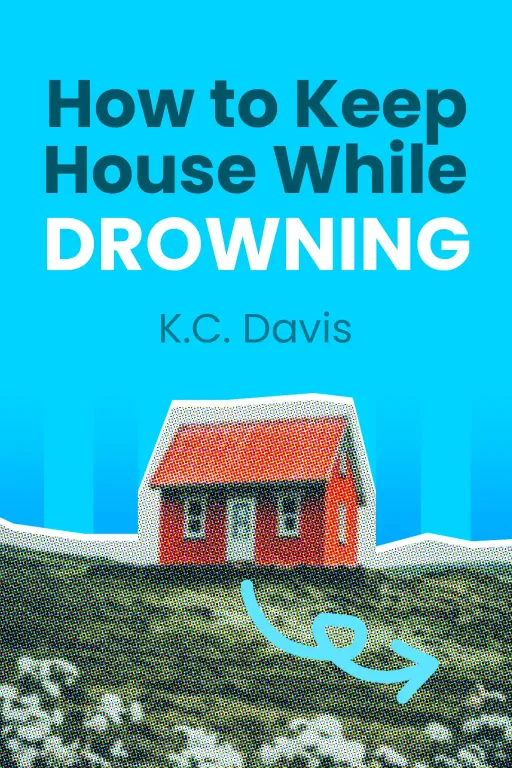
Nova: In product management, we're obsessed with creating elegant, functional systems. We build roadmaps, prioritize features, and ship MVPs. But what happens when the most important product we manage—our own life—feels like it’s running on buggy, outdated software? We get overwhelmed, we crash, and we blame ourselves. The book 'How to Keep House While Drowning' by KC Davis offers a radical system upgrade. It argues that the problem isn't you; it's your process. Today we'll dive deep into this from two perspectives. First, we'll deconstruct the 'why'—redefining our relationship with our homes and tasks by adopting an MVP mindset. Then, we'll get into the 'how'—exploring practical, almost algorithmic systems from the book that you can deploy immediately to make your space functional. And I'm so thrilled to have Titus Wabomba here with me. As a product manager in the tech world and a sharp, analytical thinker, Titus, you are the perfect person to help us reverse-engineer this.
TITUS WABOMBA: Thanks for having me, Nova. It's a fascinating premise. We spend our days optimizing complex systems for users, but often neglect the most critical one: our own. I'm excited to see if we can apply some of those professional principles to our personal lives.
Nova: I think we can. So, Titus, let's start with the book's most revolutionary idea, and it's a quote: 'You don’t exist to serve your space; your space exists to serve you.' For so many of us, that's a complete paradigm shift.
TITUS WABOMBA: It is. Because it reframes the entire problem. It asks, "What is the 'job to be done' of a house?" We assume the job is "be beautiful and clean," but the book argues the real job is "support the user's ability to function." That's a very different set of requirements.
Deep Dive into Core Topic 1: Redefining 'Done': The MVP Mindset for Your Life
SECTION
Nova: Exactly! It detaches morality from the equation. The author, KC Davis, says care tasks are "morally neutral." A messy kitchen doesn't make you a bad person, it just makes your kitchen non-functional. And this leads to a great story in the book that I think you'll appreciate. She talks about being inspired by an organizational magazine to get her shoes in order.
TITUS WABOMBA: Ah, the siren song of a perfect system. I know it well.
Nova: Right? So she goes out and buys these beautiful, clear, stackable shoe boxes for every single pair of shoes she owns. The vision is this perfect, aesthetically pleasing wall of shoes, all visible and protected. It looks amazing in theory.
TITUS WABOMBA: It sounds like a beautiful UI. A great-looking interface.
Nova: A perfect UI! But in practice, it was a disaster. To get a pair of shoes, she had to unstack the boxes, open the specific one, take out the shoes, and then restack them. Putting them away was the same process in reverse. It was so frustrating and added so much friction that she just stopped putting her shoes away altogether. They ended up in a pile on the floor anyway.
TITUS WABOMBA: So the user experience was terrible.
Nova: Exactly. So what did she do? She got rid of the pretty boxes and just threw all her shoes into one big, ugly basket in her closet. It wasn't beautiful, but it was functional. The task of putting away her shoes went from a five-step, high-friction process to a one-step, "toss it in the basket" action.
TITUS WABOMBA: That's a classic case of prioritizing UX over UI. The clear boxes are a beautiful user interface, but the user experience is terrible. The basket is ugly, but it has a one-step UX that serves the core job-to-be-done: 'store my shoes easily.' In product, we see this all the time. Teams will spend months designing a gorgeous, but complicated, feature, when a simple, less-pretty button would solve 80% of the user's problem.
Nova: And the book argues that a 'good enough' or functional home is the goal. It's like a Minimum Viable Product, or MVP.
TITUS WABOMBA: It is, precisely. An MVP isn't a bad or incomplete product; it's a product with just enough features to be usable and to solve the user's core problem. A functional home is an MVP. It lets you. It lets you function. You can eat, you can sleep, you can find your keys. You're not aiming for the "version 3.0, fully-featured, award-winning" home. You're just trying to ship version 1.0 so you can stop crashing.
Nova: I love that. Stop trying to build the perfect product and just ship something that works. It takes so much pressure off. We're not failing if our house isn't perfect; we're just living in our MVP.
TITUS WABOMBA: Exactly. And once your MVP is stable, you can start gathering 'data'—what's actually making my life harder? Maybe the dishes are the real pain point. Okay, let's iterate on that. Let's improve the 'dish' feature. But you can't do that if you're trying to build the whole perfect 'house' product from scratch and burning out in the process.
Deep Dive into Core Topic 2: Deploying Functional Systems: Agile Methods for Everyday Chaos
SECTION
Nova: I love that framing of a functional home as an MVP. So if our home is the product, and functionality is the goal, the next logical question is... how do we build it? This is where the book gets incredibly practical, almost like an agile playbook for your life.
TITUS WABOMBA: So we're moving from product strategy to execution. I'm with you.
Nova: Yes! Let's talk about tackling a messy room. For many of us, the sight of a cluttered room is so overwhelming that we just shut down. We don't know where to start. The book offers a brilliantly simple algorithm called the "Five Things Tidying Method." It says there are only five kinds of things in any messy room. That's it.
TITUS WABOMBA: Okay, I'm intrigued. What are they?
Nova: One: Trash. Two: Dishes. Three: Laundry. Four: Things that have a place, but aren't in it. And five: Things that don't have a place.
TITUS WABOMBA: That's... actually very logical. It's a classification system.
Nova: It is! And the method is to not try and clean the whole room at once. You just do one pass for each category. So you walk into the room with a trash bag and you look for trash. You ignore everything else. Once all the trash is gone, you've completed a cycle. You get a little dopamine hit. Then, you do a second pass, and you look for dishes. You gather them all up. Another cycle complete. You're breaking a huge, overwhelming project into five small, manageable sprints.
TITUS WABOMBA: That's brilliant. It's a batch processing system. It's designed to reduce context switching. In software engineering, context switching—when a developer has to stop one task, save their progress, and start a completely different one—is a massive drain on productivity and mental energy. By focusing only on 'trash,' your brain doesn't have to make a new decision for every single item you pick up. You've already made the decision for the whole category. It's incredibly efficient.
Nova: And it feels so much better! You see immediate progress. The author says our brains need to see progress or they get discouraged. This gives your brain multiple, quick finish lines.
TITUS WABOMBA: It's like closing a bunch of small, easy tickets in a sprint. It builds momentum and team morale. You feel like you're winning, which motivates you to tackle the bigger, more complex tickets later.
Nova: And this idea of prioritizing also applies to our and. The book introduces a tool called the '9 Square,' which is basically a grid for sorting tasks. On one axis, you have the effort required—low, medium, high. On the other, you have the impact on your mental health and functioning—again, low, medium, high.
TITUS WABOMBA: Wait a minute. That's a standard prioritization matrix! We use them constantly in product management to decide what features to build next. It's often called an Impact/Effort matrix.
Nova: I had a feeling you'd recognize it! So you plot your care tasks on this grid.
TITUS WABOMBA: Okay, so high-impact, low-effort tasks are your quick wins. That's like, making sure you have clean underwear. It takes five minutes to throw in a small load, but the impact on your ability to function tomorrow is huge.
Nova: Exactly! And what about the other corner?
TITUS WABOMBA: Low-impact, high-effort. Those are the tasks you de-prioritize or kill completely. In product, that's the feature that a single user is screaming for but would take three engineers a month to build. In life, that might be... I don't know, meticulously scrubbing the baseboards. It takes forever, and does it impact your ability to get through the day? Probably not.
Nova: Right! And the book gives you permission to just... not do it. To look at that task in the "high-effort, low-impact" square and say, "I am strategically choosing not to allocate resources to this right now."
TITUS WABOMBA: And that's the key. It's not laziness; it's strategic resource allocation. You have a finite amount of energy. You're choosing to invest it where you'll get the highest return. That's just smart management. It removes the shame and replaces it with logic.
Synthesis & Takeaways
SECTION
Nova: It's such a powerful reframe. So, when we put it all together, what we're really taking away from this is a two-step process. First, we redefine our goal from 'perfection' to 'functional'—we're shipping the MVP for our life.
TITUS WABOMBA: And second, we use simple, logical systems—like batch processing our tidying with the five-things method, or using a prioritization matrix for our to-do list—to execute that goal efficiently and without shame. We're not just working harder; we're working smarter. We're building a better operating system for ourselves.
Nova: It makes so much sense. It feels like we're finally getting a user manual for being human.
TITUS WABOMBA: It does. And it leads to a really practical takeaway. The book talks about juggling 'glass balls' and 'plastic balls'—the tasks that are absolutely critical versus the tasks that are okay to drop temporarily.
Nova: Like feeding your kids is a glass ball. Recycling every single piece of cardboard is a plastic ball.
TITUS WABOMBA: Exactly. So here's a thought for everyone listening, framed in product terms. In my world, a 'glass ball' is a 'P0'—a highest-priority, system-crashing bug. So, what is the one 'P0' task in your life that, if you don't do it, the whole system crashes? Maybe it's taking your medication. Maybe it's getting five hours of sleep. And what is one 'P4' task—a low-priority, cosmetic issue—that you've been stressing about? Maybe it's that pile of clothes to be donated. Give yourself permission to consciously de-prioritize that P4 this week. It's a simple, powerful exercise in strategic living.
Nova: I love that. Identify your P0, and de-prioritize your P4. That's a system upgrade I think we can all deploy. Titus, thank you so much for breaking this down with us.
TITUS WABOMBA: My pleasure, Nova. It's been great to see these worlds collide.









