

Personalized Podcast
Golden Hook & Introduction
SECTION
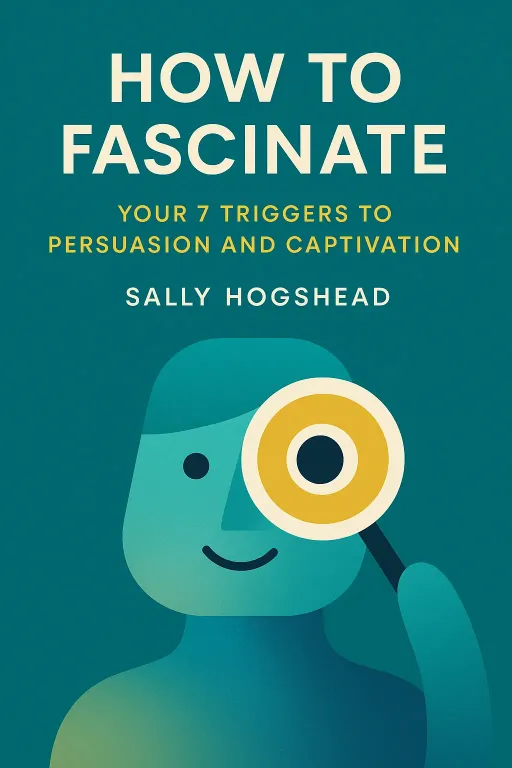
Dr. Roland Steele: Picture this. It is a cold Friday morning in a busy Washington, D. C. subway station. A man in a t-shirt and baseball cap pulls out a violin and begins to play some of the most elegant, complex music ever written. He is playing a three-million-dollar Stradivarius. Over a thousand commuters pass by, almost completely oblivious. He plays for forty-five minutes and makes a grand total of thirty-two dollars. That violinist was Joshua Bell, one of the greatest musicians in the world, playing a sold-out concert hall just days before where tickets cost a hundred dollars a minute. Why did he fail to draw a crowd in the subway? Because unrecognized greatness achieves nothing. In a distracted world, talent alone is not enough. You have to know how to fascinate. Welcome to the show. I am Dr. Roland Steele, and today we are diving into Sally Hogshead's masterpiece, How to Fascinate: Your 7 Triggers to Persuasion and Captivation. Joining me is Isaac Luhanga, a human development researcher and problem solver who is exploring how we can use data and AI to improve our communities. Isaac, welcome.
Isaac Luhanga👊: Thanks, Roland. It is great to be here. That Joshua Bell story is such a powerful hook because it perfectly illustrates a core theme of the book. We often think that if we just work harder, if we are just better, the world will naturally notice us. But Hogshead argues that in a crowded, noisy marketplace, different is actually better than better. Today, we are going to tackle this book from three distinct angles. First, we will explore the neuroscience of fascination and why understanding how the world sees you is the ultimate competitive advantage. Second, we will break down the seven Fascination Advantages and the hidden traps of overusing them under stress. And finally, we will focus on the Anthem Method, which is a practical tool to distill your unique value into a powerful two-word tagline.
The Neurological Currency of Attention
SECTION
Dr. Roland Steele: Let us start with that first angle, the neuroscience. Hogshead defines fascination not just as a casual interest, but as a neurological state of intense focus. When someone is fascinated, their brain actually deactivates the amygdala, which is the fear center. It reduces doubt, increases engagement, and creates a feeling almost like falling in love. From an economic perspective, attention is the scarcest resource we have today. We are battling what Hogshead calls the three deadly threats: distraction, competition, and commoditization. Our attention spans have shrunk to about nine seconds, which is the same as a goldfish. If you cannot capture attention quickly, your message is essentially dead on arrival.
Isaac Luhanga👊: Exactly, Roland. And as someone who looks at human development and data, what fascinates me is the psychological barrier we have to our own value. The book cites a study showing that while ninety-three percent of people believe they are above-average drivers, only thirty-nine percent consider themselves more fascinating than the average person. We have this deep-seated fear of standing out, often stemming from childhood failures where we were told not to make a scene or to just blend in. Hogshead shares her own childhood story of freezing during a dance recital because her teacher whispered, just don't forget the steps, right before she went on stage. That pressure to be perfect actually paralyzed her. We learn to be boring to protect ourselves, but in doing so, we dilute our greatest asset, which is our unique personality.
Dr. Roland Steele: That is a profound point, Isaac. We try to play someone else's game instead of leveraging our own natural advantages. Hogshead's system is different from other personality tests like Myers-Briggs because those measure how you see the world. The Fascination Advantage measures how the world sees you at your best. It is about your external impact. To prove this, Hogshead conducted a fascinating workshop at Intuit, the global software company. She divided director-level executives into seven teams based on their primary Fascination Advantage: Power, Passion, Mystique, Prestige, Alert, Innovation, and Trust. Each team had fifteen minutes to solve a marketing challenge. The behavioral differences were stark.
Isaac Luhanga👊: I love that Intuit study because the data shows how predictable our communication patterns are. Team Power, who lead through authority, immediately arranged their chairs in a perfect square and confidently debated their opinions. Team Trust, who value stability, kept their chairs in orderly lines and developed ideas systematically without interrupting each other. Meanwhile, Team Innovation, the creative experimenters, formed an amoebic circle and rapidly generated a massive list of unconventional ideas. Each team solved the same problem, but they used completely different languages to do it.
Dr. Roland Steele: Right, and the takeaway for organizations is that you do not want a team of identical players. You need cognitive diversity. If you only have Innovation personalities, you will have a million brilliant ideas but zero execution. If you only have Alert personalities, who excel at details and precision, you will have flawless execution of a very boring plan. High-performing teams understand how each member adds distinct value. It is about maximizing that value and subtracting the noise.
The Double Trouble Trap
SECTION
Isaac Luhanga👊: That leads us directly to our second key concept, which is the danger of overusing your primary advantage. Hogshead calls this the Double Trouble mode. Normally, our personalities are balanced by a primary and a secondary advantage. For example, my background is in science research and human development, and as an INFJ, I tend to rely heavily on Mystique, which is about listening and analytical thinking, combined with Trust, which is about stability. But when we get stressed, overwhelmed, or fearful, we often abandon our secondary advantage and double down on our primary one. It is like eating a mouthful of raw flour instead of a slice of cake. The balance is gone, and our greatest strength suddenly becomes a major pitfall.
Dr. Roland Steele: That is a brilliant metaphor, Isaac. The book gives some great case studies of this in action. Take Katrina, who has a primary Power advantage. Normally, she is a confident, decisive leader who inspires her team with big goals. But when the pressure mounts and she enters Double Trouble mode, she becomes the Aggressor. She starts barking orders, speaking in absolute terms, and completely silencing other voices. She thinks she is just being decisive, but her team perceives her as dictatorial and overbearing. She crushes the very collaboration she needs to solve the crisis.
Isaac Luhanga👊: Yes, and we see the same thing happen with other advantages. Consider Anton, who relies on Mystique. At his best, Anton is the Wise Owl, observing, analyzing, and bringing calm, rational insights to the table. But under stress, he slips into the Deadbolt mode. He completely withdraws, becomes secretive, and stops communicating with his team. His colleagues perceive him as cold, aloof, and untrustworthy. In his mind, he is just taking time to think, but to the outside world, he has locked the door and thrown away the key.
Dr. Roland Steele: And then there is Huang, who has the Alert advantage. Alert personalities are your natural project managers. They keep the team safe by steering clear of risks and meeting deadlines. But in Double Trouble mode, Huang becomes the Control Freak. He gets so obsessed with minor details and potential complications that he blocks any form of innovation. He rigidly adheres to rules even when they harm customer service, and his constant pessimism becomes incredibly exhausting for everyone around him.
Isaac Luhanga👊: It is a vital lesson in self-awareness. For early-career professionals, or anyone trying to solve complex community problems, you have to recognize when you are slipping into your Double Trouble mode. If you are an Innovation type, are you slipping into Anarchy, where you start ten projects and finish none? If you are a Passion type, are you slipping into the Drama mode, where your emotional volatility makes people walk on eggshells around you? Recognizing these triggers allows us to consciously bring back our secondary advantages to restore that healthy communication range.
Crafting Your Anthem
SECTION
Dr. Roland Steele: Absolutely. Restoring that balance is key, and that brings us to our third angle: how do we actually communicate our highest distinct value to the world? Hogshead developed a highly structured tool for this called the Anthem Method. Your Anthem is a short, two-word tagline for your personality. It consists of one adjective, which represents how you are different, and one noun, which represents what you do best. It is essentially your personal brand promise. It tells people exactly what they can count on you to deliver.
Isaac Luhanga👊: This is where the book gets incredibly practical, especially for entrepreneurs and problem solvers. Hogshead shares the story of Dawnna, an entrepreneur who was struggling to stand out. When asked what she did, Dawnna used to say, I am a women's diversity inclusion and empowerment expert. It was long, generic, and did not explain her unique value. After going through the Anthem exercise, she identified her archetype as the Avant-Garde, which is a combination of Prestige and Innovation. She distilled her Anthem down to forward-thinking game-changer. Within twenty-four hours of putting that on her marketing materials, her response rate tripled.
Dr. Roland Steele: A triple response rate in twenty-four hours. That is the economic ROI of clarity, Isaac. When you define your Anthem, you stop trying to be all things to all people. You stop being vanilla ice cream, which everyone tolerates but nobody passionately loves, and you become pistachio, which has a devoted, loyal following. Another great example from the book is the tale of two financial advisors, Andy and Simon. Both had similar experience, similar fees, and offered the same services. But their delivery was completely different.
Isaac Luhanga👊: Right. Simon followed a standard conversational script. He delivered a canned presentation with glossy corporate brochures, trying to show how balanced and professional he was. The clients, an empty-nester couple named the Martins, quickly disengaged. It felt like a sales pitch. Andy, on the other hand, understood his Anthem, which was Astute Questions. He is a Royal Guard archetype, combining Prestige and Mystique. Instead of pitching, Andy spent the entire meeting asking deep, carefully researched, analytical questions and listening intently. He did not try to be a charismatic showman because that was not his natural advantage. The Martins hired Andy on the spot because his quiet, analytical approach made them feel incredibly secure.
Dr. Roland Steele: That is a beautiful illustration of why you do not need to change who you are to be successful. You do not need to force yourself to be a charismatic Ringleader if your natural strength is being a thoughtful Mastermind or a dependable Guardian. In fact, trying to use your dormant advantage, the communication style that is least natural to you, is incredibly exhausting and usually leads to mediocre results. If you are forced to operate in your dormant advantage, you are playing in quicksand.
Isaac Luhanga👊: That concept of quicksand really resonates with me, Roland. In human development, we talk a lot about finding your zone of proximal development, where you are challenged but operating within your potential. Hogshead calls this your wellspring, the situations that allow you to fully apply your natural advantages. When you are in your wellspring, work feels effortless, you are in a state of flow, and you deliver maximum value. For organizations, instead of trying to fix an employee's weaknesses, they should be helping them identify their wellspring and aligning their roles accordingly.
Synthesis & Takeaways
SECTION
Dr. Roland Steele: We have covered some incredible ground today, Isaac. From the neuroscience of deactivating the fear center to the practical application of the Anthem Method, Sally Hogshead's book really challenges us to look at ourselves through a different lens. It is not about how you see the world; it is about how the world sees you at your best. If you had to distill the most important takeaway for our listeners today, especially those who are trying to make a meaningful impact in their careers or communities, what would it be?
Isaac Luhanga👊: I think it comes down to a quote from the book that really stuck with me: You do not have to be perfect at everything, but you do have to be extraordinary at something. In a world that constantly pressures us to conform, to smooth out our rough edges, and to be well-rounded, the greatest value you can add is actually to become more of who you already are. Find your point one percent of uniqueness. Are you the creative catalyst, the analytical wise owl, or the structured defender? Once you identify that, write your Anthem. Let it guide your presentations, your resume, and how you show up in meetings.
Dr. Roland Steele: Well said, Isaac. And from an economic standpoint, remember that in any crowded market, different is better than better. Being better is a temporary, fragile edge. Being different is a sustainable monopoly. Do not let your unique value go unnoticed like Joshua Bell in that subway station. Step into your wellspring, own your advantages, and let your personality shine. Isaac, thank you so much for sharing your insights with us today.
Isaac Luhanga👊: Thank you, Roland. This was a truly fascinating conversation.
Dr. Roland Steele: And to our listeners, what is your Anthem? What is the one thing the world can count on you to deliver at your absolute best? Think about it, find your two words, and we will see you next time.









