

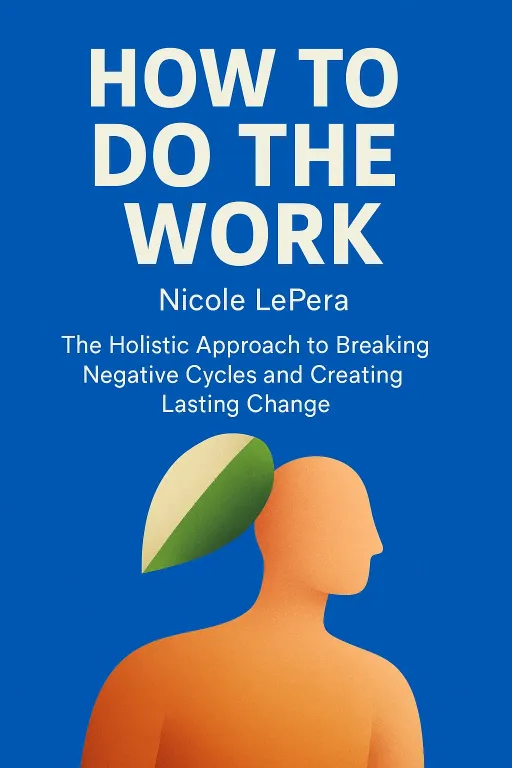
The Inner Blueprint: Engineering Lasting Change with Holistic Psychology
Golden Hook & Introduction
SECTION
Atlas: Kondwani, have you ever had that frustrating feeling where you know exactly what you do to improve—a new habit, a better mindset—but you just can't make it stick? You feel stuck on a loop.
kondwani_botha: Absolutely. It's like having a perfect project plan but the execution keeps failing for some invisible reason. You've mapped out all the steps, you have the end goal in sight, but there's a persistent friction you can't quite name. It's the most frustrating part of self-development.
Atlas: Exactly. And that's the core question Dr. Nicole LePera tackles in 'How to Do the Work.' She argues the problem isn't your willpower; it's your programming. It's your body's internal operating system running on old, outdated software. Today we'll dive deep into this from two perspectives. First, we'll explore why we get stuck, looking at the powerful, often invisible, connection between our body and our past—what she calls the 'Trauma Body.' Then, we'll shift from problem to solution, and discuss the practical blueprint the book offers for building emotional maturity and reparenting ourselves.
kondwani_botha: I love that framing. Moving from a bug report to a system architecture review. It speaks directly to my project manager brain. I'm ready.
Deep Dive into Core Topic 1: Deconstructing 'Stuckness': The Body's Autopilot
SECTION
Atlas: Great. Let's start with that feeling of being stuck. LePera's big idea, the one that changes everything, is that this isn't a mental failure. It's physical. She introduces this powerful concept of the 'Trauma Body.' This isn't just about major, catastrophic events. It's about any experience, big or small, that overwhelmed our nervous system when we were younger and which we couldn't fully process. That energy gets stored in the body.
kondwani_botha: So, it's like an unresolved task in a program that keeps consuming background resources, making the whole system sluggish and prone to errors.
Atlas: That's a perfect way to put it. And sometimes, those "errors" are dramatic. LePera shares her own story, which is just staggering. She was a trained psychologist, seemingly successful, but her body was falling apart. She describes being at a friend's housewarming party in Philadelphia. It's a sunny day, she's outside, and suddenly she feels intensely uncomfortable, light-headed, and hot. The next thing she knows, she's waking up on the concrete with people hovering over her. She had fainted.
kondwani_botha: Wow. Just out of the blue?
Atlas: Seemingly. But then it happened again. During the Christmas holidays, she was with her family at a hardware store. The bright lights, the holiday stress... she felt that same dizzy, hot feeling and fainted again. Doctors couldn't find anything wrong. But she eventually realized this wasn't random. This was her body screaming at her. It was a physical manifestation of years of unaddressed stress, of living in a state of high alert, of what she calls nervous system dysregulation. Her body was literally forcing a shutdown because it couldn't take it anymore.
kondwani_botha: That's terrifying, but also incredibly insightful. The body is essentially sending out these critical 'error signals' that we often ignore or misinterpret. It makes me think about burnout in a professional context. We see the symptoms—fatigue, cynicism, lack of motivation—and we treat them as purely psychological or motivational issues. We tell people to 'think positive' or 'find their passion.' But this reframes it completely. Burnout isn't a mindset problem; it's a physiological state.
Atlas: You've hit the nail on the head. It's a physiological state. And the mechanism she points to is Polyvagal Theory. Now, this can get complex, but the simple version is this: a part of our nervous system, the vagus nerve, is constantly scanning our environment—both internal and external—and asking one fundamental question: 'Am I safe?' This happens below the level of conscious thought. If the answer is 'no,' maybe because a current situation vaguely reminds it of a past, unresolved trauma, it automatically triggers a survival response: fight, flight, or, in her case, freeze and faint. You're no longer in conscious control. You're on autopilot.
kondwani_botha: So the past is literally playing out in our present physiology. That has huge implications for leadership. If you're a project manager and you're walking into a high-stakes meeting, your body might be reacting to a memory of being criticized by a teacher in third grade, not to the actual people in the room. And that reaction—defensiveness, anxiety—will dictate how you lead.
Atlas: Precisely. Your team isn't responding to the present-day you; they're responding to your third-grade trauma response. So, if we follow this logic, the first job of a leader, or even just for self-leadership, isn't to 'motivate.' It's to create a sense of safety—both for yourself and your team—to get the conscious, rational part of the brain, the prefrontal cortex, back online.
kondwani_botha: Right. You have to regulate the system before you can optimize it. You can't build a skyscraper on a shaky foundation, and what you're saying is that the 'Trauma Body' is that shaky foundation. That's a profound shift in perspective. It moves the locus of control back to us, but in a more compassionate way. It's not 'Why can't I do this?' but 'What does my system need to feel safe enough to do this?'
Atlas: That is the exact question. And it's the perfect bridge to the second part of our discussion. If the problem is a dysregulated system, how do you actually go about re-engineering it?
Deep Dive into Core Topic 2: Engineering the Self: The Blueprint for Emotional Maturity
SECTION
Atlas: This is where LePera moves from diagnosis to prescription. Her answer to re-engineering the self is a process she calls 'Reparenting.' Now, I know that term can sound a bit 'woo-woo,' as one of her clients put it, but she frames it as a very practical, structured process. It's about consciously giving yourself what you may not have received consistently in childhood.
kondwani_botha: So it's not about blaming your parents, but about taking responsibility for your own development now. It sounds like you're becoming your own project manager for your emotional growth. You're identifying the deficits from your 'initial build' and consciously creating new systems and protocols to address them.
Atlas: That's the perfect engineering analogy for it. And she breaks it down into four pillars, which you can think of as the key result areas for your personal project. They are: emotional regulation, loving discipline, self-care, and rediscovering childlike wonder and play. It's a holistic approach. To see how this works in practice, let's look at the story of a man named John from the book.
kondwani_botha: Okay, I'm interested to see the transformation.
Atlas: John was what you'd call 'larger than life.' A successful salesman, charismatic, but deeply emotionally immature. He grew up with an abusive father, and his way of coping was to dominate every room he was in. But if anyone questioned him, or if he felt slighted, he would explode with rage. His last girlfriend broke up with him, and in his anger, he smashed a dozen glass plates against a wall. That was his rock bottom. He realized he was becoming his father.
kondwani_botha: A classic pattern. The trauma gets passed down. So how did he apply this 'reparenting' model?
Atlas: He started small. Ridiculously small. His therapist suggested meditation, and he started with just five minutes a day. At first, it was torture. But he stuck with it. That was the 'loving discipline.' Then, he started to practice 'witnessing' his anger instead of becoming it. He'd feel that heat rising in his chest and, instead of lashing out, he would just observe it. He learned to sit with the discomfort. Over time, he realized his anger was a physiological response, not his identity. He was building his emotional regulation skills.
kondwani_botha: He was separating the signal from the noise. The 'signal' is the raw emotion, and the 'noise' is the reactive, destructive behavior. That takes incredible self-awareness.
Atlas: It does. And a key tool for that, which LePera highlights, is understanding the 'ninety-second rule' of emotions. She cites the work of brain scientist Dr. Jill Bolte Taylor, who explains that from a physiological perspective, an emotion is just a chemical cascade in the body. That rush of anger, that wave of sadness—it takes only 90 seconds for those chemicals to be triggered and then completely flushed out of your system.
kondwani_botha: Only 90 seconds? That seems impossible. Emotions feel like they last for hours.
Atlas: Exactly! Because after the 90-second chemical reaction, our brain kicks in. We start telling ourselves a about the emotion. 'He disrespected me,' 'I'm a failure,' 'This always happens to me.' We replay the event in our minds, and every time we do, we re-trigger that 90-second chemical loop. We get addicted to the emotion because we're addicted to the story.
kondwani_botha: That... that is a game-changer. That's an incredibly practical, analytical tool. So, the intervention point isn't to stop the feeling—you can't. It's to stop the after the initial 90 seconds. For a leader dealing with a high-stress project failure, or even a personal conflict, knowing you just have to ride out that initial 90-second wave of panic or anger before you react... that's an incredible leadership skill. It's the difference between a thoughtful response and a knee-jerk reaction.
Atlas: It's the essence of emotional maturity. Tolerating the 90 seconds of discomfort without lashing out, shutting down, or running away. That is, as the book's title says, how you do the work. You build the muscle to endure that discomfort, and in the space that opens up, you find choice.
kondwani_botha: And that's where the real power is. It's not about not feeling; it's about choosing how to act in the presence of the feeling. It's about being the conscious creator of your response, rather than a victim of your reaction.
Synthesis & Takeaways
SECTION
Atlas: So, to bring it all together: we're not stuck because we're weak or lazy. We're often stuck because our body is running an old, protective program based on past experiences—the Trauma Body.
kondwani_botha: And the way out isn't just to 'try harder.' It's to become the architect of our own healing. To actively 'reparent' ourselves by building the skills for emotional maturity, like learning to navigate that crucial 90-second window of emotional response. It's a shift from blaming yourself for not following the plan, to redesigning the system so the plan can actually succeed. It's about architecture, not just effort.
Atlas: Brilliantly put. That's the core of it. So, for everyone listening, especially analytical minds like Kondwani who love a concrete first step, LePera offers a simple but powerful practice called the 'Future Self Journal.' It starts with one small commitment.
kondwani_botha: I like the sound of that. Actionable intelligence.
Atlas: So the question we'll leave you with is this: What is one small, daily promise—just one—that you can make and keep for your future self, starting tomorrow? Maybe it's drinking one glass of water. Maybe it's five minutes of meditation like John. It's not about the size of the act, but the consistency of keeping a promise to yourself. That's how you rebuild trust. That's where the work begins.









