

Sharpening Your Decision-Making Edge
Golden Hook & Introduction
SECTION
Nova: Atlas, if you had to sum up the entire human experience of decision-making in just five words, what would they be? No overthinking.
Atlas: Oh, man, five words? Okay, um... "Overthinking, regret, paralysis, hope, maybe?" Does "maybe" count as a word?
Nova: It absolutely counts! And I think you just perfectly captured the chaotic, often frustrating, reality of trying to make a choice in a world that refuses to give us crystal balls. That feeling of "maybe" – that's the heart of it, isn't it?
Atlas: It really is. It’s that constant nagging uncertainty, especially when the stakes feel high. You want to move forward, you want clarity, but everything feels like a gamble.
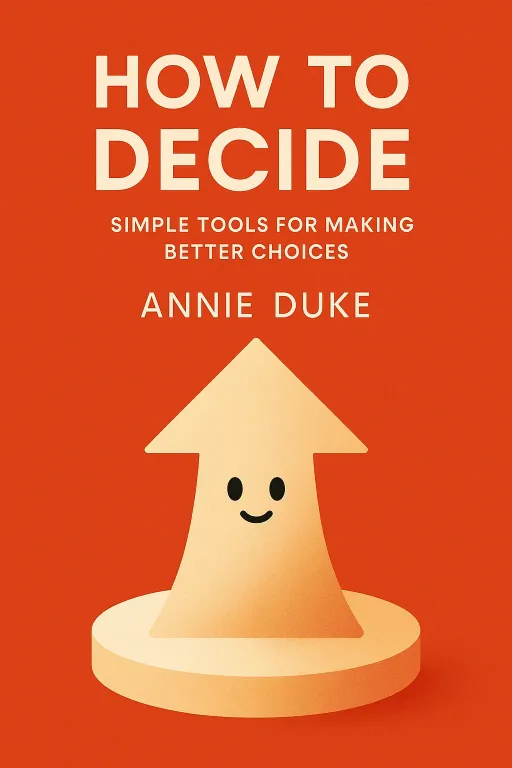
Nova: Well, today, we're diving into a powerful toolkit designed to transform that gamble into a calculated, confident strategy. We’re sharpening your decision-making edge, drawing insights from two brilliant minds. We'll be exploring Annie Duke's groundbreaking work in "How to Decide" and the structured wisdom found in Edoardo Binda Zane's "Effective Decision-Making."
Atlas: Oh, I love that pairing. Duke, a former world-champion poker player, brings this fascinating perspective from high-stakes game theory, teaching us to think in probabilities. And Zane offers a systematic, step-by-step framework, particularly valuable in complex environments. I'm curious how these seemingly different approaches complement each other.
Nova: Exactly! Duke, for instance, is widely acclaimed for making complex probabilistic thinking incredibly accessible, drawing on her unique background. She completely reframes how we perceive risk. Zane, on the other hand, is highly rated by professionals for his actionable, structured methodologies that cut through complexity. Together, they offer a truly comprehensive guide. Today, we'll first explore how thinking in probabilities, like a world-class poker player, can sharpen your intuition and manage uncertainty. Then, we'll discuss the power of a structured, step-by-step framework to analyze problems and evaluate your options. And finally, we'll bring it all together with a simple, actionable step you can take right now to make better choices.
Probabilistic Thinking & Embracing Uncertainty
SECTION
Atlas: That sounds exactly like what so many of us need. That "overthinking, regret, paralysis" I mentioned earlier, it often stems from a desperate desire for certainty, a need to know the outcome before we even decide.
Nova: Absolutely. And that's where Annie Duke's insights from the poker table become so revolutionary for everyday life. She argues that we often make a fundamental mistake: we judge the of a decision by its. She calls this "resulting."
Atlas: Hold on, so you're saying a good decision can still lead to a bad outcome? And a bad decision can somehow get lucky and lead to a good outcome? That feels... counterintuitive to everything we're taught about success.
Nova: Precisely. Imagine a poker player, for example. They have a strong hand, the odds are in their favor, they bet big, but then a highly improbable card comes out, and they lose. Was it a bad decision to bet? No, it was a decision based on the information available at the time, even though the was negative. Conversely, someone could go "all in" on a terrible hand, get incredibly lucky, and win. That doesn't make it a good decision.
Atlas: Wow, that’s a powerful distinction. I can definitely see how that applies to someone navigating a pivotal life stage, like many of our listeners. You make a big career move, it doesn't pan out, and suddenly you're questioning your judgment, even if you did all the right things.
Nova: Exactly. Duke challenges us to separate the two. A good decision is about making the best choice with incomplete information in an uncertain world. The future is probabilistic, not deterministic. We can't the outcome, but we can assign probabilities to potential outcomes.
Atlas: But how do you even begin to assign probabilities to something as messy as a career change or a personal investment? I'm not a statistician.
Nova: You don't need to be a statistician to start thinking probabilistically. It begins with acknowledging uncertainty. Instead of saying, "This happen," you start asking, "What's the likelihood this happen?" Duke encourages us to consider the range of possible outcomes and assign a rough percentage to each. For example, when making a significant decision, list out the best-case, worst-case, and most-likely scenarios.
Atlas: So it’s about mapping out the landscape of possibilities, rather than just focusing on one desired path?
Nova: Precisely. And then, here's the crucial part: identify what would shift those probabilities. What piece of data, what conversation, what research, would make you adjust your percentages for the better or worse? This forces you to think proactively about gathering intelligence, not just guessing.
Atlas: That makes sense. It’s like, instead of just hoping for the best, you're actively trying to understand the odds and what factors could change them. For someone driven by a need for clarity, that’s a huge step towards gaining mental control, even if the future is still uncertain. It’s about being uncertain, rather than just passively uncertain.
Nova: Beautifully put, Atlas. It's about making peace with the fact that we operate in a world of imperfect information, but still empowering ourselves to make the decision possible, independent of the eventual roll of the dice. It shifts our focus from controlling the uncontrollable outcome to optimizing the controllable process.
Structured Decision-Making & Systematic Evaluation
SECTION
Nova: So, if Annie Duke helps us manage the of uncertainty and evaluate the quality of our process, Edoardo Binda Zane gives us the for navigating that uncertain journey. He offers a structured, step-by-step approach that's particularly powerful for complex problems.
Atlas: Okay, so Duke says "think probabilistically," and Zane says "be systematic." How do these two work together? Does one come before the other? I'm imagining a situation where you've acknowledged the probabilities, but you're still staring at a blank page, wondering what to.
Nova: That’s a perfect setup. Zane's framework comes in right there. He breaks decision-making into clear, manageable stages. It starts with analyzing the problem, moves to evaluating options, and culminates in implementing the choice. It’s a process designed to bring clarity to chaos.
Atlas: What do you mean by "analyzing the problem"? Sometimes the problem itself feels fuzzy. Like, "I need career growth," but what of growth?
Nova: That’s exactly what Zane addresses. The first step is to precisely define the problem. What are you trying to solve? What are the true objectives? What constraints are you operating under? For instance, if the goal is "career growth," Zane would push you to refine that: "Is it a promotion? A lateral move to a more fulfilling role? A complete industry pivot?" He emphasizes asking "why" multiple times to get to the root of the issue.
Atlas: I can see how that would quiet a lot of the noise. Getting to that core objective would be a massive step towards mental clarity for anyone feeling overwhelmed.
Nova: Absolutely. Once the problem is crystal clear, you move to generating and evaluating options. This isn't just brainstorming; it's about systematically listing all possible solutions, no matter how outlandish initially. Then, you establish criteria for evaluation. What truly matters for this decision? Cost, time, impact, personal satisfaction, alignment with long-term goals? You assign weights to these criteria.
Atlas: So, it's like building a scorecard for your choices? That sounds incredibly practical. For someone trying to make informed choices, having a clear set of criteria, and even weighting them, would be invaluable.
Nova: It is. Imagine you're deciding between three potential career paths. Instead of just going with your gut, you'd list each path, then score it against your weighted criteria: financial stability, work-life balance, learning opportunities, passion alignment, growth potential. This forces an objective comparison, pulling you away from emotional biases.
Atlas: That’s brilliant. So, while Duke helps us understand the of the game—that it's all about probabilities—Zane gives us the actual for executing our moves. It's not just about knowing the odds, it's about having a strategy for how to act on them.
Nova: Exactly. And the final step is implementation and monitoring. You make the choice, but Zane stresses that the decision-making process isn't over. You need to execute, and then monitor the outcomes, ready to adapt if necessary. This loops back to Duke's idea of not "resulting" – you evaluate the based on how well you followed your criteria and probabilities, and the tells you if you need to adjust your strategy for the future.
Atlas: That’s a powerful combination. It’s about being both strategically flexible and systematically grounded. It transforms decision-making from a scary leap of faith into a structured skill. For our listeners who are looking to build a secure foundation for their future and align their path with their aspirations, this combination feels like a missing piece.
Synthesis & Takeaways
SECTION
Nova: So, bringing these two giants together, we see that decision-making isn't about eliminating uncertainty, which is impossible. It's about mastering it. Duke teaches us to probabilistically and to separate decision quality from outcome. Zane provides the to systematically analyze, evaluate, and implement those decisions. The real power is in their synthesis.
Atlas: It’s like Duke gives you the wisdom to understand the weather, and Zane gives you the tools to build a sturdy boat and navigate the storm. You can’t control the storm, but you can control your preparation and your course.
Nova: What an excellent analogy! It's about developing decision hygiene. It's a skill, not a talent you're born with. And the good news is, there's a tiny, powerful step you can take right now to start integrating both these philosophies into your life.
Atlas: Oh, I'm ready for that. Give me the actionable insight. For someone seeking direction and clarity, what's that one thing?
Nova: Before your next significant decision, write down the potential outcomes and the probability you assign to each. Then, identify one piece of information that, if you knew it, could significantly shift those probabilities.
Atlas: That’s deceptively simple, but I can see the profound impact. Writing it down forces you to articulate the uncertainty and to think systematically about what information you need. It makes the abstract concrete. Why does writing it down make such a difference?
Nova: Because it externalizes your thoughts. It forces clarity and commitment. When it's just in your head, it's fuzzy; you can rationalize away inconsistencies. On paper, those potential outcomes and probabilities stare back at you, demanding honesty. And identifying that "one piece of information" immediately gives you a tangible next step, moving you from paralysis to purposeful action. It’s about embracing the journey of discovery, one informed choice at a time.
Atlas: That’s actually really inspiring. It’s not about having all the answers, it’s about having a better process for finding them. That’s a clear path forward.
Nova: Absolutely. This is Aibrary. Congratulations on your growth!









