

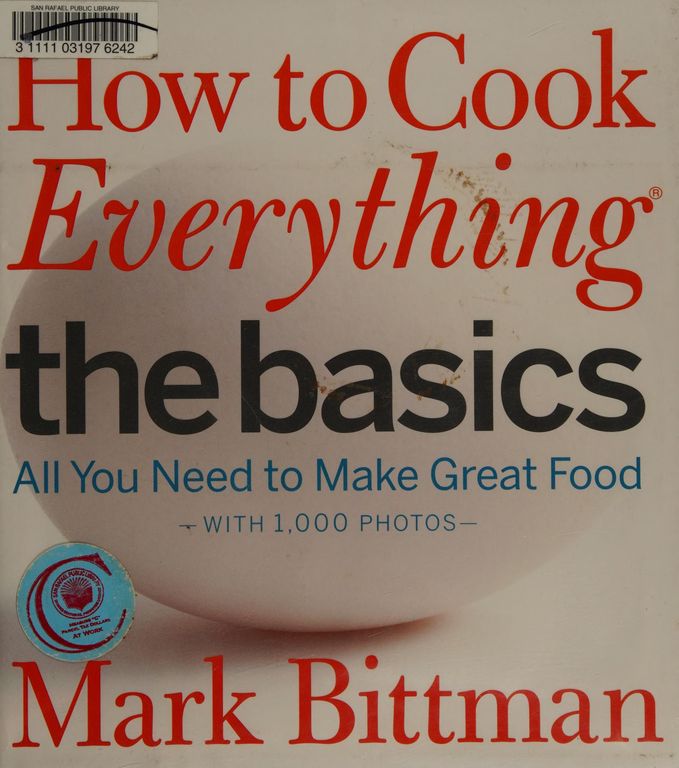
How to Cook Everything - The Basics
The Basics
Introduction
Nova: Have you ever stood in your kitchen, staring at a bag of onions or a carton of eggs, and felt a genuine sense of panic? Like, you know these things are food, but the bridge between raw ingredient and actual meal feels like it requires an engineering degree?
Nova: Exactly. And that is exactly why Mark Bittman wrote How to Cook Everything: The Basics. He is basically the guy who wants to take that panic and replace it with a shrug and a delicious dinner. He is famous for his Minimalist column in the New York Times, and this book is his manifesto for the absolute beginner.
Nova: It is much more than a condensed version. It is a complete reimagining. While the original is an encyclopedia, The Basics is a visual roadmap. It is designed for the person who does not just need a recipe for scrambled eggs, but needs to see what the eggs look like at the thirty-second mark, the one-minute mark, and the moment they are perfect.
Nova: Precisely. Today, we are diving into why this book changed the game for home cooks, the philosophy of the Minimalist, and how Bittman manages to make the most basic techniques feel like superpowers.
Key Insight 1
The Minimalist Philosophy
Nova: To understand this book, you have to understand Mark Bittman’s whole vibe. He calls himself the Minimalist. His philosophy is that cooking should not be a hobby that requires a thousand gadgets and a weekend of prep. It should be a basic life skill, like driving or doing laundry.
Nova: Bittman hates that. He actually argues that the more we complicate cooking, the less we actually do it. In his view, cooking is a radical act. It is the most important thing you can do for your health, your budget, and even the planet. But to get people to do it, he had to strip away the elitism.
Nova: Not necessarily. It is about minimal technique for maximum results. He focuses on the core of the dish. If you are making a soup, he wants you to understand the relationship between the liquid and the aromatics, not just follow a list of twenty spices. He wants you to be lazy in the best way possible.
Nova: Not at all. It means efficient. He often says he is rushed and he is not a professional chef in the traditional sense. He is a home cook who figured out the shortest path to great flavor. The Basics takes that philosophy and applies it to the very first steps of the journey.
Nova: That is a huge part of it. He believes that if you can cook a simple pot of beans or a piece of fish, you are no longer a slave to the processed food industry. You have agency. And that agency starts with knowing how to hold a knife.
Nova: And Bittman is the first person to say: That is okay. Let us start there. Let us make the kitchen a place of confidence rather than a place of performance.
Key Insight 2
The Power of the Visual
Nova: One of the biggest differences in this book compared to his others is the photography. There are over a thousand photos in here. And they are not just pretty pictures of the finished meal; they are instructional.
Nova: Exactly! Bittman uses these photos to show you the stages. There is a famous section on boiling eggs where he shows you five different eggs, boiled for different amounts of time, sliced open so you can see exactly what a six-minute egg looks like versus a ten-minute egg.
Nova: It also helps with the scary stuff, like butchering a chicken. Most people see a whole chicken and think, no way, I am buying the pre-cut breasts. But Bittman shows you, step-by-step, where to put the knife. He demystifies the anatomy of the food.
Nova: Everything. How to peel ginger with a spoon, how to dice an onion properly, how to trim asparagus. It is like a visual dictionary of kitchen moves. And the recipes themselves are structured as Master Recipes.
Nova: This is a classic Bittman move. He gives you one core method, like a basic stir-fry or a simple roast chicken. Once you see the photos and understand the technique for that one dish, he gives you a list of variations.
Nova: That is the perfect analogy. He teaches you the pattern. If you know how to sauté a chicken breast, you suddenly know how to sauté pork chops, or tofu, or even sturdy vegetables. The book is designed to make itself obsolete. He wants you to eventually stop looking at the pages.
Nova: Bittman is different. He wants to give you the intuition. He wants you to look at what is in your fridge and think, okay, I have the technique, I can make this work without a script.
Key Insight 3
The Essential Toolkit
Nova: We have to talk about the gear. Because this is where most beginners get overwhelmed. They go to a kitchen store and think they need a garlic press, a strawberry huller, and a twenty-piece knife set.
Nova: Bittman would tell you to get rid of almost all of it. His list of essentials is shockingly short. He is a huge advocate for the eight-inch chef's knife. He says if you have one good knife, you can do ninety percent of the work in a kitchen.
Nova: He likes a paring knife and a serrated knife, but the chef's knife is the workhorse. He even did a famous piece for the Times where he showed how to outfit an entire kitchen for a couple hundred dollars. He is all about the cast iron skillet and the stainless steel pot.
Nova: It is! And it is versatile. You can sear a steak on the stovetop and then throw the whole thing in the oven. That kind of multi-tasking is central to his philosophy. He wants tools that earn their keep.
Nova: He acknowledges they are useful, but he does not want them to be a barrier. If you do not have a food processor, he shows you how to do the same thing with a knife or a grater. He never wants a lack of equipment to be an excuse for not cooking.
Nova: Exactly. He even talks about the pantry in the same way. You do not need fifty exotic spices. You need salt, pepper, a good olive oil, maybe some red pepper flakes and a lemon. With those basics, you can make almost anything taste good.
Nova: Bittman spends a lot of time on seasoning. He explains that salt is not just a flavor; it is a tool that unlocks the flavor of the food. He encourages beginners to taste as they go, which is probably the most important habit any cook can develop.
Key Insight 4
Mastering the Method
Nova: Let us get into the actual cooking. The book is organized by technique rather than just by meal type. This is a subtle but huge distinction.
Nova: Exactly. Because once you master boiling, you can make pasta, you can make hard-boiled eggs, you can blanch vegetables. He breaks it down into the big four: Boiling, Sautéing, Roasting, and Braising.
Nova: But Bittman shows you that braising is actually the easiest thing in the world. It is just browning meat or vegetables and then letting them simmer in a little liquid for a long time. It is the ultimate set-it-and-forget-it technique. He calls it the secret weapon of the lazy cook.
Nova: He really is. And he tackles the things that people find intimidating, like fish. A lot of people are scared to cook fish because it is so easy to overcook. Bittman’s method is all about high heat and short times, or even just poaching it gently in a bit of water or wine.
Nova: He does, but again, he keeps it simple. He shows how a pan sauce is just taking the little brown bits left over after sautéing meat, adding a splash of liquid, and scraping it up. It takes two minutes and tastes better than anything you can buy.
Nova: He really is. And he does it with such a conversational tone. He is not lecturing you. He is more like a friend who is saying, look, I messed this up a hundred times so you do not have to. He even includes a section on what to do when things go wrong.
Nova: He has fixes for all of that. It is that kind of practical, real-world advice that makes the book feel like a safety net. He wants you to know that even if you fail, it is just a meal. You can learn from it and try again tomorrow.
Conclusion
Nova: We have covered a lot of ground today, from the minimalist philosophy of Mark Bittman to the visual power of his step-by-step guides. The real takeaway from How to Cook Everything: The Basics is that cooking is not a performance; it is a practice.
Nova: And that is the radical part. By mastering these basics, you are taking control of your health and your life. Bittman’s book is a reminder that the most sophisticated thing you can do in the kitchen is often the simplest.
Nova: That is the spirit! If you are looking for a place to start your culinary journey, or if you just want to strip away the noise and get back to the essentials, this book is your best friend. It turns the kitchen from a place of stress into a place of possibility.
Nova: This is Aibrary. Congratulations on your growth!