

The Change Algorithm: Hacking Procrastination and Impulsivity for Founders
Golden Hook & Introduction
SECTION
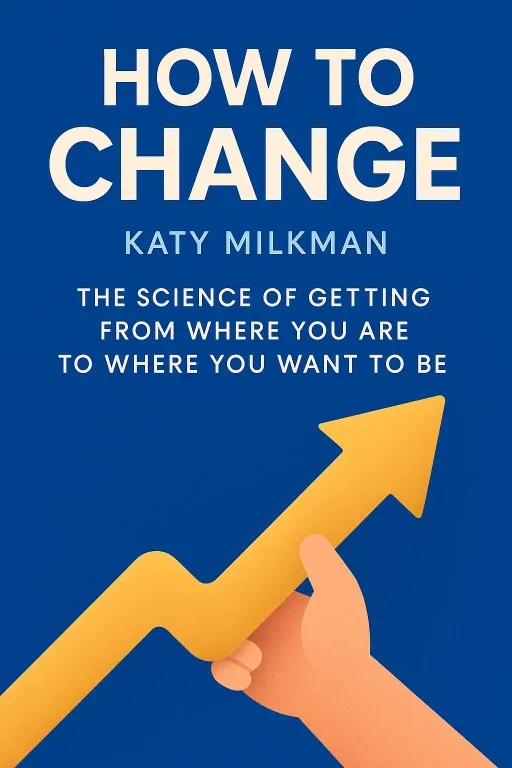
Albert Einstein: Imagine you've designed the perfect rocket ship. The engineering is flawless, the trajectory is calculated to the millimeter. But when it's time to launch, the pilot simply... decides not to press the button. They'd rather check their email. This is the frustration every leader, every entrepreneur, and frankly, every one of us faces: the gap between a perfect plan and messy human reality. Katy Milkman's book, 'How to Change,' is the manual for that unpredictable pilot. It argues that change isn't about more willpower; it's about better engineering.
Chris: That's the perfect metaphor, Albert. In tech, we call it the 'last-mile problem.' The technology works perfectly, but user adoption fails. We spend so much time on the 'what'—the features, the code—and almost no time on the 'how' of human follow-through. It’s the most expensive and overlooked part of any project.
Albert Einstein: Precisely! And Milkman's central idea, which I find so elegant, is that before you can solve the problem, you must correctly diagnose the obstacle. Is it forgetfulness? Is it laziness? Is it impulsivity? You wouldn't use a hammer to fix a leaky faucet. Today we'll dive deep into this from two perspectives. First, we'll explore how to strategically use moments of new beginnings—the 'Fresh Start Effect'—to ignite change. Then, we'll discuss a more forceful strategy: building 'Commitment Devices' to lock in your future success and defeat procrastination.
Chris: I love that. A diagnostic toolkit for human behavior. It treats change like a puzzle to be solved, not a mountain to be conquered through sheer force. That’s a language any engineer or founder can understand.
Deep Dive into Core Topic 1: The 'Fresh Start Effect'
SECTION
Albert Einstein: Exactly! So let's start with the first obstacle: inertia. How do we get that rocket off the ground in the first place? Milkman points to a fascinating phenomenon she calls the 'Fresh Start Effect'. It’s the idea that certain moments in time—a new year, a birthday, the first day of spring—act as psychological dividers. They allow us to mentally separate our current, aspiring self from our past, failing self. It’s a clean slate.
Chris: So it’s more than just a date on a calendar. It’s a mental accounting trick. We're closing the books on the 'old me' who skipped the gym and opening a new ledger for the 'new me' who won't.
Albert Einstein: You've captured it perfectly. It's a story we tell ourselves. And the book has a wonderful, extreme example of this. A man named Ray Zahab. In the late 90s, Ray was living a life of, let's say, enthusiastic self-destruction. He was a pack-a-day smoker, ate fast food for every meal, and was generally out of shape and unhappy. He wanted to change, but nothing stuck.
Chris: A familiar story for many. The intention is there, but the execution is missing.
Albert Einstein: Yes. But then, a massive fresh start was approaching for the entire world: New Year's Eve, 1999. The turn of the millennium. Ray decided this was it. He told his brother, "This is a reset switch for humanity." He smoked his last cigarette just before midnight. And on January 1st, 2000, he woke up a non-smoker. That single, powerful fresh start was the catalyst. And the end of the story? A few years later, this former chain-smoker won the Yukon Arctic Ultra, a 100-mile race in the dead of winter.
Chris: Wow. That's... a significant change. What I find so interesting there is the scale of the fresh start. It wasn't just 'a new week.' It was the 'end of a century.' It's a shared social landmark. As an entrepreneur, this makes me think about how we launch things. We could time a major product release not just on a random Tuesday, but tie it to a culturally significant moment—the 'start of summer,' the company's 10-year anniversary—to create that same psychological break from the 'old' version and give users a reason to re-engage.
Albert Einstein: You can architect these moments! That's the insight. Milkman also points to the famous 'Back to Sleep' campaign. In the early 90s, researchers discovered that putting babies to sleep on their backs cut the risk of SIDS in half. The campaign was wildly successful. Why? Because it targeted new parents. And what is having a child if not the ultimate, life-altering 'fresh start'? You're not set in your ways; you're desperate to do everything right. The message landed on fertile ground.
Chris: Right, the old habits haven't been formed yet. You're a blank slate as a parent. It's a naturally occurring window of opportunity for change. So the lesson for a leader is to identify—or create—these windows for your team. A new office, the start of a new fiscal year, the completion of a major project. These are all opportunities to introduce new habits and processes.
Albert Einstein: Precisely. You don't just hope for change; you time it for when the human mind is most receptive to it.
Deep Dive into Core Topic 2: Commitment Devices
SECTION
Albert Einstein: But what happens when a fresh start isn't enough? When the gravitational pull of old habits is too strong, and we find ourselves procrastinating despite our best intentions? This is where Milkman introduces a more... forceful idea, almost like building your own cage. She calls them 'Commitment Devices'.
Chris: A cage sounds a bit extreme, Albert.
Albert Einstein: Ah, but it's a cage you build for yourself, to protect you from a future, weaker version of yourself! The idea is to make a choice in the present that deliberately restricts your choices in the future, making it difficult or impossible to give in to temptation. The classic story is Odysseus tying himself to the mast to hear the Sirens' song without crashing his ship.
Chris: He knew he would be weak, so he made it impossible for his future self to make a bad decision. He removed the option.
Albert Einstein: Exactly! A more modern, and perhaps more relatable, example from the book is the great writer Victor Hugo. In 1830, he was facing a crushing deadline from his publisher for a new novel, which would become. But Hugo was a social butterfly; he loved parties and entertaining guests. He was procrastinating terribly.
Chris: The ultimate battle between long-term goals and short-term pleasure.
Albert Einstein: Indeed. So what did he do? He gathered up all of his fine clothes, locked them in a chest, and gave the key to his assistant. He was left with nothing to wear but a single, enormous, grey, knitted shawl. He couldn't go outside. He couldn't entertain guests. He was, in effect, under house arrest. By removing the option to socialize, he left himself with only one thing to do: write. He finished the book ahead of schedule.
Chris: That's brilliant! It's the complete opposite of 'keeping your options open,' which is what most modern business advice preaches. Hugo essentially created a 'modal' state for himself—a state with only one possible action. It's fascinating because in the tech world, we have software for this now. Apps like 'Freedom' or 'Cold Turkey' that block distracting websites for a set period. You're literally paying to have your options taken away. It's a voluntary prison to achieve a goal.
Albert Einstein: A voluntary prison! I love that. And it's not just for creative work. Milkman cites a study from the Philippines, at a place called Green Bank. They offered customers a special savings account. The catch? The customers themselves chose a date or a goal amount, and they were to withdraw their money until they hit it.
Chris: So they were sacrificing liquidity, their financial flexibility, for what? Certainty?
Albert Einstein: For the certainty of achieving their goal! And it worked. People who chose these locked accounts saved over 80% more than those who didn't. They willingly handcuffed their future selves to prevent them from dipping into their savings for impulsive purchases. They recognized their own weakness and built a system to defend against it.
Chris: That is a powerful insight for product design. People will actually choose a more restrictive product if it guarantees they will achieve a desired outcome. We're so focused on adding features and flexibility, but maybe for certain goals—like saving, learning, or fitness—the killer feature is actually flexibility. It's a 'commitment as a service.'
Albert Einstein: Commitment as a service! You see? It is all about the engineering.
Synthesis & Takeaways
SECTION
Albert Einstein: So, when we step back and look at the universe of change, we have these two wonderfully powerful, and quite different, tools. On one hand, the gentle nudge of a 'Fresh Start' to inspire new beginnings and harness moments of peak motivation.
Chris: And on the other, the hard shove of a 'Commitment Device' to enforce those beginnings when motivation inevitably wanes. It's a beautiful pairing of inspiration and enforcement.
Albert Einstein: The key, as you said earlier, Chris, is the diagnosis. Is the problem a lack of motivation to, or a lack of discipline to?
Chris: Exactly. You use the Fresh Start for the first, and a Commitment Device for the second. It's about applying the right algorithm to the right problem. As a founder, you can't just tell your team, "Be more innovative." You have to ask, "What's stopping us?" If it's old thinking, maybe you create a fresh start with an off-site or a new project structure. If it's distraction, maybe you implement a commitment device, like 'no-meeting Fridays' to force deep work.
Albert Einstein: A wonderful synthesis. So, for everyone listening, especially those of you building something new, here's a thought experiment: Look at the one goal you or your team consistently fails to achieve. What's the real, underlying obstacle? Is it inertia, or is it distraction? And could you architect a 'fresh start' or build a 'commitment device' to finally, and truly, solve it?
Chris: A question worth spending some serious time on. It might be the most productive thing you do all week.
Albert Einstein: I couldn't agree more.









