

Reclaiming Your Creative Attention
Golden Hook & Introduction
SECTION
Nova: The average person swipes, taps, or clicks their phone over two thousand six hundred times a day. That is not just a habit, it is a full-time, unpaid job where the currency is your creative soul.
Atlas: Two thousand six hundred times. Honestly, that sounds like a conservative estimate for my Tuesdays. But seriously, if we are spending that much time interacting with a glass rectangle, what is happening to the thoughts we used to have when we were just staring at the ceiling?
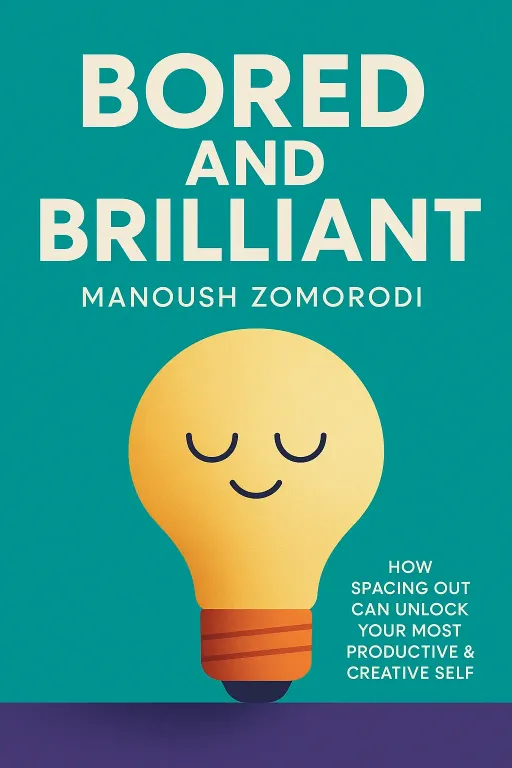
Nova: We are losing them entirely. Today we are exploring how to rescue our minds by diving into two transformative books. First, Bored and Brilliant by Manoush Zomorodi, and second, How to Break Up with Your Phone by Catherine Price. Zomorodi, a brilliant public radio host, noticed her own creative spark vanishing when she got a smartphone, which led her to launch a massive, real-world experiment with tens of thousands of listeners.
Atlas: And Catherine Price is an award-winning science journalist who had her wake-up call when she realized she was staring at her screen instead of looking at her newborn baby. Both authors realized that our attention has been systematically dismantled.
Nova: Exactly. They wanted to understand what we lose when we lose the ability to be bored, and how we can systematically rebuild our relationship with technology to reclaim our creative power.
The Default Mode Network and the Science of Boredom
SECTION
Nova: Let us start with what actually happens inside your head when you do absolutely nothing. There is a common misconception that a quiet brain is an idle brain. In reality, when you stop focusing on an external task, your brain flips a switch and activates something called the default mode network.
Atlas: Hold on, the default mode network. That sounds like the basic standby mode on a computer. Is it just the brain idling?
Nova: It is the exact opposite of idling. Think of it as a massive, behind-the-scenes theater crew that only comes out when the main actors leave the stage. When you are staring out a window, doing the dishes, or walking without a podcast playing, this network lights up. It starts connecting random memories, solving complex problems you shelved days ago, and constructing your sense of self.
Atlas: Oh, I see. So when we are constantly feeding our brains information, we are basically keeping the main actors on stage twenty-four seven. The crew never gets to clean up or rearrange the props.
Nova: That is a perfect way to put it. This network was actually discovered by accident in 2001 by a neuroscientist named Marcus Raichle. He was putting people in fMRI scanners and noticed that when they were supposed to be resting between difficult cognitive tasks, certain regions of their brains actually became much more active, not less. The brain uses about twenty percent of the body's energy, and the default mode network consumes a massive portion of that energy even when we think we are doing absolutely nothing.
Atlas: That is incredible. So doing nothing is actually highly energetic cognitive work. But what kind of work is it doing?
Nova: In Bored and Brilliant, Zomorodi talks to cognitive scientists who explain that daydreams are actually highly active states of problem-solving. When you let your mind wander, you are engaging in what researchers call autobiographical planning. You are looking at your past, connecting it to your future, and mapping out creative solutions. But when you fill every micro-moment of boredom by pulling out your phone at the grocery store line, you kill that process before it even starts.
Atlas: I can definitely relate to that nervous twitch of reaching for the phone the second there is a pause in life. But let us be honest, for anyone managing complex projects or high-pressure environments, the idea of sitting around doing nothing feels incredibly counterproductive. It feels like wasting valuable time.
Nova: It feels that way because we have been conditioned to equate constant activity with productivity. But the research Zomorodi presents shows that the most original ideas do not come when we are actively staring at a spreadsheet. They come in the shower, or during a quiet walk. One fascinating study she highlights involved researchers asking participants to complete a creative challenge. Before the challenge, one group was forced to do an incredibly boring task, like copying phone numbers from a directory.
Atlas: That sounds absolutely agonizing.
Nova: It was. But the result was stunning. The group that had to do the incredibly boring task performed significantly better on the creative tests than the group that got to jump straight in. Their brains had been primed to make novel connections because the boredom forced their default mode network to kick into high gear.
Atlas: Wow, so copying phone numbers actually unlocked creative genius. That is wild. But why does our brain do that? Is it just looking for stimulation because it is under-stimulated?
Nova: Yes, the brain naturally craves novelty. When it does not get that novelty from the outside world, it starts generating it from the inside. It digs deep into your memory banks, pulls out obscure thoughts, and stitches them together. That is the birth of original thought. If you never let your brain get under-stimulated, you are essentially outsourcing your imagination to the algorithms on your phone.
Atlas: That is a terrifying thought. We are swapping our unique creative processing power for algorithmic hand-outs. But how did we get here? Surely we did not just collectively decide to give up our attention spans overnight.
The Architecture of Hijacked Attention
SECTION
Nova: We certainly did not. And this is where Catherine Price's book, How to Break Up with Your Phone, comes in. She pulls back the curtain on how tech companies have intentionally engineered this constant state of distraction. It is not a lack of willpower on your part. Your phone is designed to be addictive.
Atlas: Okay, but how addictive are we talking? Is it just that the apps are fun, or is there something deeper happening biologically?
Nova: It is deeply biological. Price explains that developers use the principles of behavioral psychology, specifically intermittent rewards, which is the exact same mechanism that makes slot machines so addictive. This goes back to the famous experiments by B. F. Skinner. He put pigeons in boxes and gave them food pellets. If a pigeon got a pellet every single time it pressed a lever, it only pressed the lever when it was hungry. But if it got a pellet randomly, it became completely obsessed and pressed the lever constantly.
Atlas: Oh, I know that feeling. It is that constant itch of wondering if something new has landed in the inbox or on the feed. It is almost like a physical pull.
Nova: It is a physical pull because your brain associates that action with a survival mechanism. In the wild, scanning the horizon for new information kept us alive. Now, we are scanning our screens for notifications, and our brains treat every red badge like a matter of life or death. Price points out that this constant scanning keeps our bodies in a state of low-grade stress. Every buzz or ping releases a tiny micro-dose of cortisol, the stress hormone.
Atlas: That explains why we feel so exhausted even when we have just been sitting on the couch scrolling. We are literally putting our nervous systems through a marathon of micro-stressors.
Nova: Exactly. And the real tragedy is what Price calls attention fragmentation. When your attention is broken into tiny pieces throughout the day, you lose the ability to enter deep focus, or what psychologists call flow. Your brain is forced to constantly switch tasks, which carries a massive cognitive cost. It takes up to twenty-three minutes to regain deep focus after a single interruption.
Atlas: Twenty-three minutes. If you check your phone every fifteen minutes, you are literally never operating at full cognitive capacity. You are permanently running on low power mode.
Nova: You are. Your brain is constantly clearing and reloading its working memory, which leaves absolutely no energy for high-level synthesis or strategic thinking. You become highly efficient at processing shallow information, but completely incapable of deep, original creation.
Atlas: That sounds like a disaster for anyone trying to build something meaningful or lead a team. You think you are staying on top of everything by being constantly responsive, but you are actually making yourself less effective at the big picture.
Nova: That is the core paradox of the modern workplace. We prioritize responsiveness over depth, and then wonder why we feel creatively blocked and strategically stuck. Price notes that our brains are highly plastic. They adapt to the environments we put them in. If we train our brains to expect a distraction every three minutes, they will eventually demand that distraction, even when we are trying to focus on something important.
Reclaiming the Space - The Thirty-Minute Fast
SECTION
Atlas: I guess that makes sense, but how do we train our brains back? If our minds have been rewired by these tech companies, how do we break the loop and get our focus back?
Nova: Both authors agree that we cannot rely on raw willpower. The systems designed to capture our attention are simply too powerful. Instead, we have to design our own systems to protect our attention. This is where the practical magic of a digital fast comes in.
Atlas: Right, like the thirty-minute challenge. How does that actually work in practice?
Nova: It is beautifully simple. The next time you hit a creative wall, or when you need to solve a complex problem, you do not push through by staring harder at your screen. Instead, you take your phone and put it in another room. Not on your desk, not in your pocket, but physically in another room.
Atlas: Why does it have to be in another room? Can I not just put it face down on my desk?
Nova: Research shows that even having a silent phone in your field of vision drains your cognitive capacity. Your brain has to actively expend energy to ignore it. By putting it in another room, you eliminate that subconscious mental drain. Then, you set a timer for thirty minutes and you do absolutely nothing. You do not read a book, you do not listen to music, you do not clean your desk. You just sit, let your mind wander, and allow yourself to feel bored.
Atlas: That sounds incredibly uncomfortable. I imagine the first ten minutes would be filled with pure anxiety, just thinking about all the messages I might be missing.
Nova: It is uncomfortable. That discomfort is actually your brain experiencing dopamine withdrawal. But if you can sit with that discomfort and push past it, something incredible happens around the fifteen or twenty-minute mark. The anxiety fades, the mental noise quietens, and your default mode network starts to wake up. You will find your mind naturally drifting to the problem you were trying to solve, but from a completely fresh angle.
Atlas: That is a fascinating shift. It is like allowing the mud in a glass of water to settle so the water becomes clear again.
Nova: That is a perfect analogy. We do not need more information to solve our hardest problems. We need the mental space to synthesize the information we already have. By implementing this thirty-minute fast, you are not just taking a break. You are actively biohacking your brain to access its highest-level creative processing unit.
Atlas: I love that perspective. It turns what feels like a passive waste of time into an active, strategic investment in your own mind. It is about taking back control of your most valuable asset, which is your attention.
Nova: It absolutely is. Our attention is the filter through which we experience our entire lives. If we do not actively curate and protect it, someone else will exploit it for profit. Reclaiming your creative attention is not about rejecting technology. It is about establishing boundaries so that technology serves your goals, rather than your attention serving their bottom line.
Atlas: This makes me think about how we can build even more systems to protect ourselves throughout the day. Catherine Price talks about creating physical speed bumps, right?
Nova: Yes, she suggests designing friction into your environment. For example, you can put a physical rubber band around your phone. Every time you pick it up, that physical band forces you to pause and ask yourself if you actually need to use it, or if you are just reaching for it out of habit. Another great speed bump is changing your screen to grayscale. It turns your vibrant, dopamine-inducing device into a dull, unappealing tool.
Atlas: That is brilliant. It makes the phone look like a tool from the nineties rather than a slot machine. It takes the fun out of the mindless scroll.
Nova: Exactly. You are removing the visual triggers that make your brain crave the screen. You can also rearrange your home screen so that only utility apps, like maps or notes, are visible. Hide your social media and email apps inside folders on the second or third page, so you have to make a conscious effort to find them. By designing these small frictions, you reclaim control of your immediate environment.
Synthesis & Takeaways
SECTION
Atlas: This conversation makes me realize that reclaiming our attention is not a luxury. It is a fundamental necessity for anyone who wants to lead consciously and think deeply.
Nova: It really is. The profound insight here is that creativity is not a rare talent that only some people possess. It is a natural biological process that requires cognitive space to function. When we fill every gap in our day with digital noise, we are essentially starving our brains of the oxygen they need to create.
Atlas: If you want to apply this immediately, start small. The very next time you find yourself waiting in line, or sitting in your car, resist the urge to pull out your phone. Just look around. Let your mind wander. Give your default mode network a chance to do its job.
Nova: And when you face your next major creative challenge, commit to that thirty-minute digital fast. Put the phone in another room, let the boredom settle in, and watch what your mind can build when it is finally left alone.
Atlas: This is Aibrary. Congratulations on your growth!









