

Reclaiming Focus and Joy in a Digital Age
Golden Hook & Introduction
SECTION
Nova: That quick screen check while waiting for your morning coffee actually costs you about twenty-three hundred dollars a year in lost high-performance focus.
Atlas: Oh, that is a painful number to hear. I am definitely guilty of the coffee line scroll, and I imagine a lot of our listeners are calculating their own screen-time tax right now.
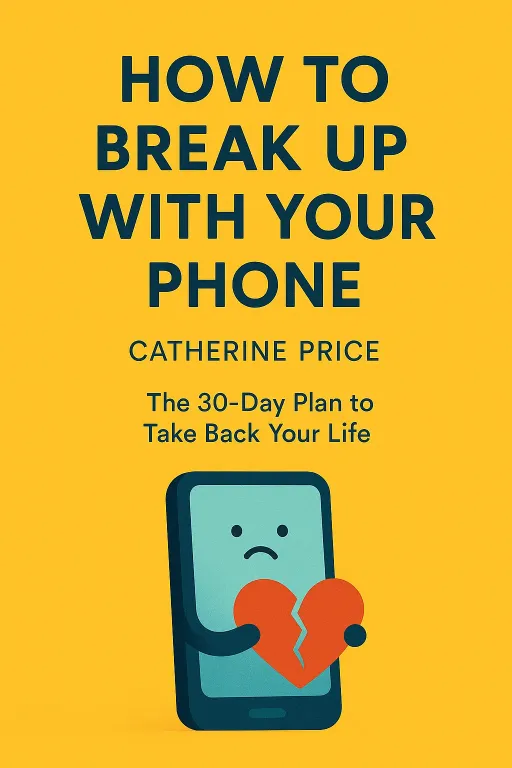
Nova: It is a massive tax on our cognitive sovereignty. Today we are diving into the brilliant work of science journalist Catherine Price, specifically looking at her two landmark books, How to Break Up with Your Phone and The Power of Fun. Price is not just offering generic self-help advice here. She is a highly respected journalist who approached her own digital exhaustion like a scientific investigation.
Atlas: What I love about her story is that it started with a very raw, human moment. She was in a dark room feeding her newborn daughter, and she suddenly realized she was staring at an article on her smartphone while her baby was staring at her face. That stark contrast between digital distraction and real-world connection is what set her on this path.
Nova: That is such a powerful image, and it highlights why this conversation is so urgent. We are going to explore how to dismantle the digital traps that drain our focus, and then we will look at why reclaiming that focus is the key to unlocking what Price calls True Fun, which is actually a biological necessity for high performance.
Atlas: This sounds like exactly what we need to navigate the constant noise of the modern workplace. Let us start with the phone breakup. How do we actually begin to untangle ourselves from these devices?
Dismantling the Digital Slot Machine
SECTION
Nova: To change our relationship with our phones, we have to understand that these devices are not just passive tools. They are deliberately engineered to hijack our attention. Price explains that the apps on our phones use the exact same psychological triggers as slot machines in Las Vegas.
Atlas: Wait, are you saying our phone screens are basically portable casinos?
Nova: That is the most accurate way to look at it. The core mechanism is something psychologists call intermittent variable rewards. When you pull down to refresh your feed, you do not know what you are going to get. Sometimes it is a boring email, sometimes it is a text from a close friend, and sometimes it is a viral post. That unpredictability triggers a massive spike of dopamine in your brain.
Atlas: Oh, I see. So it is the anticipation of the unknown that keeps us hooked, not even the content itself.
Nova: Exactly. Your brain is constantly seeking that next dopamine hit. And this constant seeking state creates what researchers call attention residue. Every time you glance at your phone, even for a split second, a part of your cognitive bandwidth remains anchored to whatever you just saw. It takes your brain up to twenty minutes to fully regain deep focus after a single interruption.
Atlas: That sounds incredibly damaging for anyone trying to do high-level strategic work. If you are constantly checking your phone, your brain is never actually running at full capacity.
Nova: It is running on a massive deficit. There was a fascinating study done at the University of Texas at Austin that really proves this point. Researchers took three groups of participants and gave them a series of tests demanding intense cognitive focus. The first group kept their phones on their desks, face down. The second group kept their phones in their pockets or bags. The third group left their phones in an entirely different room.
Atlas: I am guessing the group with their phones in the other room did the best?
Nova: They blew the other groups out of the water. What is truly shocking is that even though all the phones were completely silent and face down, the participants with their phones on their desks performed significantly worse than those whose phones were in another room. The mere physical presence of the phone was draining their cognitive capacity.
Atlas: That is wild. So even if we are not actively looking at the screen, just knowing the phone is within arm's reach forces our brain to expend energy to ignore it.
Nova: Yes, your brain is actively working to resist the temptation, which leaves you with less mental energy for the task at hand. This is why Price emphasizes that willpower is not enough. We have to change our physical environment. We need a concrete behavioral framework to protect our cognitive bandwidth.
Atlas: Okay, but how does a busy professional actually implement this without falling behind? If you are managing a team or trying to communicate strategically, you cannot just disappear into a cave.
Nova: It is about creating intentional boundaries, not living in isolation. Price suggests starting with a digital audit. You look at which apps are actually tools that serve your goals, and which apps are slot machines designed to steal your time. You can aggressively turn off all non-human notifications. If a real person is not trying to reach you in real-time, it does not deserve to interrupt your thoughts.
Atlas: That makes perfect sense. So my banking app or my favorite news site does not get to tap me on the shoulder throughout the day. Only actual humans get that privilege.
Nova: Exactly. You are reclaiming control over when you choose to engage. Another powerful step in her framework is creating physical distance. This means charging your phone outside of your bedroom at night, so your day does not begin and end with a passive scroll. It also means putting your phone in a drawer or a bag when you need to do deep, focused work.
Atlas: I can see how that would immediately free up a lot of mental space. But that brings up another challenge. Once we actually clear away those digital distractions, what do we do with all that empty time? Sometimes the silence itself can feel a bit uncomfortable.
Nova: That discomfort is actually the gateway to the second half of the equation, which is where the real magic happens.
The Biological Necessity of True Fun
SECTION
Nova: Once we reclaim our attention from the digital slot machines, we have to decide what to put in that space. And this is where Catherine Price introduces a concept that completely flips conventional productivity advice on its head. She argues that we need to actively pursue True Fun.
Atlas: That sounds a bit counterintuitive. For our listeners who are highly driven achievers, scheduling fun might feel like a distraction from their goals. We are taught that success requires relentless grind, not playtime.
Nova: That is the exact myth that Price wants to bust. She points out that we have been conditioned to view fun as a luxury, or even a waste of time. What the biological research actually reveals is that True Fun is a high-performance fuel. It is an essential state of being that reduces cortisol, boosts our immune system, and supercharges our creative problem-solving abilities.
Atlas: Okay, you have my attention. How does she define True Fun? Because I think a lot of people might confuse it with just relaxing or watching a movie.
Nova: Price defines True Fun as the magical intersection of three specific states: Playfulness, Connection, and Flow. When all three of these elements are present, you experience True Fun.
Atlas: Let us break those down. What does playfulness look like for an adult?
Nova: Playfulness is about having a lighthearted attitude and a willingness to do things simply for the joy of doing them, without being attached to the outcome. It is the opposite of perfectionism. It is about letting go of your professional identity and just exploring or laughing without worrying about being productive.
Atlas: That sounds incredibly liberating, especially for leaders who are always expected to have all the answers. And what about connection?
Nova: Connection is the feeling of shared humanity. It is that deep sense of being fully present and engaged with another person, or even with nature or an activity. It is the feeling of being truly seen and understood.
Atlas: And flow? I assume that is the classic psychological state where you are so absorbed in what you are doing that you lose track of time.
Nova: Precisely. You are completely in the zone. You are not self-conscious, and you are not thinking about your to-do list. When you combine that deep immersion of flow with the warmth of connection and the lightheartedness of playfulness, you get a powerful cognitive reset.
Atlas: I can see how that would be incredibly restorative. But I have to ask, what about passive activities? A lot of people feel like they are having fun when they are scrolling through social media or binge-watching a show. How does that fit into this model?
Nova: Price categorizes those activities as Fake Fun. Fake Fun is a parasitic drain on our energy. It is designed to mimic the dopamine release of True Fun, but it completely lacks connection and active flow. It leaves us feeling empty, hyper-stimulated, and ultimately more exhausted than when we started.
Atlas: Oh, I know that feeling all too well. You spend an hour scrolling through short videos, and you get up feeling completely drained and a little bit hollow.
Nova: That is the dopamine hangover of Fake Fun. True Fun, on the other hand, produces a cocktail of oxytocin, endorphins, and serotonin. It builds lasting cognitive resilience. Price shares a great story about her own journey. She realized she was spending all her free time on her phone, so she decided to take up music lessons and learn the acoustic guitar.
Atlas: That sounds like a big commitment for a busy writer and mother.
Nova: It was, but the impact was profound. She joined a group class, which provided the connection. Learning the chords required her full attention, which put her into a state of flow. And because she was a beginner, she had to embrace playfulness and laugh at her mistakes. She found that this single non-digital activity gave her a massive surge of energy that made her far more productive and creative in her professional writing.
Atlas: That is a beautiful example of how investing in ourselves outside of work actually makes us better at our work. It is a virtuous cycle.
Nova: It really is. When we allow ourselves to experience True Fun, we are training our brains to be fully present. We are rebuilding those deep-focus muscles that have been atrophied by years of constant digital distraction.
Synthesis & Takeaways
SECTION
Atlas: This brings us to the ultimate takeaway for our listeners. How do we take these insights and turn them into immediate action?
Nova: The most effective way to start is by implementing what Price calls a daily twenty-minute digital fast. You choose a specific twenty-minute window every day, put your phone in an entirely different room, and replace that screen time with a high-engagement, non-digital activity.
Atlas: That sounds incredibly simple, but I suspect it is harder than it looks. How do we set ourselves up for success with this twenty-minute fast?
Nova: The key is to decide what you are going to do before you put the phone away. If you just sit there staring at the wall, the urge to check your phone will be overwhelming. You want to choose an activity that naturally invites playfulness, connection, or flow. It could be reading a physical book, sketching, playing an instrument, or having an uninterrupted conversation with your partner or child.
Atlas: So we are creating a dedicated sanctuary for our attention. We are protecting this time like a critical business meeting.
Nova: Exactly. You are scheduling a meeting with your own mind. And over time, this small daily habit completely recalibrates your nervous system. You start to tolerate boredom again, which is actually where our most creative and innovative ideas are born.
Atlas: This is such a refreshing perspective. It is not about depriving ourselves of technology. It is about reclaiming our capacity for deep joy and focused impact.
Nova: That is the deeper meaning of this work. Reclaiming our attention is ultimately about reclaiming our lives. In an economy that literally profits off our distraction, choosing where we direct our focus is a powerful act of leadership and self-sovereignty.
Atlas: That is a perfect place to wrap up today's conversation. Thank you all for joining us on this journey of self-growth.
Nova: This is Aibrary. Congratulations on your growth!









