Reclaiming Attention and Managing Relational Friction
Golden Hook & Introduction
SECTION
Nova: Statistics show the average employee loses about 15 hours a month navigating workplace conflict and another several hours falling into the digital void of their own devices. That is nearly two full workdays effectively stolen by friction.
Atlas: That is a staggering amount of time. I can see how that adds up, especially when you factor in the mental overhead of ruminating on a snarky email or the phantom vibration of a phone that isn't even ringing. We are essentially paying a tax on our own focus.
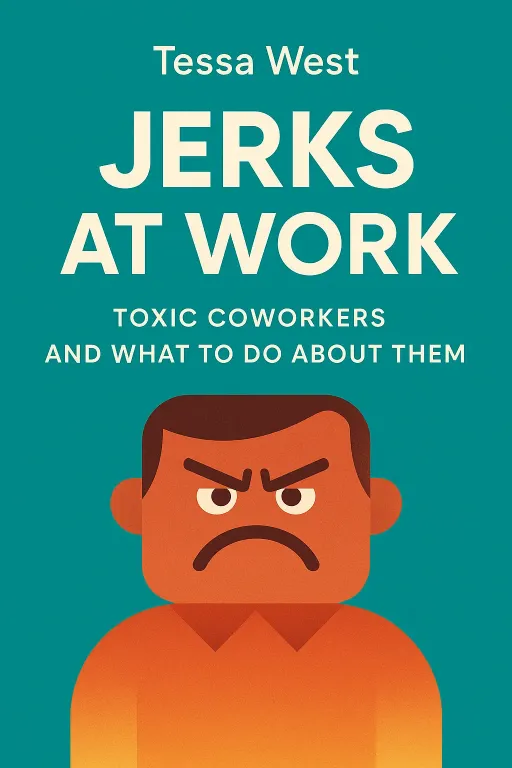
Nova: Exactly. Today we are untangling these two massive drains on our productivity and peace of mind by looking at two specific frameworks. First, we are diving into Jerks at Work by Tessa West, an NYU psychology professor who spent years analyzing the specific profiles of workplace tormentors.
Atlas: I have definitely encountered a few of those profiles in my time. It is one thing to deal with a difficult person, but it is another to understand the mechanics of how they operate.
Nova: And to round out the strategy, we are pairing that with How to Break Up with Your Phone by Catherine Price. She presents a 30-day, evidence-based plan to rewire our relationship with technology. Both books are really about the same thing: reclaiming the territory of your own mind.
Atlas: That makes perfect sense. We are constantly defending our attention from two fronts: the people around us and the devices in our pockets. Let’s start with the people. How does Tessa West break down the psychology of these workplace jerks?
The Workplace Jerk and The Psychology of Friction
SECTION
Nova: West argues that workplace toxicity is rarely random. She categorizes these tormentors into specific archetypes. The most dangerous one might be the Kiss-Up and Kick-Downer. This is the person who is incredibly charming and supportive when they are talking to their boss, but the moment they turn to you, they are dismissive, aggressive, or prone to public criticism.
Atlas: Oh, I have worked with that person. They are the ones who seem to have a split personality. They are essentially weaponizing their proximity to power to make you feel small.
Nova: Precisely. The mechanism they use is plausible deniability. If you call them out, they can easily frame it as a misunderstanding or claim you are being too sensitive because, to the boss, they are a star performer.
Atlas: That is the part that drives me crazy. It makes you feel like you are losing your mind because you are the only one seeing the behavior. What does West suggest we do? Because confronting them directly usually just gives them more ammunition to paint you as the difficult one.
Nova: She advises against the direct confrontation, at least initially. The key is to create a paper trail of their behavior that is visible to others without you having to be the whistleblower. She calls this documenting the friction. You need to frame your interactions in a way that forces them to be professional. For example, if they give you vague, aggressive feedback, you send a follow-up email summarizing the conversation. You write, I want to make sure I understood the goals for this project. To move forward, I need X, Y, and Z.
Atlas: That is brilliant. You are essentially turning their ambiguity against them. By documenting it, you are removing their ability to gaslight you about what was said.
Nova: Exactly. It forces them to either commit to a clear, professional path or reveal their true colors to anyone else who happens to be on that email chain. You are not attacking them; you are simply being rigorously professional.
Atlas: I can see how that would be incredibly frustrating for a jerk. They thrive on chaos and blurred lines. If you are the person who is always asking for clarity and documentation, you are no longer a fun target. You are a high-maintenance target, which is usually enough to make them move on to someone else.
Nova: You hit the nail on the head. West emphasizes that these people are often looking for easy wins. If you become a difficult target, they will look for someone else to torment. But this brings up a deeper point about our own psychological state. Why do we let them get under our skin so easily?
Atlas: I have a theory on that. It is because our focus is already fragmented. When you are constantly checking your phone, dealing with notifications, and living in a state of partial attention, you have less emotional bandwidth to handle the stress of a toxic coworker.
Nova: That is the perfect bridge to our second topic. When your attention is already depleted by the digital noise, you have zero resilience left for the office politics.
The Digital Tug-of-War
SECTION
Atlas: That is a harsh reality to face. I feel like my phone has become this extension of my brain, but not in a helpful way. It is more like a constant, low-level static. Catherine Price’s book, How to Break Up with Your Phone, really hits home here. She talks about the 30-day plan, but I am curious about the philosophy behind it. Is it just about deleting apps?
Nova: It is much deeper than that. Price argues that we have developed a Pavlovian response to our devices. We are not using our phones; our phones are using us. She suggests that we need to stop thinking about our phones as tools we possess and start viewing them as relationships we are in. And like any bad relationship, you need to set boundaries.
Atlas: I love that framing. It takes the guilt out of it. It is not that I lack willpower; it is that the device is designed to exploit my psychology. But how do you actually start to rewire that? It feels like a massive undertaking.
Nova: She suggests starting with a communication contract. This is not for other people; it is for yourself. You designate specific zones or times where the phone is not allowed. For example, the phone never enters the bedroom. Or, the phone is off-limits during deep work blocks.
Atlas: I have tried the bedroom rule before, and it is surprisingly difficult. The first few nights, I felt like a smoker trying to quit. I kept reaching for it, not even to check anything specific, just to feel the texture of it, to scroll through something.
Nova: That is the dopamine loop in action. Price highlights that the scroll is a form of self-soothing. When we are stressed about work, or a jerk coworker, or a looming deadline, we reach for the phone to numb the discomfort. It is an avoidance strategy.
Atlas: That is a profound insight. We are not just addicted to the content; we are addicted to the escape. So, if we are using the phone to escape the stress of the workplace, and the workplace is stressful because of the jerks, we are trapped in a cycle.
Nova: Exactly. And the 30-day plan is designed to help you recognize the "Why" behind every time you pick up your phone. Before you unlock it, you ask: Why am I doing this? Is it to gain information? Is it to connect with someone? Or is it to escape a feeling of discomfort?
Atlas: If I am being honest, most of the time it is the third one. It is the escape. If I am in a meeting and I feel bored or anxious, I pull it out. If I am waiting in line, I pull it out. I am literally afraid of having a single moment of un-stimulated thought.
Nova: That fear is exactly what the tech companies are counting on. They are selling us distraction. But once you start to identify that impulse, you gain a split-second of choice. That is where the power lies. That split second between the impulse and the action.
Atlas: I can see how this ties back to the workplace dynamics. If I am not using my phone to numb the pain, I am more present. If I am more present, I am more observant. If I am more observant, I can spot the toxic behavior of a colleague earlier and handle it with more emotional intelligence, rather than reacting out of my own stress and exhaustion.
Nova: You just connected the dots perfectly. The two books are essentially building the same foundation. Tessa West helps you build boundaries with people, and Catherine Price helps you build boundaries with your own impulses. Both are about reclaiming your agency.
Synthesis & Takeaways
SECTION
Atlas: This feels like a shift from being a passive recipient of whatever stress or noise comes my way to being an architect of my own environment. But let's get practical for the listeners. If someone is listening to this and feeling the weight of both a toxic office culture and a phone they cannot put down, what is the one, high-impact step they can take today?
Nova: I would start with the communication contract, specifically regarding the first hour of the day. Do not touch your phone for the first 60 minutes after waking up.
Atlas: That sounds like a tall order. Why specifically that hour?
Nova: Because that is when you set the tone for your cognitive state. If you start your day by reacting to emails, news, or social media, you are handing over the reins of your brain to whoever sends the first notification. You are starting in a reactive state. If you can protect that hour, you are training your brain to be proactive, not reactive.
Atlas: I love that. It is like a mental warm-up. You are telling your brain that your thoughts and your priorities come first. And once you have that anchor, it is probably a lot easier to implement West’s strategies at work. You are going into the office with a stronger sense of self.
Nova: Exactly. You are less likely to be a target for a jerk if you are grounded in your own sense of purpose. And you are less likely to be distracted by your phone if you have already spent time in your own head.
Atlas: It really comes down to intentionality. We talk a lot about productivity hacks and time management, but this is deeper. This is about managing the human element. The human element of our relationships and the human element of our own attention.
Nova: It is about recognizing that your attention is your most valuable resource. Every time you give it away to a jerk who is trying to rattle you, or to an app that is trying to keep you scrolling, you are losing a piece of your own life.
Atlas: That is a powerful way to frame it. It is not just about being more productive; it is about protecting your life energy.
Nova: And that is the ultimate goal of the Strategic Seeker. It is not just about getting more done; it is about doing the right things with a clear, focused, and resilient mind.
Atlas: I feel like I have a much clearer roadmap now. I am going to start with that morning phone ban tomorrow. And I am going to be much more mindful about documenting my interactions with the people who try to drain my energy.
Nova: That is the perfect way to start. Remember, you do not need to change everyone around you. You just need to change how you show up in the world.
Atlas: That is a great note to end on. If you are out there feeling the friction, take a breath, put the phone down, and start by reclaiming your first hour of the day.
Nova: Absolutely. It is a small change, but it has a ripple effect that touches everything else.
Atlas: This is Aibrary. Congratulations on your growth!