

Reclaiming Attention and Joy in a Hyper-Connected World
Golden Hook & Introduction
SECTION
Nova: The average person touches their smartphone 2,617 times a day. If you are awake for sixteen hours, that is roughly one interaction every twenty-two seconds, non-stop, from the moment your alarm rings to the second your head hits the pillow.
Atlas: That is a terrifying number. I actually feel my pulse rising just hearing that statistic. It feels like we are living in a constant state of low-level, digital panic. We are checking, scrolling, and tapping, but are we actually doing anything meaningful with all that time?
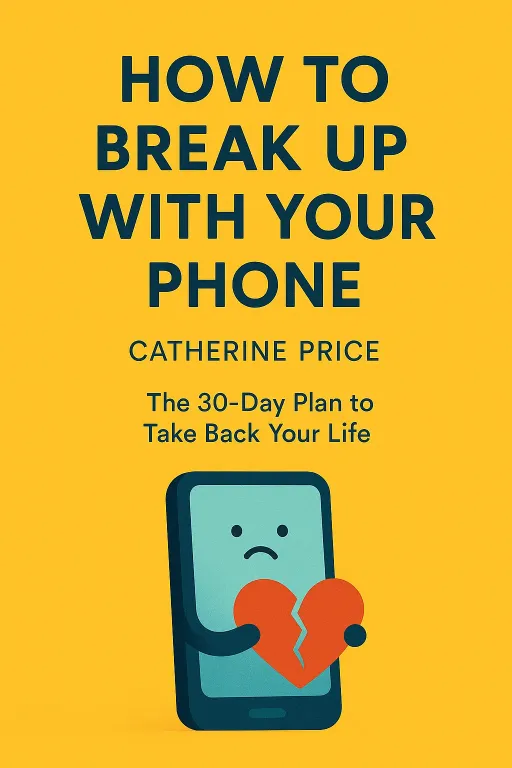
Nova: That is the central question. Today, we are looking at the work of Catherine Price. She is a science journalist who has spent years dissecting why we have become so tethered to our devices and, more importantly, how we can actually break free. We are going to be weaving together insights from two of her most impactful books: How to Break Up with Your Phone and The Power of Fun.
Atlas: I love the title of the first one because it frames the relationship exactly right. We treat our phones like partners, but honestly, it feels more like a toxic relationship. You want to leave, but you keep coming back.
Nova: Exactly. Price argues that this isn't a failure of willpower on our part. She points out that these apps are deliberately engineered to hijack our dopamine pathways. When you pull down to refresh an app, it is a deliberate design choice that mimics a slot machine. It is designed to keep you in that loop.
Atlas: Which makes sense. I have caught myself refreshing my email even when I know there is nothing new. It is a reflex, not a choice. So, if the game is rigged, how do we actually stop playing?
Reclaiming Attention and the 30-Day Plan
SECTION
Nova: The first step is acknowledging that we need a strategy, not just a vague desire to be better. Price suggests a structured, 30-day breakup plan. It is not about throwing your phone in the ocean, which is what most of us fantasize about, but rather about rebuilding a conscious relationship with the device.
Atlas: I imagine a lot of our listeners are thinking, I cannot just turn my phone off for a month. My work, my family, my entire schedule lives in there. How does she account for the fact that we actually need these tools to function in modern society?
Nova: That is a crucial distinction. Price is not a Luddite. She is a pragmatist. The 30-day plan is about creating digital-free zones and boundaries. It starts with small, manageable shifts. For example, she suggests keeping your phone out of the bedroom entirely. Not on the nightstand, not face down on the chair. In another room.
Atlas: That sounds simple, but I know for a fact that is one of the hardest things to do. My phone is my alarm clock, my news feed, my bridge to the world before I even brush my teeth. If I move it to the other room, what am I supposed to do with my brain for those first ten minutes of the day?
Nova: And that is exactly the point. You are supposed to be with your own thoughts. When you have your phone in the bedroom, you are inviting the entire world—every email, every crisis, every social media update—into your bed before you have even had a sip of coffee. By removing it, you reclaim that morning space. You are essentially saying that your attention is yours, not the property of whoever sent you a notification at three in the morning.
Atlas: I can see the logic there. It is about reclaiming the start of the day. But what about the rest of the day? If I am at work, I cannot just leave my phone in another room. The constant ping of Slack or text messages is the reality of my job. How do I apply this "breakup" logic when the environment is constantly demanding my attention?
Nova: This is where the concept of the digital-free zone becomes a power move. You do not have to be disconnected all day. You just need to be intentional about when you are connected. Price suggests designating specific times or areas where the phone is strictly off-limits. Maybe it is the dinner table, or maybe it is during your commute, or during lunch.
Atlas: I like the idea of a lunch zone. That feels like a manageable experiment. But let me push back a bit. If I am sitting at lunch without my phone, I am going to feel that itch. That phantom vibration in my pocket. How do you deal with the withdrawal? Because that is what it feels like—a physical craving.
Nova: That is a brilliant observation. It is a craving. Your brain is used to a constant drip-feed of stimulation. When you cut that off, you feel bored, anxious, or restless. Price argues that you have to sit with that discomfort. You have to learn to be bored again. Because it is in those moments of boredom—when you are not scrolling—that your brain actually starts to process information, make connections, and rest.
Atlas: So, boredom is not the enemy. It is actually the reset button.
Nova: Precisely. We have been conditioned to see boredom as a failure. We think if we are not consuming content, we are wasting time. But when you are constantly consuming, you are never creating or reflecting. You are just reacting.
The Biological Necessity of Fun
SECTION
Atlas: Okay, I am sold on the attention part. But let’s shift gears. Once I have reclaimed this attention, once I have these pockets of silence where I am not scrolling, what am I supposed to do with them? I assume the answer is not just staring at the wall.
Nova: That leads us perfectly into Catherine Price’s second major thesis, which is the absolute necessity of what she calls "True Fun."
Atlas: I have to stop you there. "True Fun"? That sounds like a buzzword. Isn't fun just... fun? Why do we need a definition for it?
Nova: It is easy to dismiss it as a luxury, but Price argues that it is a biological necessity. She defines "True Fun" as the magical intersection of three things: Playfulness, Connection, and Flow.
Atlas: Okay, break that down for me. Playfulness, Connection, and Flow. How do those three things combine to make something "True Fun"?
Nova: Think about a time you were laughing so hard with a friend that you lost track of time. That is the sweet spot. Playfulness is about being lighthearted, not taking yourself so seriously. Connection is about feeling seen and understood by someone else. And Flow is that state where you are so engrossed in an activity that the rest of the world just fades away.
Atlas: I get that. But why is this a necessity? In a professional environment, or even just in the grind of daily adult life, "fun" is usually the first thing that gets cut. We prioritize productivity. We prioritize efficiency. Are you telling me I should be scheduling fun like I schedule a dentist appointment?
Nova: I am saying that if you do not, your cognitive performance is going to suffer. Think about it. When you are stressed, your brain is in survival mode. You are constantly scanning for threats, which in our modern world means scanning for notifications. That uses a massive amount of energy. True Fun is the antidote to that stress. It resets your nervous system. It boosts your creativity.
Atlas: I see where you are going. You are saying that by engaging in "True Fun," you are actually sharpening your mind for the "serious" work. It is not an alternative to productivity; it is a prerequisite for it.
Nova: Exactly. It is not a reward you get after you finish your work. It is the fuel that allows you to do the work well. Without those moments of connection and play, you burn out. You become a rigid, reactive machine.
Atlas: That is a compelling argument. But here is the problem: how do you force "True Fun"? If I say, "Okay, I am going to have fun now," I feel like that is the fastest way to kill any joy. It becomes a task. It becomes another item on the to-do list.
Nova: That is the paradox, right? You cannot force it. You cannot schedule a "fun session" and expect it to happen. But you can schedule the for it. You can set the stage. That is where the connection to the phone breakup comes in.
Atlas: Explain that link. How does the phone breakup lead to True Fun?
Nova: You cannot experience Flow or Connection if your attention is being hijacked by your phone. If you are sitting with a friend, or trying to work on a creative project, and you check your phone every five minutes, you are breaking the state of Flow. You are severing the Connection. By using the digital-free zones we talked about earlier, you are clearing the space for True Fun to actually occur.
Atlas: That makes so much sense. It is like trying to have a conversation in a room where someone is constantly playing loud music. You can try to talk, but you are never going to have a real connection. The phone is the background noise.
Nova: Precisely. And when you remove that noise, you might find that you don't need to do anything extravagant to have "True Fun." It could be cooking a meal with someone without checking your notifications. It could be taking a walk without a podcast in your ears. It is about being present in the moment.
Atlas: I have been thinking about this in terms of my own life. I often use my phone as a buffer. If I am in an elevator, or standing in line, or waiting for a meeting to start, I pull out my phone to avoid that awkward silence or to avoid feeling "bored." But what you are saying is that by avoiding those moments, I am actually robbing myself of the micro-doses of life that could be fun or at least restorative.
Nova: That is the insight. Those transition moments are where we have the most potential for small, micro-doses of "True Fun" or just simple, quiet connection. When you pull out your phone, you are shielding yourself from your own life.
Atlas: It is a defense mechanism. We are defending ourselves against the present moment.
Nova: Yes. And Price is challenging us to lower that shield.
Synthesis & Takeaways
SECTION
Atlas: This has been a fascinating conversation because it connects two things I usually keep separate: my digital habits and my personal happiness. I always thought they were two different lanes. But you are saying they are deeply intertwined.
Nova: They are the same lane. Your attention is your life. If you spend your attention on things that are designed to hijack it, you are essentially spending your life on something you didn't choose.
Atlas: So, if I want to wrap this up for our listeners, the takeaway is not just "put your phone down." The takeaway is "reclaim your attention so you can invest it in things that actually matter."
Nova: Exactly. Reclaim your attention first by creating those digital-free zones. Start with the 30-day plan. Get the phone out of the bedroom. Create a lunch zone. And then, once you have that space, don't just fill it with more work. Use it to schedule those micro-doses of True Fun.
Atlas: I am going to try the lunch experiment. No phone, no emails, no news feed. Just me and my sandwich. Or maybe me and a colleague, if I am feeling social.
Nova: That is the perfect start. You will be amazed at how much more connected you feel to yourself and to the people around you when you are not looking at a screen. You might even find that the "boredom" you were so afraid of turns out to be the most creative part of your day.
Atlas: I love that. It’s a challenge to our listeners: leave the phone in another room during lunch today. Just once. See what happens when you’re fully present, even for thirty minutes.
Nova: And remember, this is not a one-time fix. It is a practice. You will fail, you will pick the phone back up, and that is okay. The goal is not perfection. The goal is consciousness. It is about waking up to the fact that you have a choice.
Atlas: Consciousness over convenience. I think that is a great place to leave it. Thank you for walking me through this, Nova.
Nova: It was a pleasure, Atlas. And to everyone listening, take back your attention. It is the most valuable asset you have. This is Aibrary. Congratulations on your growth!









