Information Systems and the Digital Mind
Golden Hook & Introduction
SECTION
Atlas: Your smartphone is currently the most sophisticated piece of technology in your possession, yet for most of us, it functions primarily as a high-speed engine for distraction. We are essentially walking around with the entirety of human knowledge in our pockets, but we use it to scroll through infinite feeds of triviality.
Nova: That is the modern paradox, isn't it? We have built a world of incredible computational density, yet our personal capacity to process that world is being systematically eroded. It feels like we are losing the battle for our own attention before we even wake up in the morning.
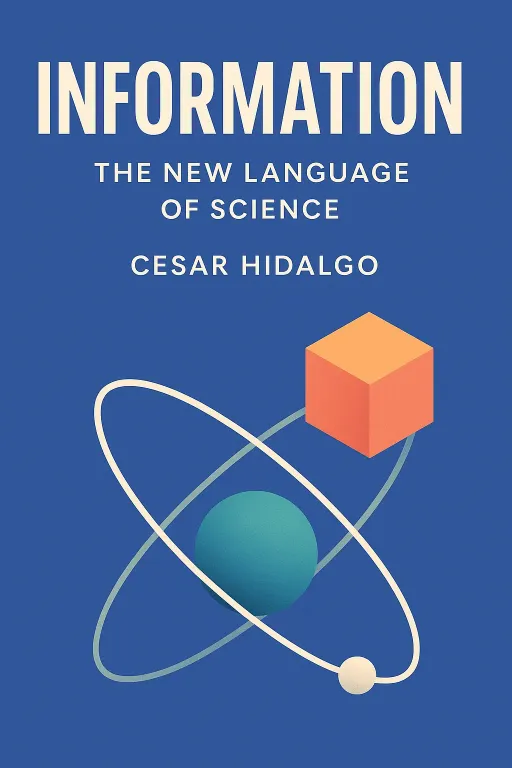
Atlas: It feels like a losing battle because the game is rigged. That is the reality. We are talking about two very different, but deeply connected, ways of looking at our digital existence today. We are looking at the work of César Hidalgo, specifically his book Why Information Grows, and combining it with the practical, often uncomfortable truths from Catherine Price’s book, How to Break Up with Your Phone.
Nova: It is a fascinating pairing. César Hidalgo, who spent years at the MIT Media Lab, approaches the world through the lens of physics and complexity. He views the economy not as a system of money, but as a system of physical information. On the other side, Catherine Price, a science journalist, looks at the human brain and how tech companies have weaponized our own biology against us. When you put them together, you get a clear picture of why we feel so scattered and how we might actually fix it.
Atlas: I am ready to dive into this. Let’s start with the big picture. If Hidalgo is right, and the economy is fundamentally about information, why does it feel like our personal economies are crashing?
The Physics of Information and Crystallized Imagination
SECTION
Nova: To understand why it feels like we are crashing, we first need to understand what we are actually building. Hidalgo’s central thesis is that economic growth is the growth of physical information. He argues that humans are the only species that can externalize their imagination into matter. Think about it. A bird builds a nest, but that nest is instinct. A human builds a car, a skyscraper, or a smartphone. Those objects are not just stuff; they are crystallized imagination. They are information that has been encoded into the physical world.
Atlas: That is a wild way to look at a toaster or a skyscraper. You are saying those things are essentially solidified thoughts?
Nova: Exactly. Think of a computer chip. It is a piece of silicon, but it is arranged in a way that represents years of human computation and design. That is physical information. Hidalgo argues that our ability to grow as a civilization depends on our collective computational capacity—our ability to process information and turn it into new forms of matter. If you look at a remote, undeveloped village versus a high-tech city, the difference is not just money. The difference is the amount of physical information that has been accumulated and organized in that space.
Atlas: Okay, I follow that. We are nodes in a massive, global network of computation. We are constantly taking in information, processing it, and outputting something new. But that leads me to a problem. If our growth depends on our computational capacity, what happens when the information we are processing is just digital noise?
Nova: That is the million-dollar question. If we are the processors, and we are being fed garbage data, our output is going to be garbage. This is where the two authors collide. Hidalgo explains that the growth of the world depends on our ability to process information, but Price explains how our processors are being hijacked.
Atlas: It feels like we are trying to run a supercomputer, but someone has installed a virus that makes it play nothing but cat videos and outrage bait.
Nova: That is a perfect analogy. Price points out that the companies designing our devices know exactly how our brains work. They are not designing for our well-being; they are designing for our attention. They use something called intermittent variable rewards. It is the same psychological principle that makes slot machines so addictive. You do not know what you are going to get when you pull the lever—or in this case, refresh your feed—so you keep pulling it.
Atlas: I have done that a thousand times. I check my email, nothing there. I check it again ten seconds later, even though I know nothing has changed. It is irrational, but I cannot seem to stop.
Nova: It is not irrational if you look at it through the lens of behavioral design. You are being conditioned. Price argues that we have to stop viewing our phones as neutral tools. They are not just glass and metal. They are active participants in our lives that are constantly nudging us, interrupting us, and demanding our cognitive bandwidth. When you are constantly interrupted, you cannot engage in the kind of deep, complex thought required to contribute to that physical information growth Hidalgo talks about.
The Cost of Cognitive Bandwidth
SECTION
Atlas: This brings up a point about the cost. We talk about the cost of a phone in dollars, but what is the cost in cognitive bandwidth? Because if I am spending three hours a day on my phone, that is three hours I am not spending building my own "crystallized imagination," to use Hidalgo’s term.
Nova: You are spot on. Our attention is a finite resource. If we waste it on low-value information—which is what most of the digital feed is—we are essentially starving our own ability to innovate. Hidalgo makes a point that information needs to be embodied to be useful. You cannot just consume information; you have to do something with it. But if your brain is constantly toggling between different tabs, notifications, and apps, you never reach the deep state of flow required to embody that information into something real.
Atlas: I find that when I am in that state of constant context-switching, I feel like I am working, but at the end of the day, I have nothing to show for it. I have processed a lot of emails, I have seen a lot of news, I have reacted to a lot of posts, but I haven't actually created anything.
Nova: That is the trap. You are being busy without being productive. Price suggests that we need to treat our attention like a scarce and valuable currency. You wouldn't let a stranger reach into your wallet and take a twenty-dollar bill every time you walked down the street, right? Yet, we let apps reach into our pockets and steal five minutes of our time, every single time they ping.
Atlas: How do we actually change that? Because I have tried turning off notifications, and I just end up picking up the phone anyway. It feels like an itch I have to scratch.
Nova: Price’s approach is not just about willpower. She suggests a systemic change. She calls for a "breakup" with your phone, which involves a period of re-evaluating what you actually use it for. It is not about throwing the phone in the trash; it is about reclaiming agency. You have to change your physical environment. If your phone is on your desk, your brain is going to be thinking about your phone.
Atlas: That sounds like basic advice, but it is surprisingly hard to do. I work in an environment where everyone is expected to be reachable. If I put my phone away, I feel like I am failing at my job.
Nova: And that is the challenge. We have built our professional and social environments to require constant connectivity. But think about the trade-off. Is the cost of that connectivity worth the loss of your cognitive capacity? Hidalgo would say that if we want to build a better future—a future with more complex, more useful physical information—we need humans who are capable of deep, sustained thought. If we are constantly distracted, we are essentially lowering our collective IQ.
Atlas: That is a sobering thought. We are literally dumbing ourselves down by refusing to disconnect.
Nova: Exactly. We are optimizing for the short term—for the quick hit of dopamine from a notification—at the expense of the long term—the ability to think, create, and build. This is why the connection between these two books is so powerful. Hidalgo gives us the "why"—we have a responsibility to contribute to the growth of information in the world. Price gives us the "how"—we have a responsibility to protect our attention so that we can actually fulfill that purpose.
Redesigning the Digital Mind
SECTION
Atlas: So, if we want to apply this, where do we start? If I am sitting at my desk, and I want to shift from being a passive consumer of digital noise to an active processor of information, what is the first step?
Nova: The first step is to recognize that your environment is currently designed to hijack you. Price suggests you start by making your phone less interesting. Move your apps into folders, turn off all non-human notifications, and maybe even turn your screen to grayscale. It sounds extreme, but it removes the visual cues that trigger that slot-machine response in your brain.
Atlas: I have tried the grayscale thing. It actually works. It makes the phone look boring, which is exactly what I need.
Nova: It is fascinating, isn't it? As soon as the vibrant red notification badges and the colorful icons are gone, the "hook" is weakened. But let's take it a step further. How do we apply Hidalgo’s concept of physical information to our daily lives? Instead of just consuming digital content, we should be looking to embody the information we take in. When you read something, ask yourself: "How can I turn this into something physical?" Maybe it is writing a summary, teaching a concept to someone else, or applying a new idea to a project at work.
Atlas: I like that. It turns consumption into creation. It changes the nature of the interaction. Instead of the information just passing through me, it becomes a part of me. It becomes a building block.
Nova: Precisely. You are becoming a node that adds value to the network, rather than just a node that consumes bandwidth. And when you do that, you are actively participating in the growth of information that Hidalgo talks about. You are taking the "crystallized imagination" of others and using it to create your own.
Atlas: It makes me think about the role of human connection in all of this. If we are so focused on our screens, are we losing the ability to process the most complex information of all: other human beings?
Nova: That is the most critical point. Price talks about how our devices act as a wedge between us and the people in front of us. When you are on your phone, you are not really present. You are physically there, but your computational capacity is somewhere else. And if we look at Hidalgo’s work, he emphasizes that human connectivity is the ultimate source of our collective intelligence. We are smart because we can share information, build on each other’s ideas, and collaborate. If we break that connection, we break the engine of our own growth.
Atlas: So, the goal is to be more intentional about where we direct our processing power. We need to prioritize high-value information and high-value connections, and be ruthless about cutting out the noise.
Nova: Exactly. It is about curation. You are the architect of your own digital mind. You have to decide what information gets in, and more importantly, what information gets out. You don't have to consume everything. You don't have to be up to date on every news cycle or every social media trend. You need to protect your bandwidth for the things that actually matter.
Atlas: This feels like a shift from being a victim of technology to being a master of it. It is not about being a Luddite and throwing away your phone; it is about using the phone as a tool to expand your capacity, rather than a shackle that limits it.
Nova: That is the perfect way to put it. We are not against technology; we are for the human mind. We want to ensure that our technology serves us, rather than the other way around. We have the potential to build incredible things, to solve massive problems, and to create a world of unprecedented richness. But that requires us to be the ones in control.
Synthesis & Takeaways
SECTION
Atlas: I feel like we have touched on something profound today. It is not just about productivity hacks or digital detoxes. It is about our role in the universe. We are the processors, the builders, the ones who turn ideas into reality.
Nova: And that is a responsibility we should take seriously. Every time you choose to put your phone down and engage with the real world—or even just engage in deep, focused thought—you are making a choice to contribute to the growth of human information. You are choosing to be an active participant in the future, rather than a passive observer of the feed.
Atlas: I love that. It gives me a sense of purpose. It makes the struggle to put the phone down feel like an act of creation, not just an act of deprivation.
Nova: It is absolutely an act of creation. You are creating space. You are creating time. You are creating the conditions for your own growth. And that, ultimately, is how we move forward. We don't need more information; we need more wisdom, more understanding, and more capacity to act.
Atlas: If our listeners take one thing away from this, I hope it is this: start auditing your inputs. Look at your environment, look at your screen time, and ask yourself if what you are consuming is helping you build something, or if it is just consuming your capacity to build.
Nova: That is the core of it. We are the architects of our own cognitive environments. Let’s start building them with intention. This has been a great conversation, Atlas. It really highlights how we can take these complex ideas from Hidalgo and Price and turn them into something actionable in our own lives.
Atlas: It really does. I’m going to go home and move a few apps into folders, and maybe even leave my phone in another room tonight. It is a small step, but it feels like the right direction.
Nova: That is the best way to start. Small, intentional changes lead to big results over time. This is Aibrary. Congratulations on your growth!